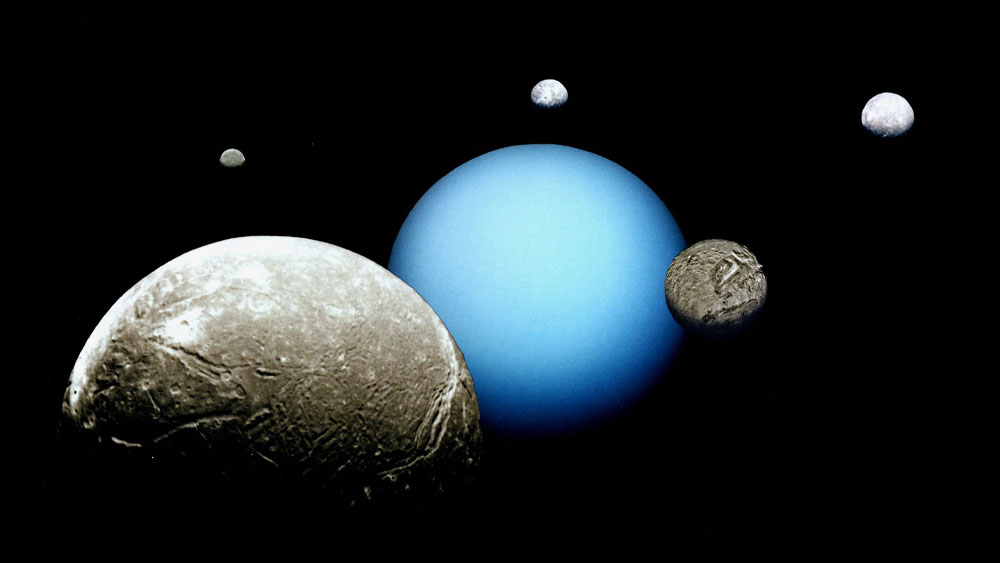
A team of researchers led by University of North Dakota planetary scientist Dr. Caleb Strom concluded that the two Uranian moons Ariel and Miranda (directly left and right of pale blue Uranus in the above image, respectively) once had water oceans within their interiors.1,2 They obtained their conclusions, published in the journals Icarus and The Planetary Science Journal, by studying cracks, or stress fractures, on the surfaces of the two moons and by using computer models to determine the internal conditions needed to produce those cracks.3,4
These stress fractures are caused by gravitational tugs exerted on Ariel and Miranda by Uranus and, to a lesser extent, by the other Uranian moons. These tugs slowly deform these Uranian moons, making their shapes at times a little more like that of an American football than a sphere. These tugs can also warm the interiors of small moons like Ariel and Miranda. These tugs are stronger when the orbits of Ariel and Miranda have higher eccentricities, that is, when their orbits around Uranus are more stretched-out or elongated. As explained by coauthor of the Icarus paper Dr. Alex Patthoff, “In order to create those fractures [on Ariel’s surface], you have to have either a really thin ice on a really big ocean, or a higher eccentricity and a smaller ocean . . . . But either way, we need an ocean to be able to create the fractures that we are seeing on Ariel’s surface.”1
Similar reasoning applies to Miranda. In fact, scientists have not ruled out that a liquid ocean may still exist within Miranda’s interior.2 Some researchers think that as many as 23 bodies in our solar system other than Earth may have frozen or liquid water.5 The possible additions of Ariel and Miranda to this list would increase that number to 25.
Evolutionary scientists want very much to find evidence of liquid water beyond Earth because they think this will somehow make the evolutionary story more believable. However, this reasoning is obviously fallacious, since water, though necessary for life as we know it, is also detrimental to chemical origin-of-life scenarios.6 Although wishful thinking could be clouding the judgment of conventional scientists somewhat, there is fairly strong evidence of liquid water within Saturn’s moon Enceladus and Jupiter’s moon Europa.7 Indeed, one of the goals of the Europa Clipper mission is to attempt to verify whether Europa has a subsurface ocean. Also, evidence for a subsurface ocean on Saturn’s moon Mimas was published last year in the journal Nature.8,9
That solar system bodies other than Earth could contain liquid water should be very exciting to Bible-believing Christians. First, the Lord made the Earth out of a watery mass (Genesis 1:2, 2 Peter 3:5), and creationist physicist Dr. Russell Humphreys has long suggested that He might have made the heavenly bodies out of water, as well.10 Thus, it would make sense for some bodies in our solar system to still retain some primordial water.
Second, the presence of liquid water on these moons is evidence they are young. Small planets and moons quickly radiate heat to space, so any water within them would likely have frozen eons ago. It is for this very reason that conventional researchers were surprised by geological evidence of past (or remaining) liquid water on Miranda and other moons: “Because of its small size and old age, scientists didn’t expect Miranda to harbor an ocean. Instead, they assumed any residual heat from its formation would have dissipated long ago.”2
And it isn’t just Ariel and Miranda—many small bodies within our solar system seem warmer than they should be if they are billions of years old.11–13 So conventional scientists are often forced to conclude that these small bodies were warmed up by gravitational tugs only within the recent geological past. Yet it seems a truly odd coincidence that all these solar system bodies warmed up at the same time, a time when we just happen to be lucky enough to observe them with our telescopes and space probes.13 Of course, the existence of warm, small, and young solar system bodies should come as no surprise to the Bible-believing Christian, since Scripture testifies that the Lord Jesus created the universe, including our solar system, just a few thousand years ago.14,15
References
- Kelley, M. M. Uranian Moon Ariel’s Surface Features Point to a Past Ocean Over 100 Miles Deep. Phys.org. Posted on phys.org September 29, 2025, accessed September 29, 2025.
- Kelley, M. M. Is There an Ocean Lurking Beneath One of Uranus’ Moons? Planetary Science Institute. Posted on psi.edu November 17, 2024, accessed September 29, 2025.
- Strom, C. et al. 2024. Constraining Ocean and Ice Shell Thickness on Miranda from Surface Geological Structures and Stress Modeling. The Planetary Science Journal. 5 (226): 1–18.
- Strom, C. et al. 2026. Constraining Ocean and Ice Shell Thickness on Ariel from Surface Geologic Structures and Stress Mapping. Icarus. 444: 116822.
- Wenz, J. and M. Wagh. There Are 23 Moons and Planets with Water in Our Solar System. Popular Mechanics. Posted on popularmechanics.com, last updated December 8, 2022, accessed September 29, 2025.
- Vieira, A. d. N. et al. 2020. The Ambivalent Role of Water at the Origins of Life. FEBS Letters. 594 (17): 2717–2733.
- Hebert, J. Jupiter’s Young Moons. Acts & Facts. 52 (5): 14–16.
- Lainey, V. et al. 2024. A Recently Formed Ocean Inside Saturn’s Moon Mimas. Nature. 626 (7998): 280–282.
- Hebert, J. 2024. A Subsurface Ocean on Mimas? Creation Science Update. Posted on ICR.org March 18, 2024, accessed September 29, 2025.
- Humphreys, D. R. 1984. The Creation of Planetary Magnetic Fields. Creation Research Society Quarterly. 21 (3): 140–149.
- Hebert, J. Youthful Solar System Bodies Puzzle Evolutionary Scientists. Creation Research Update. Posted on ICR.org February 13, 2013, accessed October 7, 2025.
- Hebert, J. Reminder: Saturn’s Moon Titan Really Looks Young. Creation Research Update. Posted on ICR.org February 8, 2021, accessed October 7, 2025.
- McKee, M. 2013. Planetary Science: Caught in the Act. Nature. 493 (7434): 592–596.
- Genesis 1:1; Colossians 1:13–16.
- Johnson, J. J. S. 2008. How Young Is the Earth? Applying Simple Math to Data Provided in Genesis. Acts & Facts. 37 (10): 4.
* Dr. Jake Hebert is a research scientist at the Institute for Creation Research and earned his Ph.D. in physics from the University of Texas at Dallas.