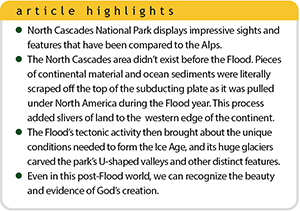
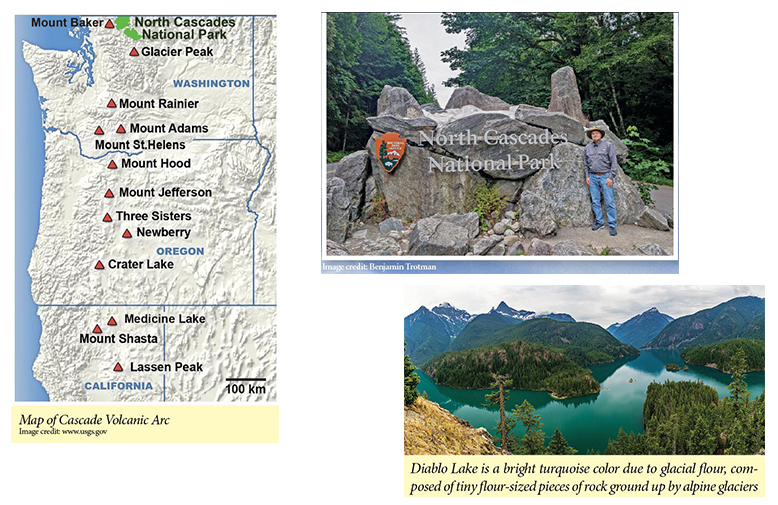
 North Cascades National Park is sometimes called “the American Alps” for its stunning vistas that average about 5,000 feet above sea level, with the highest reaching 9,220 feet at Goode Mountain in the south unit.1 About three hours from Seattle, the park is just a few miles east of Mount Baker, and its northern border abuts Canada. “Nowhere do the mountain masses and peaks present such strange, fantastic, dauntless, and startling outlines as here,” wrote Henry Custer in 1859 as a member of the International Boundary Commission.2
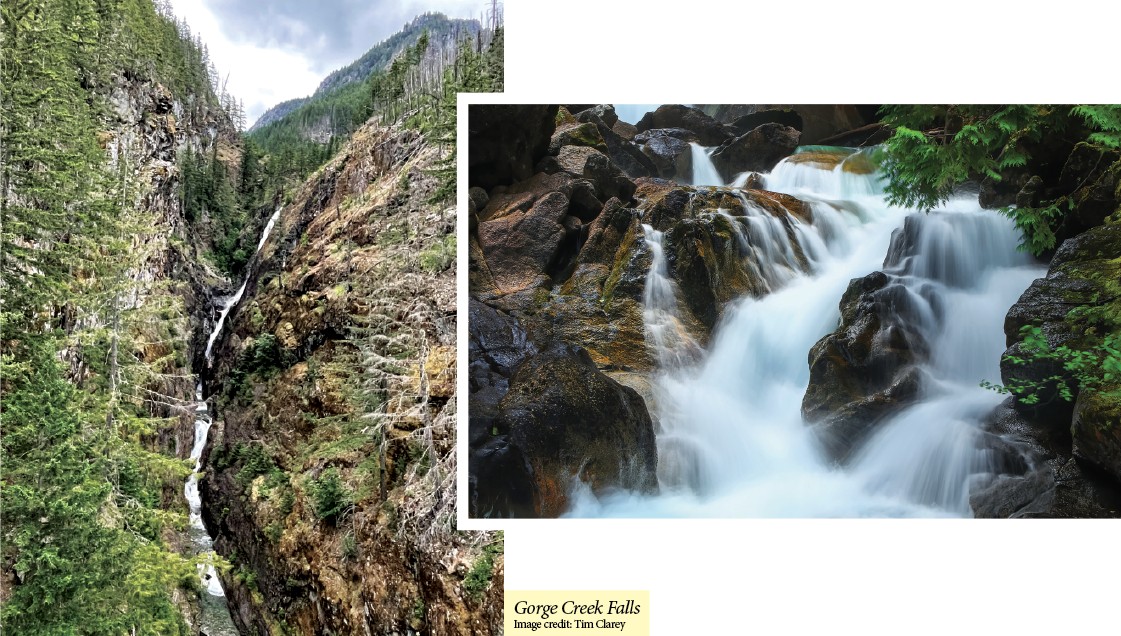
Established as a National Park in 1968, North Cascades encompasses 789 square miles of mountainous terrain filled with hundreds of waterfalls, massive U-shaped valleys, and turquoisecolored lakes.1 In fact, the numerous waterfalls gave the park its name.2 North Cascades also contains one of the deepest lakes in the U.S.: Lake Chelan, reaching a depth of about 1,500 feet.2
People enjoy the beautiful vistas and lakes as they are, but the park’s fascinating geological and glacial history inspires even greater appreciation for the impressive features there. And all is the result of the global Flood.
Accretion During the Flood
The Cascade Mountains may conjure up images of Mount Rainier, Mount Hood, and even Mount St. Helens and its historic eruption of 1980. But maybe surprisingly, not all of the Cascade Mountains are volcanic in origin. The volcanoes compose the Cascade volcanic chain or High Cascades. However, parts of the Cascade Mountains have a dramatically different origin altogether.
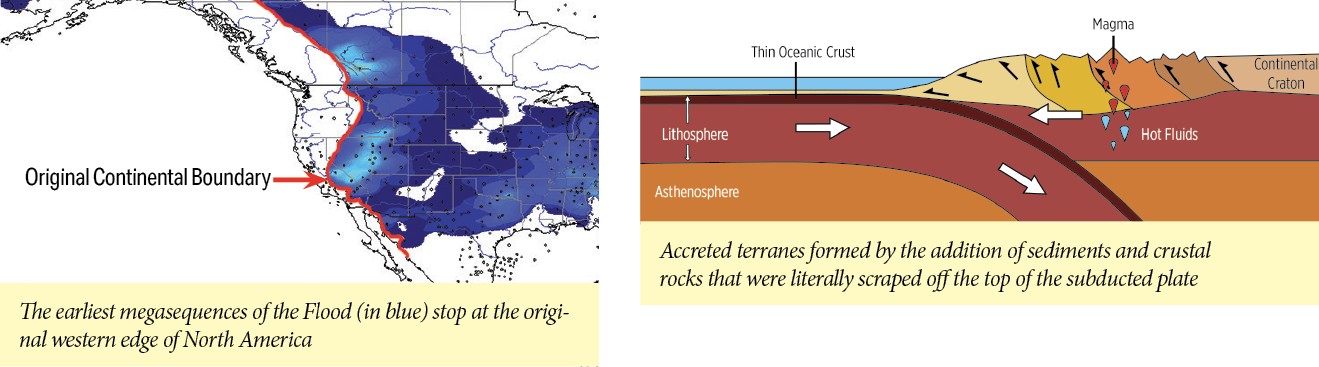
The section of Washington that includes North Cascades didn’t exist at all prior to the Flood. North America originally ended in eastern Washington, near Spokane. This western part of North America was later pieced together by plate tectonic activity, sliver by sliver, and added to the continent. There are three of these slivers within the park, known by geologists as “accreted terranes,”3 that are separated by steep fault zones that run nearly north-south.1
How exactly does that happen? Geoscientists have demonstrated that slivers (120–250 miles wide) of continental crust can be added to the continents as the denser ocean crust is pulled down into the mantle. Flood geologists think this happened much quicker during the Flood year, with plate rates of several yards per second.4 They have called this catastrophic plate tectonics (CPT).
In the process, pieces of small continents, ocean sediments, and possibly islands embedded in the ocean crust were scraped off the subducting ocean crust, leaving behind or accreting 120- to 250-milewide belts of rock. These were added to the edges of the continents during the Flood year, literally as the “rug was pulled out from underneath it.” Each terrane has a completely different geology compared to the adjacent terrane.
Most of North Cascades National Park is a single terrane called the Cascade Crystalline Core.2 This piece of crust was added to North America during the deposition of the Zuni Megasequence, close to the highest water point of the global Flood (possibly about Day 140).5
Runaway Subduction Caused the Ice Age
CPT also provides a mechanism for the Ice Age that occurred at the end of the Flood. A hot, newly formed ocean crust covering 70% of the world would have provided tremendous amounts of heat energy to the ocean water above. This would have raised the overall temperature of the water and caused a greater amount of evaporation, resulting in staggering amounts of precipitation. Increased volcanic activity from the subduction zone volcanoes, including the Cascades volcanoes, and the unique chemistry of subduction zone magmas late in the Flood would have placed huge volumes of ash and aerosols into the atmosphere, cooling the climate most noticeably in the higher latitudes.
The net result of hotter oceans and tremendous silica-rich volcanic activity brought on from plate motion would be a widespread Ice Age. Finally, as the ocean water slowly cooled and volcanic activity diminished in the centuries after the Flood, the Ice Age would have ended as abruptly as it began.
Sculpted by the Ice Age
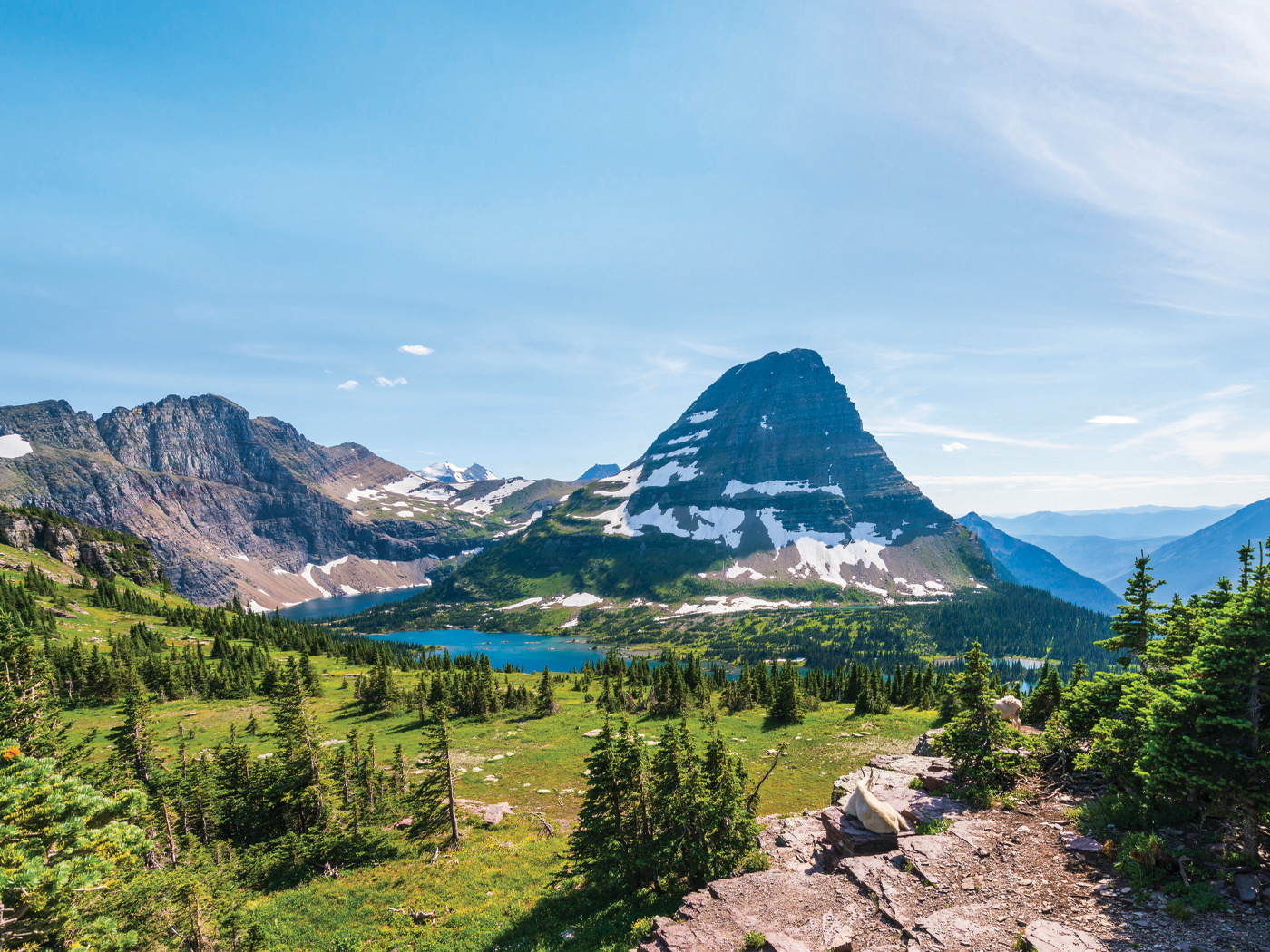
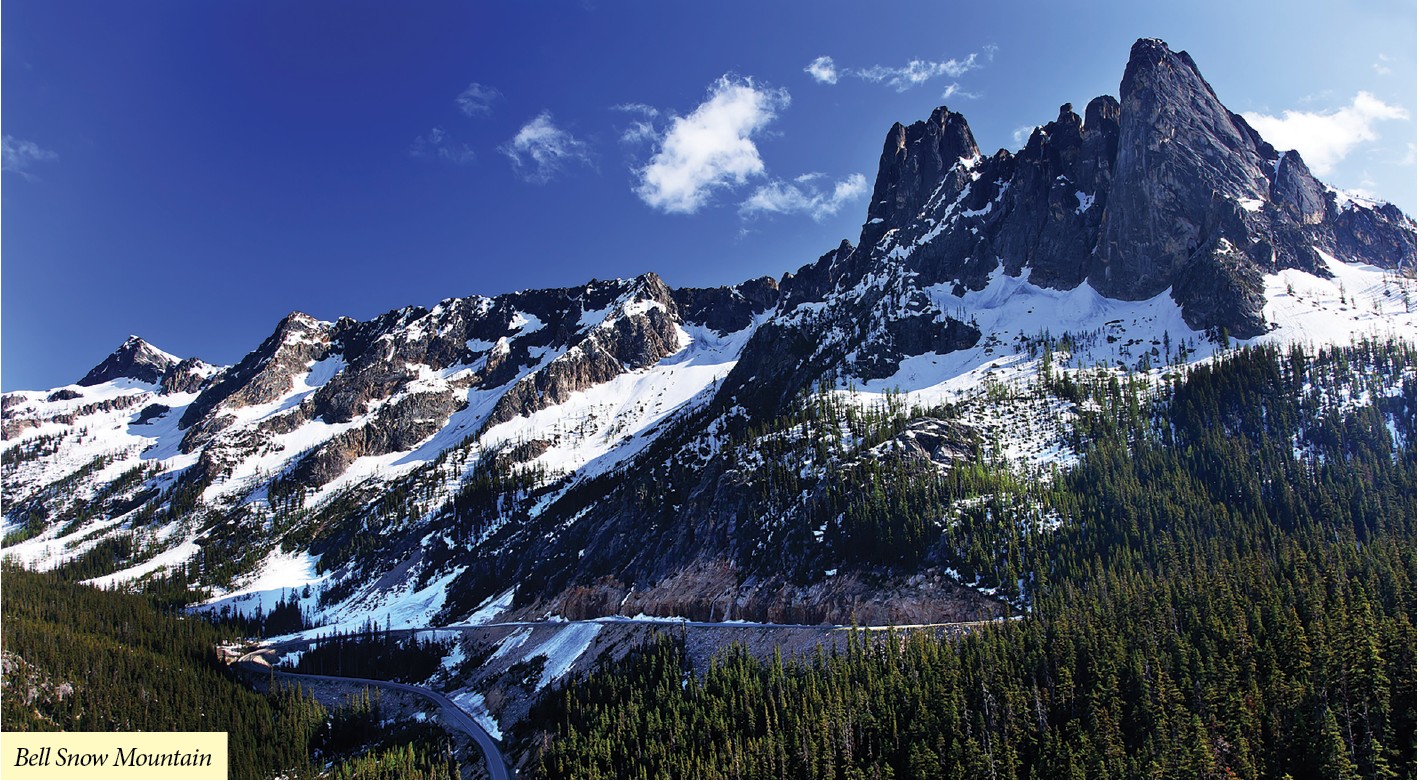
Why is this Ice Age information relevant to the North Cascades? Because the national park shows ample evidence that it was filled with alpine glaciers during the Ice Age. Vast U-shaped valleys (glacial troughs), horns, and jagged ridges called arêtes are found throughout the park. These erosional features are indicative of alpine glaciated terrains. The deep Lake Chelan lies in the bottom of a glacial trough. And most of the lakes in the park are a vivid turquoise blue due to a fine, dust-sized material left by glaciers called glacial flour.
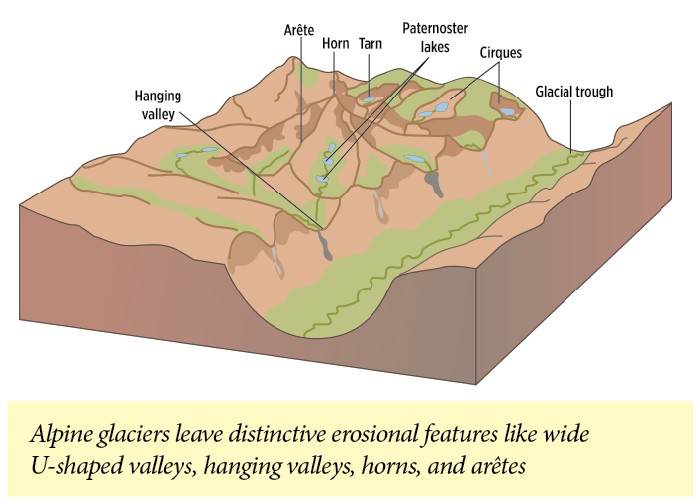 Mount Shuksan and Eldorado Peak are glacial horns, formed by several glaciers eroding different sides of the peak.1 The Picket Range, Sawtooth Ridge, and Mount Johannesberg are examples of knife-edged glacial arêtes.2 Hanging valleys are also found throughout the park with many spectacular waterfalls descending from them to the glacial trough below, with one dropping 1,500 feet from a small trough on Bacon Peak.1
The beautiful mountains and valleys of North Cascades National Park are the result of the Flood, both directly and indirectly. The rocks composing North Cascades were assembled by catastrophic processes during the Flood, and the subsequent Ice Age smoothed and scoured the uplifted mountains into spectacular valleys and peaks. This resulted in the many waterfalls, vivid blue lakes, and jagged ridges. The handiwork of the Lord Jesus is on display all across the post-Flood landscape.
References
- Hacker, D. and D. Foster. 2018. North Cascades National Park: North Central Washington. In The Geology of National Parks, 7th ed. D. Hacker, D. Foster, and A. G. Harris, eds. Dubuque, IA: Kendall-Hunt, 521–535.
- Macy, M. 1999. America’s Spectacular National Parks. Los Angeles, CA: Perpetua Press, 82–83.
- An accreted terrane is an “exotic” rock fragment that originally came from some other location. Each represents a sliver of crust that was added to a larger continent through subduction. The more buoyant fragments (small continents or islands) get scraped off the top of the descending slab and become accreted onto the adjacent continent, ultimately making the continent larger.
- Baumgardner, J. 1994. Runaway Subduction as the Driving Mechanism for the Genesis Flood. Proceedings of the International Conference on Creationism. 3, article 14: 63–75.
- Clarey, T. 2020. Carved in Stone: Geological Evidence of the Worldwide Flood. Dallas, TX: Institute for Creation Research.
* Dr. Clarey is the director of research at the Institute for Creation Research and earned his Ph.D. in geology from Western Michigan University.
Stage image: North Cascades National Park, Mt. Shuksan (an example of a glacial horn)