“I get what you’re saying! And I would love to think about biology from a design perspective, but I don’t even know where to begin,” my friend David said while walking to a breakout lecture at an intelligent design conference. Moments before I had emphasized that thinking about creatures from an engineering perspective was different from simply recognizing specified or irreducible complexity or, for that matter, any other complicated feature. He had abruptly stopped, and I sensed his desire for immediate clarity.
“Well, it’s not hard to do,” I encouraged him in hopes of still making it to the lecture, “and your appreciation of biology will skyrocket. But the hard part is letting go of nearly all we’ve previously been taught. The prevailing framework was purposefully set up to get people to think about the way creatures operate as if they were never engineered. We’ll know that our thinking about creatures has changed when how we talk about their operation is exactly the way we talk about highly engineered, man-made things.”
Spontaneous conversations can turn into delightful surprises. A real gem happened when my friend David and I began discussing what it really means to see biology from an engineering perspective. I planned on getting straight to the point. But our meandering conversation and bunny trails ultimately made it easier to see the distinctiveness of engineered biology, consequential key theological issues, and why a theory of biological design (TOBD) matters. You’re welcome to eavesdrop.

We’re Thinking More Like Darwinists than Engineers
“Wait,” David cut in, “nearly everyone here believes that organisms were intelligently designed.”
“That’s true,” I said, “but listen to how we talk. Our vocabulary, which reflects the concepts guiding our thinking, is essentially identical to that of the evolutionist. We’re still thinking from the nonengineering perspective. For example, take the plenary speaker who just alluded to adaptation. In essence he said that when a population of organisms develops ‘random mutations’ that get fractioned out over time by deadly struggles to survive, then the ‘fittest’ are the ones that have ‘selectable traits.’ How’s that different from Richard Dawkins’ description?”
“Since we’ve all been conditioned to think about adaptation within the Darwinian mechanism, and we’re reassured that it’s compatible with design, we fail to think deeply about its basic assertions. But, let me ask, does the Darwinian process that we just heard sound in any way like an engineered way for creatures to adapt? Engineers don’t talk like that—which indicates they think differently. How we should think about creatures’ operation is the same way we think about a space shuttle’s operation as ‘engineered’—a word that helps align our thinking closer to reality than ‘designed.’”
“Hold up a second,” he said. I could see his tentative look. “How does describing organisms as engineered make a difference in our thinking any more than saying they’re designed?”
I replied, “Well, anyone here can take the back of a napkin and sketch out a design for something, yet the key question that engineers need to ask is . . . ” David stepped in and supplied the right question, “will that design actually work?”
Darwin Hijacked the Iterative Engineering Process
“Yes! And more importantly,” I added, “engineers apply physics and chemistry-based tests to determine if the materials and design(s) will work while simultaneously improving it. Engineers enhance designs through an iterative process. By testing them against specific challenges and selecting the best solutions (i.e., test-select-repeat), they refine the design’s characteristics for, let’s say, efficiency, optimization, or robustness. Creatures demonstrate these highly refined characteristics in abundance. How creatures came to have these characteristics,” I stressed, “is perhaps the biggest question in biology because they intuitively look incredibly engineered. Now we can see why understanding this iterative engineering process ties so many things together.”
“I’m not exactly seeing that link between ‘doing engineering’ and the development of either evolutionary theory or a theory of engineered adaptability,” David said.
“You’re in big company,” I replied. “It’s likely most evolutionists don’t understand Darwin’s cleverness in developing his theory. For millennia most people intuitively thought that the rational reason creatures look exceptionally engineered is that they were created by the supernatural power and genius of a divine engineer. So, how could someone—without looking foolish—claim that creatures were really produced by a random, natural, mindless process? No one throughout history has ever seen something create itself—especially having multiple parts working together for a purpose. How did Darwin change the way people think about creatures so radically that sceptics like Dawkins could claim to be ‘intellectually fulfilled atheists?’”
David moved his books to his other arm and waited through my pause. I sensed that the Lord wanted us to stay on topic and skip the breakout session. I said, “Darwin ingeniously and quietly imported the iterative engineering process as nature’s mechanism to produce incredible biological complexity.”

“An engineer’s path to improved design,” I went on, “is to repeatedly test potential solutions and select the best one until the design is refined to where he wants it. Analogously, Darwin’s process begins with organisms producing various traits (i.e., potential solutions to problems). These undergo tests in deadly struggles imposed by so-called selective pressures. Survivors are said to possess selectable traits, and the best of those are ‘selected for’ by nature—which was personified to act like a thinking human engineer with selective capability. The process repeats ad infinitum. Once these corresponding steps are pointed out, they’re obvious to see despite evolutionists concealing each step with their just-so stories, selective jargon, and personifications.”
Do Evolutionists Really Say That?
Three examples of selectionist theory imitating the iterative engineering process and personifying nature to explain the origin of advanced biological complexity:
1. Adaptable genomes
“We humans are living, breathing computational systems that have been evolving in complexity and power for millions of years. . . . These structures aren’t random. Over millions of years, nature appears to have optimized the genome’s shape to make it more efficient at storing and accessing information.”1 (emphasis added)
2. Intracellular machinery
“Inside every cell in the body, molecules known as proteins act like tiny machines, carrying out biological functions—their efficiency honed by eons of natural selection.”2 (emphasis added)
3. Feet
“Adaptive changes groomed by natural selection might indeed sculpt a fin into a primitive foot.”3 (emphasis added)
Our conversation had so far covered how far creationists and design advocates currently are from thinking about biology from an engineering perspective. David better understood how the appropriation of the iterative engineering process of test-select-repeat into selectionism is a ruse that misleads the general population into thinking selection can explain the origin of biological complexity. So, discussing theology was bound to come.
Engineered Biology: Better for Theology and Science
“It’s clear,” David said forcefully, “that the theological implications are huge.”
Looking to sum up with some reasons why thinking about creatures from an engineering perspective is vital, I said, “Exactly. Darwin’s school of thinking about adaptation—‘random-mutation, natural selection’—shrewdly has an anti-designer element that’s so unintelligibly random, clunky, death-driven, and cruel that if God used it, then He isn’t worth our respect. That anti-designer element is coupled with the pro-design element that intentionally mimics the iterative engineering process to build astounding complexity. But instead of an engineer, nature is the active force. Nature supposedly works on relatively passive organisms. Over time nature is credited with crafting organisms that look like they were highly engineered by God (but really weren’t) to be precisely fitted for life in diverse ecological niches. In one swoop, Darwin’s ostensibly natural process explains the mind-boggling complexity of organisms. And since they’re specialized for different niches, the diversity of life is also supposedly accounted for.”
Do Evolutionists Really Say That?
Three examples of exquisite engineering supposedly crafted by bumbling natural selection:
1. “This example of convergent evolution of protein function provides an impressive demonstration of the ability of natural selection to cobble together complex design solutions by tinkering with different variations of the same basic protein scaffold.”4 (emphasis added)
2. “However, if one wanted to play with a comparison, one would have to say that natural selection does not work as an engineer works. It works like a tinkerer—a tinkerer who does not know exactly what he is going to produce.”5 (emphasis added)
3. “In the same way, natural selection . . . builds step by step, even if by trial and error, entities of infinite complexity, ingenuity, and if one be inclined to say so, beauty.”6 (emphasis added)
“So . . .,” David jumped in, “are you saying that evolutionists are unimpressed that irreducible complexity is an unassailably positive evidence for intelligent design?”
“Totally unimpressed,” I said. “Selectionism is a mystical way of thinking about biology with nothing but mental constructs (e.g., selective pressures) that the selectionist personifies as active agents possessing God-like power to sculpt biological systems of infinite complexity—both specified and irreducible. We cannot overcome the selectionist way of thinking about biology merely with evidence of its limitations—especially when our arguments come from that same mystical framework.”
“Every time we say, ‘all selection can do is . . .’ or ‘selection pressures can only mold . . .,’ we don’t refute personifications—we reinforce them. Even worse, we embed our minds within Darwinism in how we interpret biology. We’re so off track from the outset that we’re not even asking engineering-based research questions. Our minds will only be liberated when we leave this mysticism behind and begin thinking about biology from an engineering perspective.”
David replied thoughtfully, “I see some irony here. Engineers don’t explain the success or failure of their solutions to problems by inserting imagined selection events or unquantifiable selection pressures. So, if this engineered approach is imported into biology, then paradoxically it’s so-called naturalism loses its magical explanations. If the precision of engineers was controlling biology, then evolutionary biologists would choke, so to speak, on their own naturalism if peer reviewers allowed only observable natural causes as explanations and rejected any imaginary selective narratives. The engineering-based approach would kill the ghost of selectionism animating the evolutionary machine. That’s powerful. How do we teach that?”
David’s insight was spot on. Darwinists insist that their creative—though unconscious—process is a non-supernatural explanation, but it is only a facade of naturalism and just as mystical as any cultic belief ever was. David now understood why we need to replace all vestiges of selectionism in our minds with an engineering perspective.
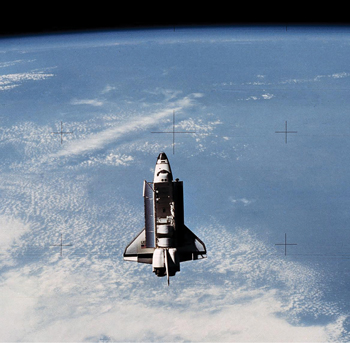
Using Space Shuttles to Explain Biology
“To start thinking from an engineering perspective, consider what people intuitively understand about space shuttles. They know they’re highly engineered to travel through wide-ranging external conditions. People correctly assume that shuttles are filled with fully automated systems. If asked to explain how a shuttle operates, they naturally focus on the shuttle and its engineered features alone. They know that anything that the shuttle can or can’t do rests totally upon the capabilities of its features.”
“Selectionism indoctrinates all to view creatures like passive modeling clay being shaped by their environment. But by applying an engineering perspective to biology, we replace the selectionists’ explanations with something they won’t consider: creatures—just like space shuttles—are highly engineered to adjust to wide-ranging external conditions, driving their own adaptations by changing themselves. Engineering descriptions of causal operability must ultimately focus on the designed entity. That’s step one in thinking about biology from an engineering perspective.”
“No one has ever taught me to think like that,” David said. “That’s a total theoretical shift in emphasis. We must teach people to describe creatures just like they describe space shuttles as active, problem-solving vessels.”
“Design advocates,” I added, “must embrace four decades of growing research that demonstrates that essentially all biological systems—even cells themselves—have innate abilities to acquire, transmit, store, and retrieve data, transform data to information, and act proactively or responsively, i.e., demonstrate cognitive abilities. These correspond conceptually, operationally, and quite often structurally to human-engineered systems performing similar functions. These internal capabilities actively control their relationship to their environments to maintain homeostasis, metabolize resources, adapt, grow, and reproduce.”
“So this engineering-oriented thinking helps keep our position from falling in the personification trap,” David remarked.
“That’s where another step will help,” I added. “We need to educate design advocates to describe how specific traits successfully solve the problems of certain environmental exposures, conditions, or design constraints. The objective phrase ‘the organism successfully solved . . .’ replaces the invisible finger that ‘selected for/by/against . . .’ This ensures that the creatures themselves—not nature—are properly credited for solving problems.”
David jumped in, “This must mean that if we’re examining organism-to-organism relationships, we analyze each one separately from its own perspective.”
“Exactly,” I affirmed. “And a third way to see things from an engineering perspective is to evaluate our verbiage in attributing causality. If it sounds silly when applied to the operation of man-made things, then don’t apply it to biological things.”
David asked, “Is this what distinguishes ‘successfully solved’ as more precise than saying, ‘selected against’?”
I answered, “Consider the space shuttle Columbia that suffered a heart-wrenching loss traversing the atmosphere on reentry. Any NASA engineer would lose his job if he explained the heat-friction failure by saying ‘the atmosphere selected against it’ or the shuttle ‘wasn’t favored.’ Engineers know that an entity’s traits determine its capabilities and should be identified with the success or failure of resolving environmental challenges. The engineers examined the shuttle’s traits and then remedied the shuttles—not the atmosphere.”

Wrapping Up
As we walked back to the auditorium, I stressed, “It also shows that switching perspectives isn’t simply semantics. The engineering perspective completely changes our focus back to organisms as the cause of their own changes. After this lecture, let’s discuss how a TOBD enables specific research predictions.” David concurred as we found our seats.
Darwin’s selectionism gets us headed in the wrong direction from the outset. A thoughtful evolutionist, Dr. James Shapiro, recognizes this but also appreciates the hurdle in changing people’s perspective. He said, “A shift from thinking about gradual selection of localized random changes to sudden genome restructuring by sensory network–influenced cell systems is a major conceptual change. It replaces the invisible hands of geological time and natural selection with cognitive networks and cellular functions for self-modification.”7
In changing the way people think about God’s creatures, Darwin changed the way people think about God. Since creatures are engineered by the Lord Jesus, only by explaining their operation from an engineering perspective will we reclaim the wonder due to His handiwork.
References
- Walter, N. Scientists Uncover Hidden ‘Geometric Code’ that Helps DNA Compute and Remember. Interesting Engineering. Posted on interestingengineering.com October 29, 2025, accessed November 5, 2025.
- Greenwood, V. 2025. The Scientist in Ceaseless Motion. Harvard Magazine. 128 (2): 36.
- Callier, V. Theorists Debate How ‘Neutral’ Evolution Really Is. Quanta Magazine. Posted on quantamagazine.org November 8, 2018, accessed December 23, 2025.
- Hoffmann, F. 2010. Gene Cooption and Convergent Evolution of Oxygen Transport Hemoglobins in Jawed and Jawless Vertebrates. Proceedings of the National Academy of Scientists. 107 (32): 14274–14279.
- Jacob, F. 1977. Evolution and Tinkering. Science. 196 (4295): 1161–1166.
- Lerner, I. M. 1959. The Concept of Natural Selection: A Centennial View. Proceedings of the American Philosophical Society. 103 (2): 173–182.
- Shapiro, J. 2022. Evolution: A View from the 21st Century. Fortified. Chicago, IL: Cognition Press, 415. Shapiro adds, “The emphasis is systemic rather than atomistic and information based rather than stochastic.”
Dr. Guliuzza is the president of the Institute for Creation Research. He earned his doctor of medicine from the University of Minnesota, his master of public health from Harvard University, and received an honorary doctor of divinity from Southern California Seminary. He served in the U.S. Air Force as 28th Bomb Wing flight surgeon and chief of aerospace medicine. Dr. Guliuzza is also a registered professional engineer and holds a B.A. in theology from Moody Bible Institute.