Archive of Articles
.jpg)
Cite this article: Bergman, J. and J. Calkins. 2005. Is the Backwards Human Retina Evidence of Poor Design? Acts & Facts. 34 (10).
[body_edit] =>By Jerry Bergman, Ph.D. and Joseph Calkins, M.D.*
Introduction
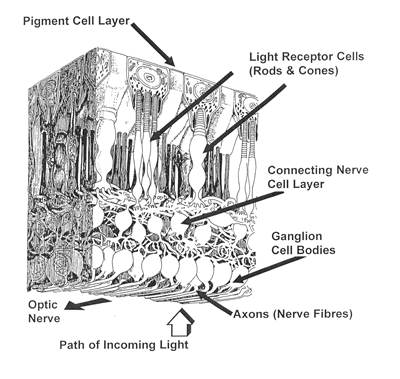
The so-called backwards retina is an example of an argument against creationism long ago disproved. Nonetheless, it is one of the most common arguments used by Darwinists to argue that life was not designed. For example, one of the leading American Darwinists, Brown University Professor Kenneth Miller, claimed that a prime example of "poor design" is the fact that light in the human eye has to travel through the neuron layers before it reaches the retina photoreceptors. He argues that this design reflects poorly on an Intelligent Designer and, to Miller, provides clear evidence that no designer exists. Rather, it demonstrates to him that the eye evolved by mutations and natural selection and was not designed. In the words of Miller, an Intelligent Designer would not have placed the neural wiring of the retina on the side facing incoming light. This arrangement scatters the light, making our vision less detailed than it might be, and even produces a blind spot at the point that the wiring is pulled through the light-sensitive retina to produce the optic nerve that carries visual messages to the brain (1999, p. 101).
The blind spot does not reduce vision quality for several reasons. Special tests are normally required to even notice it because the other eye fills in the gap. Furthermore, the brain only uses information from the retina to construct an image and does an excellent job of dealing with other "blind spots" such as shadows, reflection problems, dim light, and dirt on a person's glasses. Shermer claims that the human eye is not just "poorly designed" but the anatomy of the human eye shows that it is anything but "intelligently designed." It is built upside down and backward, with photons of light having to travel through the cornea, lens, aqueous fluid, blood vessels, ganglion cells, amacrine cells, horizontal cells, and bipolar cells, before reaching the light-sensitive rods and cones that will transduce the light signal into neural impulses (2005, p. 186).
Williams adds that not only human eyes, but those of "all other vertebrates, have the functionally stupid upside-down orientation of the retina" and that the "functionally sensible arrangement is in fact what is found in the eye of a squid and other mollusks" (1997, pp. 9-10). An evaluation of this argument reveals it is not only naive, but grossly erroneous.
The Findings of Research
Research by ophthalmologists has clearly shown why the human retina must employ what is called the "inverted" design. An inverted retina is where the photoreceptors face away from the light, forcing the incoming light to travel through the front of the retina to reach the photoreceptors. The opposite placement (where the photoreceptors face the front of the eye) is called a "verted" design. One of the many reasons for the inverted design is, behind the photoreceptors lies a multifunctional and indispensable structure, the retinal pigment epithelium (Martínez-Morales 2004, p. 766). This monolayered tissue contains the black pigment melanin that absorbs most of the light not captured by the retina. This design has the very beneficial effect of preventing light from being reflected off the back of the eye onto the retina, which would degrade the visual image.
The photoreceptors (rods and cones) must also face away from the front of the eye in order to be in close contact with the pigment epithelium on the choroid, which supplies the photoreceptors with blood. This arrangement allows a "steady stream of the vital molecule retinal" to flow to the rods and cones without which vision would be impossible (Kolb 2003, p. 28). The verted design, claimed by Miller to be superior, would place the photoreceptors away from their source of nutrition, oxygen, and retinal (the choroid). This design would cause major problems because rods and cones require an enormous amount of energy for their very high metabolism required in functioning, maintenance, and repair. In addition, because of phototoxicity damage, the rods and cones must completely replace themselves approximately every seven days or so.
The photoreceptors and retinal epithelium absorb an enormous amount of light on a continuous basis when the eyes are open. Because the light is converted largely into heat, the retina must have a very effective cooling system, again provided by the choroidal blood supply directly behind the pigment epithelium. If the pigment epithelium tissue were placed in front of the retina, sight would be seriously compromised. Reversing the retina so that it faces away from the pigment epithelium would also compromise sight to the degree that sight would be impossible because the photoreceptors must be embedded in the retinal pigment epithelium to obtain the nutrients required to function.
This design is extremely critical because the retina requires a high metabolism level due to the continual replacement of the photoreceptors required for vision. Consequently, the retina uses more oxygen and nutrients than almost every other part of the body, requiring an ample blood supply. The verted design would not allow the rods and cones to function properly because of the blood supply required for their high rate of metabolism. If the photoreceptors were in front of the neurons, the blood supply would have to be either directly in the light path of the receptors, or on their side, which would significantly reduce the number of photoreceptors used for sight.
Importantly, placing the retina neural components in front of the photoreceptors does not produce an optical handicap for several reasons. One reason is the neural elements are separated by less than a wavelength of light. Consequently, very little or no scattering or diffraction occurs, and the light travels through this area as if it was at near-perfect transparency. Secondly, when viewed under the microscope, most cells are largely transparent (and it is for this reason stains, such as Eosin-Y and Hematoxylin 2, are needed to better visualize the various cell parts). Consequently, the thin layer of cells in front of the retina rods and cones have a negligible light blocking effect.
In the retina region which has the highest resolution, the central retina (the fovea and, in particular, the foveola), the neurons in front of the photoreceptors are shifted to the side so that light has a direct pathway to them, resulting in the least distortion where it matters most. The high resolution macula also uses cones that are more tightly packed to achieve high resolution color vision. The peripheral retina has lower resolution and consists of mostly rods for black and white vision.
This design is a highly effective method to accurately transmit enormous amounts of data along the optic nerve in a method analogous to the zipping and unzipping of a computer file to facilitate computer file transmission. To function, the transmission must be very rapid because the image needs to be refreshed continuously like a pixel TV image. The eye's design actually appears to be optimized around the physical limits of the visible light spectrum (Calkins 1986).
The pigment epithelium tissue performs numerous other functions critical for retina viability and activity. One is that it phagocytosises ten percent of the mass of each photoreceptor outer segment on a diurnal schedule, and constantly restores the chromophore to 11-cis-retinal from its all-trans configuration, permitting visual pigment synthesis and regeneration (Dowling 1987, p. 198). It also is part of the outer blood-retinal barrier, helps maintain water and ion flow between the neural retina and the choroid, protects against free radical damage, and regulates retinoid metabolism (Martínez-Morales, et al., 2004, p. 766).
This short review covers only a few of the many reasons for the superiority of the existing design of the mammalian retina. Our knowledge now shows that the retina design is superior to what we understood even just a few short years ago. Gratitude rather than impertinence seems the more appropriate response to its ingenious design.
Note: I wish to thank Jody Allen for her review of an earlier draft of this article.
References
- Bergman, Jerry. 2000. "Is the Inverted Human Eye a Poor Design?" Journal of the American Scientific Affiliation. 52(1):18-30, March.
- Calkins, Joseph L. 1986. "Design in the Human Eye." Bible-Science Newsletter. March. pp. 1-2.
- Dowling, John E. 1987. The Retina: An Approachable Part of the Brain. Cambridge, MA: The Belknap Press of Harvard University Press.
- Kolb, Helga. 2003. "How the Retina Works." American Scientist. 91:28-35.
- Martínez-Morales, Juan Ramón, Isabel Rodrigo, and Paola Bovolenta. 2004. "Eye Development: A View from the Retina Pigmented Epithelium." BioEssays. 26:766-777.
- Miller, Kenneth R. 1999. Finding Darwin's God: A Scientist's Search for Common Ground Between God and Evolution. New York: Cliff Street Books.
- Shermer, Michael. 2005. Science Friction: Where the Known Meets the Unknown. New York: Henry Holt/Times Books.
- Williams, George C. 1997. The Pony Fish's Glow and Other Clues to Plan and Purpose in Nature. New York: Basic Books.
* Jerry Bergman is on the Biology faculty at Northwest State College in Ohio. Joseph Calkins is an Ophthalmologist in private practice, formerly Professor of Ophthalmology at Johns Hopkins University.
Cite this article: Bergman, J. and J. Calkins. 2005. Is the Backwards Human Retina Evidence of Poor Design? Acts & Facts. 34 (10).
[typeID] => 2 [visible] => t [pdf] => /i/pdf/imp/imp-388.pdf [publishURL] => backwards-human-retina-evidence-poor-design [publishDate] => 0000-00-00 [authorAsterisk] => f [domainID] => 1 [publication] => [volume] => [issue] => [page] => [author] => Various Authors ) -->
Dr. John Baumgardner has more than 30 years of professional experience in large-scale numerical modeling, including 20 years in a computational fluid dynamics group at Los Alamos National Laboratory. Several other researchers who intend to use the computer also have considerable numerical modeling experience. Some of the researchers who plan to use the computer immediately on high-priority projects include Drs. Larry Vardiman, D. Russell Humphreys, Steve Austin, Andrew Snelling, and Dan Criswell.The new computer was paid for by gifts from a generous donor to ICR research last January. However, support for the individual research projects is still needed. If you are interested in donating to the Epiphany project or specifically to any of the associated research projects, please contact Dr. Larry Vardiman at 619/448-0900 or LVardiman@icr.edu. Anticipated computational research topics include modeling of submarine debris flows, submarine cross-bed formation, runaway subduction, rapid mountain uplift, Ice Age climate dynamics, cosmologies without the assumption of the Copernican principle, galactic spiral structure development, limits and costs of natural selection, effects of environmental "noise" on genetic selectibility, effects of near-neutral mutations on long-term genomic stability, genome comparison between human and chimpanzee, as well as many yet to be identified areas of origins research.
[body_edit] =>
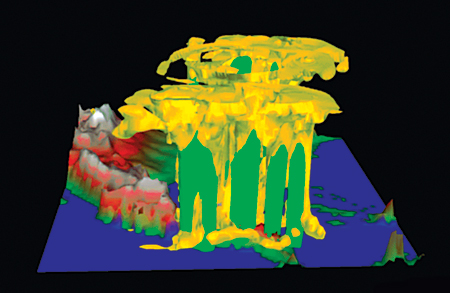
Example of computer modeling done by Dr. Larry Vardiman.A new high-speed, 40-processor research computer was delivered to ICR in August and within days began crunching numbers to support new research. ICR is expanding its efforts in numerical simulation and plans to use this computer to perform model development and data analysis in several new areas.
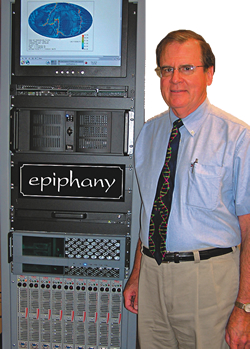
The computer was custom designed and fabricated by Davis Systems Engineering of Princeton, New Jersey, in collaboration with Dr. John Baumgardner, the new head of ICR's research computing center. It consists of 40 AMD 64-bit Opteron 2 GHz processors, each with 1GB of memory. The unit has the speed of 120 older processors used previously by Dr. Baumgardner in a similar configuration. The multiple processors are connected via gigabit Ethernet through a 24-port crossbar switch. Message Passing Interface (MPI) software allows individual applications to run simultaneously on multiple processors.
The new computer has been named Epiphany, which means to reveal or show forth, particularly to commemorate Jesus as the Christ. Dr. Baumgardner hopes the work on this new resource will lead to breakthroughs in creationist understanding in many fields.
Problems Dr. Baumgardner intends to explore include catastrophic sedimentary processes, regional and global tectonic processes, paleoclimatic/Ice Age studies, early cosmos dynamics with non-Copernican boundary conditions, galaxy dynamics and development, effects of mutation and selection of genomic stability, and detailed human/chimpanzee genome comparison.
Dr. John Baumgardner has more than 30 years of professional experience in large-scale numerical modeling, including 20 years in a computational fluid dynamics group at Los Alamos National Laboratory. Several other researchers who intend to use the computer also have considerable numerical modeling experience. Some of the researchers who plan to use the computer immediately on high-priority projects include Drs. Larry Vardiman, D. Russell Humphreys, Steve Austin, Andrew Snelling, and Dan Criswell.The new computer was paid for by gifts from a generous donor to ICR research last January. However, support for the individual research projects is still needed. If you are interested in donating to the Epiphany project or specifically to any of the associated research projects, please contact Dr. Larry Vardiman at 619/448-0900 or LVardiman@icr.edu. Anticipated computational research topics include modeling of submarine debris flows, submarine cross-bed formation, runaway subduction, rapid mountain uplift, Ice Age climate dynamics, cosmologies without the assumption of the Copernican principle, galactic spiral structure development, limits and costs of natural selection, effects of environmental "noise" on genetic selectibility, effects of near-neutral mutations on long-term genomic stability, genome comparison between human and chimpanzee, as well as many yet to be identified areas of origins research.
[typeID] => 9 [visible] => t [pdf] => [publishURL] => new-state-art-research-computer-installed-at-icr [publishDate] => 0000-00-00 [authorAsterisk] => f [domainID] => 1 [publication] => [volume] => [issue] => [page] => [author] => ) -->
Example of computer modeling done by Dr. Larry Vardiman.








(3) ICR is NOT a church renewal or correctional ministry
Many churches today surely need to return to sound doctrine and practice with respect to Biblical creation. I strongly believe in the local church—have served as teacher and deacon in three of them and pulpit speaker in hundreds. My wife and I even started a church (now thriving with a fine new sanctuary) that began with two families and several college students(meeting in our basement). But "straightening-out" churches is not our basic purpose at ICR.
(4) ICR is NOT a children's or youth ministry
We have great concern for children and young people, but again reaching them is not our main goal. My wife sponsored and taught Child Evangelism classes for many years, and we have seen many children come to Christ. As far as college youth are concerned, I have served as faculty advisor to Christian student organizations in 5 secular universities (in one, over 50 were saved in one year!).
(5) ICR is NOT an evangelistic ministry
Evangelism is vitally important, but is essentially an indirect result of the ICR mission. We are thankful when people are saved through one of our ICR books or seminars, but this is not our main purpose as an organization.
(6) ICR is NOT a missionary agency
Although a few churches have placed ICR on their missionary budget, and the outreach of our ICR books, seminars, radio, etc., has extended into six continents, this is not our main purpose.
(7) ICR is NOT a political organization
Although we would love to see creationism taught in all schools, we have never sponsored legislation to accomplish this. From the Biblical perspective, all education should be under the home, not the government, but we do not try to attain such an ideal with political pressure.
The Distinctive Purpose of ICR
There is nothing wrong with the above activities; all of them are very important, but ICR's main purpose (note Isaiah 51:1-2) is not evangelism or missions, not books or politics, not church growth or youth ministries.
Our primary ministry is education! Especially higher education, including relevant research at the graduate level. This purpose may seem mundane and relatively unimportant to some Christians. Evangelism, missions, political power, personal relationships—all may seem to be more glamorous and worthy of support. But that is not the way God sees it!
God's first commandment on the created earth was what has been called the dominion mandate (Genesis 1:26-28) and this has never been withdrawn or diluted. It was repeated and extended to the survivors of the global deluge (Genesis 9:1-7). This first divine mandate requires what we now would call scientific research and then the transmission of the accumulating information about God's creation to all succeeding generations (that is, by education!). Since this was His first priority, it surely warrants our obedience and support even today.
A second worldwide divine mandate is the "Great Commission," which could also be called the Missionary Mandate—calling for teaching about God's redemptive work. It was not given to all mankind (as was the first mandate) but only to believing Christians.
As in the dominion mandate, education again is emphasized. Jesus said that we should be "teaching them to observe all things whatsoever I have commanded you" (Matthew 28:19-20). The new mandate thus not only commands preaching the gospel and baptizing believers but teaching everything taught by Christ!
This includes everything in His creation, "for all things were made by Him" and He is now "upholding all things" (John 1:3; Hebrews 1:3). As Creator, He had issued the primeval dominion mandate and this later mandate now implies teaching all things learned under the first mandate, in addition to teaching about His work of redeeming all things.
All true education therefore should be carried out in the context of both creation and redemption, Christ being the Author of both mandates.
Because of its key importance in God's plan for His creation, Satan has sought very successfully to gain control of education—especially higher education. His system of evolution is the key weapon in his control of education and he bitterly opposes all who presume to teach against that system. ICR was founded with this very issue in mind.
The ICR Graduate School therefore has the primary mission of providing true education, in its creation/redemption framework instead of the evolutionary humanistic system which permeates all secular colleges and universities and has led even most evangelical colleges to compromise with it.
Ideally, ICR (or some other Christian educational institution or consortium) should provide such creation-oriented education at all levels in all fields. This may seem impossible, however, as long as Satan is "the god of this world" (II Corinthians 4:4). Nevertheless, the two mandates need to be implemented by means of at least one great creationist university (the very term implies "universal" coverage), which could serve as a model for others (and perhaps even as a foundation and model for the education system in a future millennium!).
ICR is not that needed central university of research and education, but we have made a start in the ICR Graduate School with its students and science faculty (full-time and adjunct). Our four science M.S. programs would be the key component in any such future university, or consortium of Christian colleges. There are now a significant number of colleges that have become committed to literal Biblical creationism, but none as yet offer graduate science programs except ICR.
Thus, as I envision it at least, ICR has four chief functions at present:
- Providing M.S. creationist training in the key sciences related to origins and earth history. Evolution dominates every field today, but those in all other fields do this on the basis that "science" has "proved" evolution (an utterly false concept!). This notion must be corrected.
- Training science teachers for other Christian schools, including elementary and secondary schools.
- Winning the "sciences" to Christ. That is, we are developing model curricula which teach the actual facts of biology, geology, etc., in a Biblical creationist framework. Also, ICR-sponsored research (e.g., RATE) is resolving supposed scientific problems in creationism.
- Developing extension ministries (books, seminars, radio, etc.) which can reach many others in all walks of life with the essentials of scientific creationism. In addition, no Graduate School is ever financed solely by tuitions, and ICR does not solicit or accept government grants, but these adjunct ministries also help win supporters. Our primary financial support must come from such concerned Christian men and women.
God has blessed ICR with a marvelous worldwide impact since we started on a shoestring in 1970. No doubt we can improve in many ways and we need your prayers, but we must never forget why we began and where we are going.
Finally, all this should be carried out in the light of eternity and God's ultimate purpose for us in His magnificent, infinite, and eternal creation.
*Dr. Henry Morris is Founder and President Emeritus of ICR.
[body_edit] =>Some of our constituents have raised questions about ICR's specific mission, so this may be a good time to state it clearly.
Reasons for Founding ICR
Initially, ICR was a division of Christian Heritage College, which had been founded in 1970 as a unique Christian liberal arts college and eventually a university firmly committed in all programs to a specifically creationist (meaning literal six-day creation and global flood) worldview.
As CHC co-founder, I had argued for this approach as the result of my 28 years of teaching experience in five large secular universities, plus speaking on many other campuses as a result of the impact of our book, The Genesis Flood (published in 1961). All secular colleges had been structured completely around evolutionary humanism, and all evangelical colleges seemed to have accepted the evolutionary geological ages.
However, the accrediting association would not allow us to offer graduate degrees in science, so we had to do this through making ICR a separate institution. M.S. degrees are almost universally required for science teachers even in Christian schools, and these had to be obtained (before ICR, that is) from secular universities. So the ICR Graduate School was formed in 1980 and has been offering M.S. degrees in four key science areas dealing with origins since 1981. Over a dozen other Christian liberal arts colleges have also started teaching literal Biblical creationism in science, but ICR is still alone in offering graduate programs in science. ICR is now fully accredited through TRACS, a nationally approved accrediting agency.
What ICR's Purpose Is NOT
Because ICR has become internationally known largely because of its books, seminars, etc., I must first emphasize that these are all vital extension ministries, but not ICR's main purpose.
(1) ICR is NOT a publishing business
We cannot measure our success by book sales. I have written some 60 books myself, so I surely appreciate the importance of publishing substantive books on creation. But that is only an extension aspect of our basic mission.
(2) ICR is NOT a seminar ministry
Although I have participated in many seminars—even before CHC or ICR were formed—and these have been of significant influence in stimulating global awareness of the issue, this also is merely an extension of ICR's fundamental purpose.
(3) ICR is NOT a church renewal or correctional ministry
Many churches today surely need to return to sound doctrine and practice with respect to Biblical creation. I strongly believe in the local church—have served as teacher and deacon in three of them and pulpit speaker in hundreds. My wife and I even started a church (now thriving with a fine new sanctuary) that began with two families and several college students(meeting in our basement). But "straightening-out" churches is not our basic purpose at ICR.
(4) ICR is NOT a children's or youth ministry
We have great concern for children and young people, but again reaching them is not our main goal. My wife sponsored and taught Child Evangelism classes for many years, and we have seen many children come to Christ. As far as college youth are concerned, I have served as faculty advisor to Christian student organizations in 5 secular universities (in one, over 50 were saved in one year!).
(5) ICR is NOT an evangelistic ministry
Evangelism is vitally important, but is essentially an indirect result of the ICR mission. We are thankful when people are saved through one of our ICR books or seminars, but this is not our main purpose as an organization.
(6) ICR is NOT a missionary agency
Although a few churches have placed ICR on their missionary budget, and the outreach of our ICR books, seminars, radio, etc., has extended into six continents, this is not our main purpose.
(7) ICR is NOT a political organization
Although we would love to see creationism taught in all schools, we have never sponsored legislation to accomplish this. From the Biblical perspective, all education should be under the home, not the government, but we do not try to attain such an ideal with political pressure.
The Distinctive Purpose of ICR
There is nothing wrong with the above activities; all of them are very important, but ICR's main purpose (note Isaiah 51:1-2) is not evangelism or missions, not books or politics, not church growth or youth ministries.
Our primary ministry is education! Especially higher education, including relevant research at the graduate level. This purpose may seem mundane and relatively unimportant to some Christians. Evangelism, missions, political power, personal relationships—all may seem to be more glamorous and worthy of support. But that is not the way God sees it!
God's first commandment on the created earth was what has been called the dominion mandate (Genesis 1:26-28) and this has never been withdrawn or diluted. It was repeated and extended to the survivors of the global deluge (Genesis 9:1-7). This first divine mandate requires what we now would call scientific research and then the transmission of the accumulating information about God's creation to all succeeding generations (that is, by education!). Since this was His first priority, it surely warrants our obedience and support even today.
A second worldwide divine mandate is the "Great Commission," which could also be called the Missionary Mandate—calling for teaching about God's redemptive work. It was not given to all mankind (as was the first mandate) but only to believing Christians.
As in the dominion mandate, education again is emphasized. Jesus said that we should be "teaching them to observe all things whatsoever I have commanded you" (Matthew 28:19-20). The new mandate thus not only commands preaching the gospel and baptizing believers but teaching everything taught by Christ!
This includes everything in His creation, "for all things were made by Him" and He is now "upholding all things" (John 1:3; Hebrews 1:3). As Creator, He had issued the primeval dominion mandate and this later mandate now implies teaching all things learned under the first mandate, in addition to teaching about His work of redeeming all things.
All true education therefore should be carried out in the context of both creation and redemption, Christ being the Author of both mandates.
Because of its key importance in God's plan for His creation, Satan has sought very successfully to gain control of education—especially higher education. His system of evolution is the key weapon in his control of education and he bitterly opposes all who presume to teach against that system. ICR was founded with this very issue in mind.
The ICR Graduate School therefore has the primary mission of providing true education, in its creation/redemption framework instead of the evolutionary humanistic system which permeates all secular colleges and universities and has led even most evangelical colleges to compromise with it.
Ideally, ICR (or some other Christian educational institution or consortium) should provide such creation-oriented education at all levels in all fields. This may seem impossible, however, as long as Satan is "the god of this world" (II Corinthians 4:4). Nevertheless, the two mandates need to be implemented by means of at least one great creationist university (the very term implies "universal" coverage), which could serve as a model for others (and perhaps even as a foundation and model for the education system in a future millennium!).
ICR is not that needed central university of research and education, but we have made a start in the ICR Graduate School with its students and science faculty (full-time and adjunct). Our four science M.S. programs would be the key component in any such future university, or consortium of Christian colleges. There are now a significant number of colleges that have become committed to literal Biblical creationism, but none as yet offer graduate science programs except ICR.
Thus, as I envision it at least, ICR has four chief functions at present:
- Providing M.S. creationist training in the key sciences related to origins and earth history. Evolution dominates every field today, but those in all other fields do this on the basis that "science" has "proved" evolution (an utterly false concept!). This notion must be corrected.
- Training science teachers for other Christian schools, including elementary and secondary schools.
- Winning the "sciences" to Christ. That is, we are developing model curricula which teach the actual facts of biology, geology, etc., in a Biblical creationist framework. Also, ICR-sponsored research (e.g., RATE) is resolving supposed scientific problems in creationism.
- Developing extension ministries (books, seminars, radio, etc.) which can reach many others in all walks of life with the essentials of scientific creationism. In addition, no Graduate School is ever financed solely by tuitions, and ICR does not solicit or accept government grants, but these adjunct ministries also help win supporters. Our primary financial support must come from such concerned Christian men and women.
God has blessed ICR with a marvelous worldwide impact since we started on a shoestring in 1970. No doubt we can improve in many ways and we need your prayers, but we must never forget why we began and where we are going.
Finally, all this should be carried out in the light of eternity and God's ultimate purpose for us in His magnificent, infinite, and eternal creation.
*Dr. Henry Morris is Founder and President Emeritus of ICR.
[typeID] => 1 [visible] => t [pdf] => /i/pdf/btg/btg-197.pdf [publishURL] => icr-its-origin-goal [publishDate] => 0000-00-00 [authorAsterisk] => f [domainID] => 1 [publication] => [volume] => [issue] => [page] => [author] => Henry M. Morris, Ph.D. ) -->

Darwin even compiled an elaborate system to accurately record his numerous killings. His list was subdivided into partridges, hares, and pheasants in order to keep a running total of "everything he killed through the season" (Browne, p. 110). How important killing animals was to him is also indicated by the following experience:I kept an exact record of every bird which I shot throughout the whole season. One day when shooting . . . I thought myself shamefully used, for every time after I had fired and thought that I had killed a bird, one of the two acted as if loading his gun and cried out, "You must not count that bird, for I fired at the same time," and the gamekeeper perceiving the joke, backed them up. After some hours they told me the joke, but it was no joke to me for I had shot a large number of birds, but did not know how many, and could not add them to my list. . . . This my wicked friends had perceived (Darwin, p. 54).
Browne concluded that his sporting ledger was emotionally as important to him as was shooting itself, indicating an obsession similar to a murderer who notches his gun after each killing. Darwin's own father saw his obsession as a problem. He once said that Charles cared "for nothing but shooting, dogs, and rat-catching," and, as a result, he "will be a disgrace" to himself and his entire family (Darwin, p. 28). Even Darwin himself had regrets about spending so much time shooting as a youth, but he never expressed any regrets for his sadistic behavior, only his extreme obsession with it. According to Bowler (p. 39), Darwin "developed a passion for shooting that was to survive into his university days, to be repudiated eventually as useless slaughter." Of course, it was not just useless slaughter, but much worse. One wonders if this "passion" for killing and death might have played a part in developing his ruthless "survival of the fittest" tooth-and-claw theory of natural selection.
The attitude of Charles contrasts greatly with several members of his family. His sister concluded it was not proper even to kill insects for collections, and that "dead ones would have to do" (Desmond and Moore, p. 16). Darwin acquiesced to her ideals, and concluded that it "was not right to kill insects for the sake of making a collection" (Darwin, p. 45). Later, he ignored this ideal, and collected with abandon (p. 62). Darwin's attitude toward killing for collections also contrasts with that of certain renowned biologists. Professor August Forel said that he was allowed, as a child, to collect only dead insects. Then in 1859 he was allowed to collect living specimens after his uncle, also an entomologist, showed him how to kill the creatures painlessly (1937, p. 33).
Darwin claimed, regarding his father (even though he was a doctor), "To the end of his life, the thought of an operation almost sickened him and he could scarcely endure to see a person bled" (1958, p. 30). It is interesting that Darwin sat in on two "bad operations," one on a child, but he walked out before they were completed, "this being long before the blessed days of chloroform" (p. 48). He had no such qualms about "stuffing birds," an area in which he took lessons to develop his taxidermist skills (p. 51).
Darwin's behavior is ironic, in view of his complaint that God is sadistic. In a letter to his friend, Professor Hooker, dated July 13, 1856, Darwin said in reference to pollen "in which nature seems to us so clumsy & wasteful" that "What a book a Devil's chaplain might write on the clumsy, wasteful, blundering low & horridly cruel works of nature!" (Darwin, p. 1990, p. 178).
In another letter, this one sent to Asa Gray on May 22, 1860, Darwin wrote that he could not believe in the Christian creator God because there is so much misery in the world. The example he gave was:
I cannot persuade myself that a beneficent & omnipotent God would have designedly created the Ichneumonidae [parasitic insects] with the express intention of their feeding within the living bodies of caterpillars or that a cat should play with mice (Darwin, 1993, p. 224).
Some may see it as the height of irony that Darwin argued the Christian God does not exist because Darwin thought He did the very same things that Darwin himself enjoyed as a youth!
Conclusions
Darwin evidently suffered from an inordinant desire to kill animals for most of his life, especially when he was a young man in the prime of his life. Unfortunately, most writers have shied away from the implications of this trait of Darwin's, indicating only that he liked to hunt (hardly an accurate assessment of his behavior). One possible reason why many writers avoid this topic is because Darwin is now idolized by many scientists (and others) and wanton killing of animals is not. Often listed as one of the greatest scientists of the nineteenth century, if not the greatest scientist that ever lived, Darwin is one of the few scientists known to most Americans. To understand Darwin as a person and his motivations, though, one must evaluate his almost pathological drive to kill, and consider how it may have affected his conclusions about natural selection.
References
- Bowler, Peter J. 1990. Charles Darwin; The Man and His Influence. Cambridge, MA: Basil Blackwell.
- Browne, Janet. 1995. Charles Darwin: Voyaging. Princeton, NJ: Princeton University Press.
- Darwin, Charles. 1958. The Autobiography of Charles Darwin 1809-1882. New York: Norton. Autobiography. New York: W. W. Norton. Edited by Nora Barlow.
- _____ 1990. The Correspondence of Charles Darwin. Volume 6 1856-1857.
- New York: Cambridge University Press. Edited by Frederick H. Burkhardt
- and Sydney Smith.
- _____ 1993. The Correspondence of Charles Darwin. Volume 8. New York: Cambridge University Press. Edited by Frederick Burkhardt.
- Desmond, Adrian and James Moore. 1991. Darwin: The life of a Tormented Evolutionist. NY. Warner Books.
- Forel, August. 1937. Out of My Life and Work. New York: W. W. Norton.
- Gale, Barry G. 1982. Evolution Without Evidence: Charles Darwin and The Origin of Species. Albuquerque, NM: University of New Mexico Press.
* Dr. Bergman is on the Biology faculty at Northwest State College in Ohio.
[body_edit] =>One side of Darwin rarely discussed in popular and scientific literature was his powerful sadistic bent. One of his passions that reflected this was his love for shooting, hunting, and guns. Darwin's interest in shooting and hunting was not unusual in nineteenth century England, but he carried it far beyond that of most of his contemporaries. Many people hunt for food and/or sport, then as well as now, but wanton killing for its own sake can hardly be justified. With Darwin it was an obsession which involved behavior that, at the least, bor-dered on sadism.
Early hints of this dark side included Darwin's propensity to lie and steal in order to create excitement and to get attention. In his own words, "as a little boy I was much given to inventing deliberate falsehoods, and this was always done for the sake of causing excitement" (1958, p. 23). Darwin also admitted to stealing for the fun of it (p. 24). A clearer example of his sadistic impulse was when, as a young boy, Darwin "beat a puppy . . . simply from enjoying the sense of power." He even admitted that he later felt much guilt over his behavior, indicating that he knew his actions were wrong (p. 27). At this time, he still had a strong faith in God, and this fact may partly explain his guilt (p. 25).
Darwin's Sadistic Impulses
Although Darwin first learned to handle a gun before he was about 15, it evidently did not become a passion until he killed his first animal. His "passion for shooting, . . . would stay with him through all the years of his formal schooling and some years beyond" (Gale, 1982, p. 9). Darwin loved killing so much that when he killed his first bird, he literally trembled with excitement. His own words, recorded in his biography, provide a vivid illustration of just how important killing animals was to him:
In the latter part of my school life I became passionately fond of shooting, and I do not believe that anyone could have shown more zeal for the most holy cause than I did for shooting birds. How well I remember killing my first snipe, and my excitement was so great that I had much difficulty in reloading my gun from the trembling of my hands. This taste long continued and I became a very good shot (1958, p. 44, emphasis mine).
He also wrote in his autobiography, "How I did enjoy shooting" (p. 55), and "If there is bliss on earth, that is it" (quoted in Browne, p. 109). He even declared: "My zeal was so great that I used to place my shooting boots open by my bed-side when I went to bed, so as not to lose half-a-minute in putting them on in the morning" (p. 54).
By 1828, his ambitions for killing animals had outgrown his equipment. He wanted a more powerful double-barrelled gun, and so petitioned his father and sisters for the money to buy a new one. He threatened them with dire consequences if he continued using his old gun, which he claimed could, at any moment, "destroy the aforesaid Charles Darwin's legs, arms, body & brains" (Browne, p. 110). He soon got his new gun, which he later used as a student at Cambridge to practice. When he could not be outside, he would practice shooting in his room! While at Cambridge, he joined the "sporting set," and "did a good deal of drinking, hunting, and riding" (Gale, p. 13).
Browne claimed that every summer and autumn of Darwin's youth, after about 1826, was dedicated to killing birds and other animals. Nonshooting months were passed by "studying handbooks about guns and in writing down useful information about the diameter of shot" needed to kill different animals (Browne, p. 110). Darwin gleaned numerous books, such as Instructions for Young Sportsmen by an Old Sportsman, for their advice to help him improve his already considerable skills in killing animals. His "beloved shooting" came first in his life (Gale, p. 144).
His passion for hunting was so great that Darwin even had much difficulty waiting until hunting season to stalk his prey. So he weighed "the financial penalties for killing game out of season," and he even considered ignoring the law since "no common person or gamekeeper can demand your certificate without producing his own" (Browne, p. 110). He was also very aware that he had an obsession with shooting and killing animals, for he once said: "I must have been half-consciously ashamed of my zeal, for I tried to persuade myself that shooting was almost an intellectual employment" (p. 55).
His passion for shooting was well known and, as a young man, was greater than for any other activity, although later in life his love for science also became very important. Browne noted that:
The only object that could possibly have matched a microscope in Darwin's affections at that time was a gun; and a gun he already had. Shooting completely dominated those thoughts not given over to beetles (p. 109).
Darwin admitted that shooting was for a long time even more important than science:
I visited Barmouth to see some Cambridge friends who were reading there, and thence returned to Shrewsbury and to Maer for shooting; for at that time I should have thought myself mad to give up the first days of partridge-shooting for geology or any other science (p. 71).
Darwin even compiled an elaborate system to accurately record his numerous killings. His list was subdivided into partridges, hares, and pheasants in order to keep a running total of "everything he killed through the season" (Browne, p. 110). How important killing animals was to him is also indicated by the following experience:

I kept an exact record of every bird which I shot throughout the whole season. One day when shooting . . . I thought myself shamefully used, for every time after I had fired and thought that I had killed a bird, one of the two acted as if loading his gun and cried out, "You must not count that bird, for I fired at the same time," and the gamekeeper perceiving the joke, backed them up. After some hours they told me the joke, but it was no joke to me for I had shot a large number of birds, but did not know how many, and could not add them to my list. . . . This my wicked friends had perceived (Darwin, p. 54).

Browne concluded that his sporting ledger was emotionally as important to him as was shooting itself, indicating an obsession similar to a murderer who notches his gun after each killing. Darwin's own father saw his obsession as a problem. He once said that Charles cared "for nothing but shooting, dogs, and rat-catching," and, as a result, he "will be a disgrace" to himself and his entire family (Darwin, p. 28). Even Darwin himself had regrets about spending so much time shooting as a youth, but he never expressed any regrets for his sadistic behavior, only his extreme obsession with it. According to Bowler (p. 39), Darwin "developed a passion for shooting that was to survive into his university days, to be repudiated eventually as useless slaughter." Of course, it was not just useless slaughter, but much worse. One wonders if this "passion" for killing and death might have played a part in developing his ruthless "survival of the fittest" tooth-and-claw theory of natural selection.
The attitude of Charles contrasts greatly with several members of his family. His sister concluded it was not proper even to kill insects for collections, and that "dead ones would have to do" (Desmond and Moore, p. 16). Darwin acquiesced to her ideals, and concluded that it "was not right to kill insects for the sake of making a collection" (Darwin, p. 45). Later, he ignored this ideal, and collected with abandon (p. 62). Darwin's attitude toward killing for collections also contrasts with that of certain renowned biologists. Professor August Forel said that he was allowed, as a child, to collect only dead insects. Then in 1859 he was allowed to collect living specimens after his uncle, also an entomologist, showed him how to kill the creatures painlessly (1937, p. 33).
Darwin claimed, regarding his father (even though he was a doctor), "To the end of his life, the thought of an operation almost sickened him and he could scarcely endure to see a person bled" (1958, p. 30). It is interesting that Darwin sat in on two "bad operations," one on a child, but he walked out before they were completed, "this being long before the blessed days of chloroform" (p. 48). He had no such qualms about "stuffing birds," an area in which he took lessons to develop his taxidermist skills (p. 51).
Darwin's behavior is ironic, in view of his complaint that God is sadistic. In a letter to his friend, Professor Hooker, dated July 13, 1856, Darwin said in reference to pollen "in which nature seems to us so clumsy & wasteful" that "What a book a Devil's chaplain might write on the clumsy, wasteful, blundering low & horridly cruel works of nature!" (Darwin, p. 1990, p. 178).
In another letter, this one sent to Asa Gray on May 22, 1860, Darwin wrote that he could not believe in the Christian creator God because there is so much misery in the world. The example he gave was:
I cannot persuade myself that a beneficent & omnipotent God would have designedly created the Ichneumonidae [parasitic insects] with the express intention of their feeding within the living bodies of caterpillars or that a cat should play with mice (Darwin, 1993, p. 224).
Some may see it as the height of irony that Darwin argued the Christian God does not exist because Darwin thought He did the very same things that Darwin himself enjoyed as a youth!
Conclusions
Darwin evidently suffered from an inordinant desire to kill animals for most of his life, especially when he was a young man in the prime of his life. Unfortunately, most writers have shied away from the implications of this trait of Darwin's, indicating only that he liked to hunt (hardly an accurate assessment of his behavior). One possible reason why many writers avoid this topic is because Darwin is now idolized by many scientists (and others) and wanton killing of animals is not. Often listed as one of the greatest scientists of the nineteenth century, if not the greatest scientist that ever lived, Darwin is one of the few scientists known to most Americans. To understand Darwin as a person and his motivations, though, one must evaluate his almost pathological drive to kill, and consider how it may have affected his conclusions about natural selection.
References
- Bowler, Peter J. 1990. Charles Darwin; The Man and His Influence. Cambridge, MA: Basil Blackwell.
- Browne, Janet. 1995. Charles Darwin: Voyaging. Princeton, NJ: Princeton University Press.
- Darwin, Charles. 1958. The Autobiography of Charles Darwin 1809-1882. New York: Norton. Autobiography. New York: W. W. Norton. Edited by Nora Barlow.
- _____ 1990. The Correspondence of Charles Darwin. Volume 6 1856-1857.
- New York: Cambridge University Press. Edited by Frederick H. Burkhardt
- and Sydney Smith.
- _____ 1993. The Correspondence of Charles Darwin. Volume 8. New York: Cambridge University Press. Edited by Frederick Burkhardt.
- Desmond, Adrian and James Moore. 1991. Darwin: The life of a Tormented Evolutionist. NY. Warner Books.
- Forel, August. 1937. Out of My Life and Work. New York: W. W. Norton.
- Gale, Barry G. 1982. Evolution Without Evidence: Charles Darwin and The Origin of Species. Albuquerque, NM: University of New Mexico Press.
* Dr. Bergman is on the Biology faculty at Northwest State College in Ohio.
[typeID] => 2 [visible] => t [pdf] => /i/pdf/imp/imp-383.pdf [publishURL] => darwins-passion-for-hunting-killing [publishDate] => 0000-00-00 [authorAsterisk] => f [domainID] => 1 [publication] => [volume] => [issue] => [page] => [author] => Jerry Bergman, Ph.D. ) -->
I could wish it were still accepted as the standard.But it is definitely not perfect. There are a number of points where its translation could have been better…at least in my judgment.2
But did not God say that He would preserve all His pure words, and do so forever? If so, many would ask, where is it? Where can we read these perfectly preserved words?
Well, God has clearly answered this good question! "For ever, O Lord, thy word is settled in heaven" (Psalm 119:89). This great affirmation is surely one of the key verses of the Bible…right at the middle of its longest chapter, that amazing psalm of 176 verses, with its 176 affirmations extolling the Holy Scriptures.
God is undoubtedly keeping all His pure words intact in heaven. Just possibly the original manuscripts…long vanished from the earth…are being kept in the Ark of God's Covenant, like the original tables of the law were kept while the Ark was in the wilderness tabernacle (Hebrews 9:4).
That Ark, incidentally also has…like the autographs…seemingly vanished from the earth. When Nebuchadnezzar destroyed Solomon's Temple, he carried all its treasures away to Babylon, (II Chronicles 36:18), but these evidently did not include its most valuable treasure, the Ark of the Covenant.
I believe that the Ark of God's Covenant (like Elijah) was taken by angels directly to heaven for safekeeping, wherein perhaps the divine originals…if not the earthly transcriptions…could be kept "for ever settled in heaven." When one is a "naïve literalist" like myself, he cannot help but note that John actually saw in the heavenly temple "the ark of His testament" (Revelation 11:19), so perhaps it is really there.
In any case, God's Word is there in heaven preserved in its entirety somewhere. Even though textual scholars may not yet have been able to reproduce all the original autographs word perfect, they have been able to come very close by analyzing the thousands of hand copies left by the copyists here on Earth. Conservative scholars have made a strong case that the Masoretic Hebrew text and the Greek Textus Receptus (or something very similar) are so close to the originals that we can use any literal translation based on them (such as the King James) with confidence that it is essentially the actual written Word of God, while yet allowing the possibility here and there of occasional copyist errors or inadequate translations…which can often be resolved and corrected by further study.
The Scriptures also promise that, in the future, God will "turn to the people a pure language, that they may all call upon the name of the Lord, to serve Him with one consent" (Zephaniah 3:9). Whether this "pure language" will be Hebrew or the language of Adam or something else (English?), we don't know.
Whatever it is, we shall surely at that time have available the "forever settled" Word of God in that language, so that all who are there in that wonderful coming age can then indeed "call upon the name of the Lord, to serve Him with one consent."
Endnotes
[body_edit] =>
- Gail Riplinger, In Awe of Thy Word, (A.V. Publications Corp., 2003),
pp. 206-224.- For example, the KJV translates the Hebrew male in Genesis 1:28 as "replenish" instead of its normal meaning "fill," thus allowing compromisers to accept pre-Adamites, the geological ages, and even evolution. There are a number of such unfortunate word choices, but these are rare.
There is a wonderful promise found in one of David's psalms, as follows:
The words of the Lord are pure words: as silver tried in a furnace of earth, purified seven times. Thou shalt keep them, O Lord, thou shalt preserve them from this generation for ever (Psalm 12:6-7).
These pure words of God were conveyed to men through David and Moses and Paul and the other authors of the books of the Bible. But that was a long time ago, and the original manuscripts are apparently long gone, so just how did the Lord intend to preserve those words from that generation forever?
Furthermore, He frequently issued serious warnings against changing any of these words. For example, Moses wrote:
Ye shall not add unto the word which I command you, neither shall ye diminish ought from it, that ye may keep the commandments of the Lord your God which I command you (Deuteronomy 4:2).
Many years later, in the Proverbs God inserted a further warning:
Every word of God is pure: He is a shield unto them that put their trust in Him. Add thou not unto His words, lest He reprove thee, and thou be found a liar (Proverbs 30:5-6).
At the very end of the Bible, of course, is found the extremely grave warning through Christ's beloved disciple John:
For I testify unto every man that heareth the words of the prophecy of this book, If any man shall add unto these things, God shall add unto him the plagues that are written in this book: And if any man shall take away from the words of the book of this prophecy, God shall take away his part out of the book of life, and out of the holy city, and from the things which are written in this book (Revelation 22:18-19).
God was indeed dead serious when He assured David (and all of us!) that He would preserve His pure words forever! Remember also that the Lord Jesus Himself said:
For verily I say unto you, Till heaven and earth pass, one jot or one tittle shall in no wise pass from the law, till all be fulfilled (Matthew 5:18).
And He also insisted that "the scripture cannot be broken" (John 10:35).
We believe our Bible comprises these divine words as they have come down to us. However the problem is that none of these original prophetic writings (the so-called "autographs") are still available, and no one can really verify that any of the handwritten copies we now have are exactly as originally written.
The transmission through many centuries of the books of the Bible is a fascinating saga of God's providential care of His words. The Old Testament writings were given first in Hebrew, then meticulously copied and re-copied by many scribes, finally to be edited into their present form by the Masoretes, all before the invention of the printing press.
The New Testament books were first written in the so-called Koine Greek. These also, originally written by Paul, Peter, and other apostles, were soon being copied and circulated all over the Christian world. It was not surprising that many variations (usually…but not always…very minor) crept into these copies. Also, both Old and New Testament books began to be translated and circulated in other languages…Latin, Syrian, Coptic, etc.…and these also had variations. All in all, however, the vast majority were really intended to be faithful copies and/or translations of the originals. Since there are several thousand of these hand-copied manuscripts of all or parts of the Bible still extant, various textual scholars have been able to reproduce with considerable accuracy the original text of both the Hebrew and Greek portions of the Bible. There are still, however, a fair number of variations even in these different collations. Furthermore, the Bible now has also been translated into thousands of different modern languages.
So how do we know which one…if any…contains the exact words which God promised to preserve?
As far as our English language is concerned, it did not even exist as such at the times the Bible books were being written. However, the Bible or portions of it were available in the many pre-English languages in use in England very soon after the Roman conquest. The development of modern English gradually took place from these earlier tongues and by the time of our familiar King James Authorized Translation (1611), it was very much like today's English.
In fact, it is interesting to note that the so-called Bishop's Bible, which preceded the King James and was widely used for many years before the latter, contained language much more like today's English than did the later King James itself.1 The "learned men" selected by King James to produce the Authorized Version, were specifically instructed to produce a version which would not only be literally accurate but would also "sing" with poetic prose which would be easier to memorize and have a more powerful spiritual impact. That they were notably successful in these efforts has been proved by almost four centuries of widespread acceptance and use throughout the English-speaking world.
But all translations, including even the King James are imperfect. None of these scholars were quite like the "holy men of God" who were supernaturally endowed in various ways to write the original autographs and who therefore "spake as they were moved by the Holy Ghost" (II Peter 1:21). At least the Bible nowhere says they would be so endowed and careful evaluation of each modern translation surely confirms that they are all less than perfect.
I have some forty or so translations myself and profit by studying them, but am personally satisfied that the old King James is still the most reliable and most nearly literally accurate, as well as the most beautiful and spiritually powerful.
I could wish it were still accepted as the standard.But it is definitely not perfect. There are a number of points where its translation could have been better…at least in my judgment.2
But did not God say that He would preserve all His pure words, and do so forever? If so, many would ask, where is it? Where can we read these perfectly preserved words?
Well, God has clearly answered this good question! "For ever, O Lord, thy word is settled in heaven" (Psalm 119:89). This great affirmation is surely one of the key verses of the Bible…right at the middle of its longest chapter, that amazing psalm of 176 verses, with its 176 affirmations extolling the Holy Scriptures.
God is undoubtedly keeping all His pure words intact in heaven. Just possibly the original manuscripts…long vanished from the earth…are being kept in the Ark of God's Covenant, like the original tables of the law were kept while the Ark was in the wilderness tabernacle (Hebrews 9:4).
That Ark, incidentally also has…like the autographs…seemingly vanished from the earth. When Nebuchadnezzar destroyed Solomon's Temple, he carried all its treasures away to Babylon, (II Chronicles 36:18), but these evidently did not include its most valuable treasure, the Ark of the Covenant.
I believe that the Ark of God's Covenant (like Elijah) was taken by angels directly to heaven for safekeeping, wherein perhaps the divine originals…if not the earthly transcriptions…could be kept "for ever settled in heaven." When one is a "naïve literalist" like myself, he cannot help but note that John actually saw in the heavenly temple "the ark of His testament" (Revelation 11:19), so perhaps it is really there.
In any case, God's Word is there in heaven preserved in its entirety somewhere. Even though textual scholars may not yet have been able to reproduce all the original autographs word perfect, they have been able to come very close by analyzing the thousands of hand copies left by the copyists here on Earth. Conservative scholars have made a strong case that the Masoretic Hebrew text and the Greek Textus Receptus (or something very similar) are so close to the originals that we can use any literal translation based on them (such as the King James) with confidence that it is essentially the actual written Word of God, while yet allowing the possibility here and there of occasional copyist errors or inadequate translations…which can often be resolved and corrected by further study.
The Scriptures also promise that, in the future, God will "turn to the people a pure language, that they may all call upon the name of the Lord, to serve Him with one consent" (Zephaniah 3:9). Whether this "pure language" will be Hebrew or the language of Adam or something else (English?), we don't know.
Whatever it is, we shall surely at that time have available the "forever settled" Word of God in that language, so that all who are there in that wonderful coming age can then indeed "call upon the name of the Lord, to serve Him with one consent."
Endnotes
[typeID] => 1 [visible] => t [pdf] => /i/pdf/btg//btg-196.pdf [publishURL] => preserving-words-god [publishDate] => 0000-00-00 [authorAsterisk] => f [domainID] => 1 [publication] => [volume] => [issue] => [page] => [author] => Henry M. Morris, Ph.D. ) -->
- Gail Riplinger, In Awe of Thy Word, (A.V. Publications Corp., 2003),
pp. 206-224.- For example, the KJV translates the Hebrew male in Genesis 1:28 as "replenish" instead of its normal meaning "fill," thus allowing compromisers to accept pre-Adamites, the geological ages, and even evolution. There are a number of such unfortunate word choices, but these are rare.

Earthquake-generated Waves
Four mechanisms are responsible for most, if not all, tsunamis: earthquake, landslide, volcano, or extraterrestrial impact. The Indian Ocean tsunami was an example of the earthquake-generated type, but there have been many others. In 1755 a big wave struck Lisbon, Portugal, following an estimated 8.7M earthquake that reduced that nation's shipping industry and navy to a shambles overnight. A seismically active deep-sea trench very similar to the Sunda Trench seems poised off the Washington-Oregon coast. Evidence for several tsunami strikes over the past few hundred years has been found by geologists in the coastal marshes of the Pacific Northwest.2 The tsunamis in these cases were probably comparable in size to the December 26, 2004, Indian Ocean event.
Shallow-focus earthquakes, the kind that generate most tsunamis, seem to be size and energy limited. Deep-focus earthquakes, on the other hand, are generated by an entirely different process. Low density minerals (like olivine) can transform to higher-density minerals (like spinel and perovskite), abruptly changing the volume of rocks.3 Volume reduction associated with this sudden phase-change is capable of delivering an immense seismic jolt. Historic deep-focus earthquakes may represent mere residual stresses left over from much greater, planet-wide plate movements that are modeled to have accompanied the Genesis Flood. Magnitude-13 earthquakes and greater are conceivable during this time of theoretical whole-mantle overturn.4 Herein lies a mechanism for generating "super-size" tsunamis in the past.
Landslide-generated Waves
Big waves that struck the sparsely populated Newfoundland coast in 1929 and the north coast of Papua New Guinea in 1998 testify to landslide processes. Landslide scarps and debris deposits from both tsunamis have been located on the ocean floor.5 Thus, the evidence for past tsunamis can be found by wash marks on shore, or, indirectly, in the form of large landslides, scarps, and debris piles lying on the deep ocean floor.
Landslide debris covers the mostly underwater Hawaiian Ridge over an area that is five times greater than the area of the Hawaiian Islands themselves.6 Individual landslides have been identified that are as large as 17,000 cubic kilometers. Underwater mapping reveals a lumpy appearance to the deposits that is strikingly similar to that left by the 1980 Mount St. Helens landslide, only 1000 times larger. These landslides must have traveled underwater at speeds on the order of 100 kilometers per hour and unquestionably caused monstrous tsunamis. But how big were they? Basalt cobbles and reef debris found 375 meters above present sea level on the island of Lanai, testify that waves ten times the height of those that recently struck Sumatra washed the debris onto the Hawaiian mountainsides. Similar landslide debris offshore from both New Jersey and Oregon testify of enormous past tsunamis that struck the U.S. mainland.7
The largest landslide-generated tsunami appears to have occurred when the entire continental shelf surrounding the Gulf of Mexico gave way, and produced 200-meter-plus tsunamis across that region.8 The trigger for this simultaneous collapse across such a large area is postulated to have been the Chicxulub (extraterrestrial) impact on Mexico's Yucatan peninsula. Some of North America's largest oilfields owe their existence to sediments moved by this tsunami.9 Oilfield geologists take catastrophic geology seriously in the Gulf region.
Volcanic-collapse Generated Waves
Large composite-cone volcanoes usually collapse inward after eruption and form a crater like depression called a caldera. If near sea level, the sudden rush of ocean waters into a hot and instantly formed caldera can generate impressive tsunamis. The crater left by the explosion of Krakatoa (1883) in Indonesia's Sunda Strait measures about 5 kilometers by 6 kilometers. The sudden infilling of this caldera with seawater is the probable cause for tsunami wave runups of 37 meters on neighboring coastlines that killed 36,000 people. Santorini Volcano in the Aegean Sea erupted explosively around 1490 B.C., and left a caldera of about 8 by 11 kilometers, over ten times the collapsed volume of Krakatoa. Sea-borne pumice deposits 250 meters above sea level on the nearby island of Anaphi, and an unusual deep-sea deposit tens of meters thick across much of the eastern Mediterranean, have both been attributed to the Santorini tsunami.10 Globally, at least 37 volcanic craters are known to be more than ten times bigger than Santorini and Krakatoa, and many of these are found at, or near sea level.11 Certainly volcanic-collapse generated waves, including some of super-size, played a major role in earth history.
Impact-generated Waves
Craters and suspected craters have been found in continental margins that record at least 18 large asteroid or comet impact events.12 Despite the lack of historical precedent, tsunamis of potentially super-size by impact have occurred in the past. The 90-kilometer-diameter Chesapeake Bay structure lies beneath 400-500 meters of coastal sediments in northeastern Virginia.13 Seismic imagery reveals a near circular crater as deep as Grand Canyon and encompassing an area twice that of Rhode Island. Waters that rushed into this instantly formed crater must have generated outward-bound waves with initial or "primary" heights of up to 500 meters, modeling predicts, which probably put the Appalachian foothills underwater.
Impacts of much larger proportions struck when most of the continent was under water, probably during Noah's Flood. Across a 10,000 square kilometer area in southern Nevada, disrupted limestone blocks and as many as five graded beds occur, as if great tsunamis sorted debris by size.14 The Manson impact structure, located in north-central Iowa, also took place when the continent was underwater, and is associated with a widespread limestone tsunami deposit.15
Do Tsunamis Have a Size Limit?
Life on our blue planet has had to cope with tsunamis of super-size, even in human history. Science has discovered this fact. What is the size limit for tsunamis? An ancient text says, "In the six hundredth year of Noah's life, in the second month, the seventeenth day of the month, the same day were all the fountains of the great deep broken up, and the windows of heaven were opened" (Genesis 7:11). The text provides the date, the duration, the depth and the extent of a seafloor disturbance that began a Flood affirmed to be worldwide by the prophet Moses, the Lord Jesus Christ, and the apostle Peter. If this really happened in the fabric of space-time history, it surely would have created the greatest of tsunamis. As the people of South Asia pick up the pieces from the Indian Ocean catastrophe, perhaps they will discover a new and unique perspective on this passage of Scripture. May they find the Ark of salvation that is in the Lord Jesus Christ.
Endnotes
- Tsunami energy of 8 x 10¹⁵ joules is estimated from disturbance map in: Science News, Jan. 8, 2005. Total energy of the earthquake is 2 x 10¹⁸ joules.
- Atwater, B. F., 1987, Evidence for great Holocene earthquakes along the outer coast of Washington state: Science, 236:942-944.
- Dabler, R., and D. Yuen, 1996, The metastable olivine wedge in fast subducting slabs: Constraints from thermo-kinetic coupling: Earth and Planetary Science Letters, 137:109-118.
- Baumgardner, J., 2003, Catastrophic plate tectonics: The physics behind the Genesis Flood, in R. L. Ivey, editor: Proceedings of the Fifth International Conference on Creationism, Creation Science Fellowship, Pittsburgh, PA, pp. 113-126, also in http://globalflood.org.
- 5Monastersky, R., 1998, Waves of death: why the New Guinea tsunami carries bad news for North America: Science News, Oct. 3, 1998.
- Normark, W. R., and others, 1993, Giant volcano-related landslides and the development of the Hawaiian Islands: United States Geological Survey Bulletin, 2002:184-196.
- Driscoll, N. W., and others, 2000, Potential for large-scale submarine slope failure and tsunami generation along the U.S. mid-Atlantic coast: Geology, 28:407-410; and C. Goldfinger, and others, 2000, Super-scale failure of the southern Oregon Cascadia margin: Pure and Applied Geophysics, 157:1189-1226.
- Bralower, T. J., and others, 1998, Cretaceous-Tertiary boundary cocktail: Chicxulub impact triggers margin collapse and extensive sediment gravity flows: Geology, 26:331-334.
- Including the giant Canterell field (17 billion barrels, original reserves) and others in Mexico's prolific Campeche Platform: J. M. Grajales-Nishimura and others, 2000, Chicxulub impact: The origin of reservoir and seal facies in the southeastern Mexico oil fields: Geology, 28:307-310.
- Yokoyama, I., 1978, The tsunami caused by the prehistoric eruption of Thera, in Thera and the Aegean World I: Santorini, Greece, Second International Scientific Congress, pp. 277-283; and M. Cita, and others, 1996, Deep-sea tsunami deposits in the eastern Mediterranean: new evidence and depositional models: Sedimentary Geology, 104:155-173.
- Mason, B., and others, 2004, The size and frequency of the largest explosive eruptions on earth: Bulletin of Volcanology, 66:735-748.
- Dypvik, H., and L. Jansa, 2003, Sedimentary signatures and processes during marine bolide impacts: a review: Sedimentary Geology, 161:309-337.
- Poag, C. W., and others, eds., 2004, The Chesapeake Bay Crater: Springer, New York, 522 pp.
- Warme, J. E., and H. C. Kuehner, 1998, Anatomy of an anomaly: The Devonian catastrophic Alamo impact breccia of southern Nevada: International Geology Review, 40:189-216.
- Hartung, J. B., and R. R. Anderson, 1996, A brief history on investigations of the Manson impact structure, Geological Society of America, Special Paper 302, pp. 31-43.
* William Hoesch, M.S. geology, is Research Assistant in Geology, and Steven Austin, Ph.D. geology, is Chairman of the Geology Department, both at ICR.
[body_edit] =>Fast-food consumables like french fries are known to come in "super-size." According to Hollywood, tsunamis do also. But is there scientific evidence for super-size tsunamis in the past? The Indian Ocean tragedy has brought attention to the fact that these large water waves rank among earth's most severe natural disasters. Because water is incompressible, disturbance at the ocean floor generates a surface wave. In deep water such waves propagate at speeds (celerity) as high as 800 kilometers per hour, and their passage through the deep ocean is barely perceptible. As water depths shallow, however, wave energy becomes packed into a smaller column of water, the wave slows, or "shoals," and its form builds to fearsome proportions.
The Indian Ocean Tsunami of 2004
The catastrophe began on December 26, 2004, with a magnitude 9.0 earthquake in the deep-water Sunda Trench offshore Sumatra. Within 3-4 minutes, a 1200 kilometer-long rupture opened the seafloor, and a region roughly the length and half the width of California was displaced vertically by about two meters. The work involved is a measure of the raw energy imparted to the tsunami. In this case, it was equivalent to about 100 Hiroshima-sized atomic bombs.1
Directly east of the epicenter lies the coastline of Sumatra's Aceh province which experienced wave run-ups as high as 30 meters above sea level (height of a ten-story building). Across the Indian Ocean, the Sri Lanka coast received devastating waves with run-ups to 10 meters. Hollywood imagery of steep-fronted and curling waves may appear spectacular, but are generally not true. Rather, tsunamis are best likened to an advancing plateau of water, and the shape of the wave front has probably less significance than the mass of water behind it. Both the rushing waves and receding waves do geologic work, creating distinctive sedimentary deposits.
Earthquake-generated Waves
Four mechanisms are responsible for most, if not all, tsunamis: earthquake, landslide, volcano, or extraterrestrial impact. The Indian Ocean tsunami was an example of the earthquake-generated type, but there have been many others. In 1755 a big wave struck Lisbon, Portugal, following an estimated 8.7M earthquake that reduced that nation's shipping industry and navy to a shambles overnight. A seismically active deep-sea trench very similar to the Sunda Trench seems poised off the Washington-Oregon coast. Evidence for several tsunami strikes over the past few hundred years has been found by geologists in the coastal marshes of the Pacific Northwest.2 The tsunamis in these cases were probably comparable in size to the December 26, 2004, Indian Ocean event.
Shallow-focus earthquakes, the kind that generate most tsunamis, seem to be size and energy limited. Deep-focus earthquakes, on the other hand, are generated by an entirely different process. Low density minerals (like olivine) can transform to higher-density minerals (like spinel and perovskite), abruptly changing the volume of rocks.3 Volume reduction associated with this sudden phase-change is capable of delivering an immense seismic jolt. Historic deep-focus earthquakes may represent mere residual stresses left over from much greater, planet-wide plate movements that are modeled to have accompanied the Genesis Flood. Magnitude-13 earthquakes and greater are conceivable during this time of theoretical whole-mantle overturn.4 Herein lies a mechanism for generating "super-size" tsunamis in the past.
Landslide-generated Waves
Big waves that struck the sparsely populated Newfoundland coast in 1929 and the north coast of Papua New Guinea in 1998 testify to landslide processes. Landslide scarps and debris deposits from both tsunamis have been located on the ocean floor.5 Thus, the evidence for past tsunamis can be found by wash marks on shore, or, indirectly, in the form of large landslides, scarps, and debris piles lying on the deep ocean floor.
Landslide debris covers the mostly underwater Hawaiian Ridge over an area that is five times greater than the area of the Hawaiian Islands themselves.6 Individual landslides have been identified that are as large as 17,000 cubic kilometers. Underwater mapping reveals a lumpy appearance to the deposits that is strikingly similar to that left by the 1980 Mount St. Helens landslide, only 1000 times larger. These landslides must have traveled underwater at speeds on the order of 100 kilometers per hour and unquestionably caused monstrous tsunamis. But how big were they? Basalt cobbles and reef debris found 375 meters above present sea level on the island of Lanai, testify that waves ten times the height of those that recently struck Sumatra washed the debris onto the Hawaiian mountainsides. Similar landslide debris offshore from both New Jersey and Oregon testify of enormous past tsunamis that struck the U.S. mainland.7
The largest landslide-generated tsunami appears to have occurred when the entire continental shelf surrounding the Gulf of Mexico gave way, and produced 200-meter-plus tsunamis across that region.8 The trigger for this simultaneous collapse across such a large area is postulated to have been the Chicxulub (extraterrestrial) impact on Mexico's Yucatan peninsula. Some of North America's largest oilfields owe their existence to sediments moved by this tsunami.9 Oilfield geologists take catastrophic geology seriously in the Gulf region.
Volcanic-collapse Generated Waves
Large composite-cone volcanoes usually collapse inward after eruption and form a crater like depression called a caldera. If near sea level, the sudden rush of ocean waters into a hot and instantly formed caldera can generate impressive tsunamis. The crater left by the explosion of Krakatoa (1883) in Indonesia's Sunda Strait measures about 5 kilometers by 6 kilometers. The sudden infilling of this caldera with seawater is the probable cause for tsunami wave runups of 37 meters on neighboring coastlines that killed 36,000 people. Santorini Volcano in the Aegean Sea erupted explosively around 1490 B.C., and left a caldera of about 8 by 11 kilometers, over ten times the collapsed volume of Krakatoa. Sea-borne pumice deposits 250 meters above sea level on the nearby island of Anaphi, and an unusual deep-sea deposit tens of meters thick across much of the eastern Mediterranean, have both been attributed to the Santorini tsunami.10 Globally, at least 37 volcanic craters are known to be more than ten times bigger than Santorini and Krakatoa, and many of these are found at, or near sea level.11 Certainly volcanic-collapse generated waves, including some of super-size, played a major role in earth history.
Impact-generated Waves
Craters and suspected craters have been found in continental margins that record at least 18 large asteroid or comet impact events.12 Despite the lack of historical precedent, tsunamis of potentially super-size by impact have occurred in the past. The 90-kilometer-diameter Chesapeake Bay structure lies beneath 400-500 meters of coastal sediments in northeastern Virginia.13 Seismic imagery reveals a near circular crater as deep as Grand Canyon and encompassing an area twice that of Rhode Island. Waters that rushed into this instantly formed crater must have generated outward-bound waves with initial or "primary" heights of up to 500 meters, modeling predicts, which probably put the Appalachian foothills underwater.
Impacts of much larger proportions struck when most of the continent was under water, probably during Noah's Flood. Across a 10,000 square kilometer area in southern Nevada, disrupted limestone blocks and as many as five graded beds occur, as if great tsunamis sorted debris by size.14 The Manson impact structure, located in north-central Iowa, also took place when the continent was underwater, and is associated with a widespread limestone tsunami deposit.15
Do Tsunamis Have a Size Limit?
Life on our blue planet has had to cope with tsunamis of super-size, even in human history. Science has discovered this fact. What is the size limit for tsunamis? An ancient text says, "In the six hundredth year of Noah's life, in the second month, the seventeenth day of the month, the same day were all the fountains of the great deep broken up, and the windows of heaven were opened" (Genesis 7:11). The text provides the date, the duration, the depth and the extent of a seafloor disturbance that began a Flood affirmed to be worldwide by the prophet Moses, the Lord Jesus Christ, and the apostle Peter. If this really happened in the fabric of space-time history, it surely would have created the greatest of tsunamis. As the people of South Asia pick up the pieces from the Indian Ocean catastrophe, perhaps they will discover a new and unique perspective on this passage of Scripture. May they find the Ark of salvation that is in the Lord Jesus Christ.
Endnotes
- Tsunami energy of 8 x 10¹⁵ joules is estimated from disturbance map in: Science News, Jan. 8, 2005. Total energy of the earthquake is 2 x 10¹⁸ joules.
- Atwater, B. F., 1987, Evidence for great Holocene earthquakes along the outer coast of Washington state: Science, 236:942-944.
- Dabler, R., and D. Yuen, 1996, The metastable olivine wedge in fast subducting slabs: Constraints from thermo-kinetic coupling: Earth and Planetary Science Letters, 137:109-118.
- Baumgardner, J., 2003, Catastrophic plate tectonics: The physics behind the Genesis Flood, in R. L. Ivey, editor: Proceedings of the Fifth International Conference on Creationism, Creation Science Fellowship, Pittsburgh, PA, pp. 113-126, also in http://globalflood.org.
- 5Monastersky, R., 1998, Waves of death: why the New Guinea tsunami carries bad news for North America: Science News, Oct. 3, 1998.
- Normark, W. R., and others, 1993, Giant volcano-related landslides and the development of the Hawaiian Islands: United States Geological Survey Bulletin, 2002:184-196.
- Driscoll, N. W., and others, 2000, Potential for large-scale submarine slope failure and tsunami generation along the U.S. mid-Atlantic coast: Geology, 28:407-410; and C. Goldfinger, and others, 2000, Super-scale failure of the southern Oregon Cascadia margin: Pure and Applied Geophysics, 157:1189-1226.
- Bralower, T. J., and others, 1998, Cretaceous-Tertiary boundary cocktail: Chicxulub impact triggers margin collapse and extensive sediment gravity flows: Geology, 26:331-334.
- Including the giant Canterell field (17 billion barrels, original reserves) and others in Mexico's prolific Campeche Platform: J. M. Grajales-Nishimura and others, 2000, Chicxulub impact: The origin of reservoir and seal facies in the southeastern Mexico oil fields: Geology, 28:307-310.
- Yokoyama, I., 1978, The tsunami caused by the prehistoric eruption of Thera, in Thera and the Aegean World I: Santorini, Greece, Second International Scientific Congress, pp. 277-283; and M. Cita, and others, 1996, Deep-sea tsunami deposits in the eastern Mediterranean: new evidence and depositional models: Sedimentary Geology, 104:155-173.
- Mason, B., and others, 2004, The size and frequency of the largest explosive eruptions on earth: Bulletin of Volcanology, 66:735-748.
- Dypvik, H., and L. Jansa, 2003, Sedimentary signatures and processes during marine bolide impacts: a review: Sedimentary Geology, 161:309-337.
- Poag, C. W., and others, eds., 2004, The Chesapeake Bay Crater: Springer, New York, 522 pp.
- Warme, J. E., and H. C. Kuehner, 1998, Anatomy of an anomaly: The Devonian catastrophic Alamo impact breccia of southern Nevada: International Geology Review, 40:189-216.
- Hartung, J. B., and R. R. Anderson, 1996, A brief history on investigations of the Manson impact structure, Geological Society of America, Special Paper 302, pp. 31-43.
* William Hoesch, M.S. geology, is Research Assistant in Geology, and Steven Austin, Ph.D. geology, is Chairman of the Geology Department, both at ICR.
[typeID] => 2 [visible] => t [pdf] => /i/pdf/imp//imp-382.pdf [publishURL] => do-tsunamis-come-super-size [publishDate] => 0000-00-00 [authorAsterisk] => f [domainID] => 1 [publication] => [volume] => [issue] => [page] => [author] => William A. Hoesch, M.S. ) -->