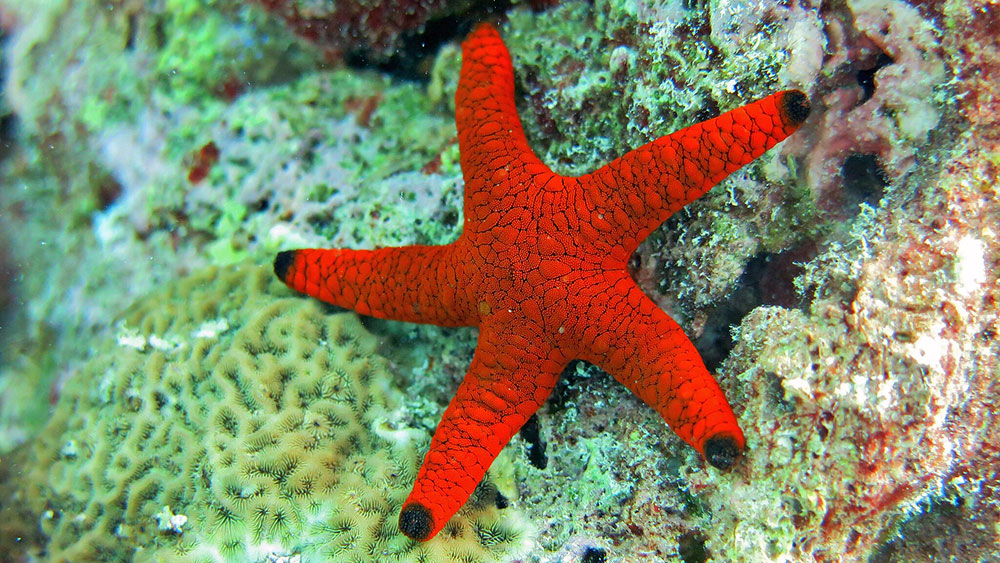
The beautiful sea stars (“starfish”), classified as echinoderms, are one of the most easily identifiable marine invertebrates, with their characteristic radiating arms and stony skin of calcium carbonate. The sea star’s water vascular system is one of the more amazing and complex arrangements in the animal world. The brittle stars and basket stars comprise the largest class of living echinoderms.
Recently, scientists “at the Biomimetics-Innovation-Center, Hochschule Bremen—City University of Applied Sciences, have made pioneering discoveries about how mechanical stress shapes the ultrastructure [fine structure within a cell] of starfish skeletons.”1
The Phys.org article states, “Sharing an evolutionary lineage with vertebrates, starfish serve as powerful models for studying the development of endoskeletons.”1 Mossig and Bremen presuppose vertebrates and invertebrates are evolutionarily linked, but there is no evidence that such a fantastical transition took place. Specifically, evolution theory maintains that people (vertebrates) and echinoderms share a common ancestor that was a primeval bilaterally symmetric echinoderm about 650 million years ago. This alleged primitive ancestor to echinoderms has never been found, and creationists predict it will never be found. Sea stars may be an assumed powerful model for endoskeleton development, but the fact remains that there are no intermediates between the vertebrate endoskeleton and the sea star mesoderm (the middle layer of cells of the embryo that develops into organs).
Regardless, scientists appeal to a porous microstructure made of calcium carbonate found in echinoderms called stereom.
As bones in invertebrates have a porous trabecular microstructure, a similar porous microstructure can be found in the echinoderm's ossicles [small pieces of calcified material]. This porous microstructure exists in different geometries known as stereom. Different types of stereom are present within a single ossicle and are organized in complex geometrical patterns. Multiple types of stereom in individual ossicles might serve several different functions within the skeleton and might be subjected to different types of mechanical loads correspondingly.2
It should be noted that stereom did not evolve but is found even in “basal” echinoderms. Indeed, stereom genes that code for stereom are unique to echinoderms.
The Phys.org article mentions the tiny stereom structures thicken under stress like vertebrate bones.
By employing cutting-edge X-ray microtomography and computational modeling, the researchers examined the 3D architecture and stress distribution of starfish ossicles. They found that regions subjected to higher mechanical stress developed thicker stereom microstructures—a principle similarly observed in vertebrate bones.1
Instead of evidence for evolution, we see how sea stars are designed—like vertebrate bone—to respond to mechanical stress, “Our findings suggest that the ability to adapt to mechanical loads is a common feature of mesoderm endoskeletons within the Deuterostomia taxonomic group [echinoderms].”2
Evolutionists can only theorize, “This study shows a correlation between the ultrastructure and the mechanical stress in the starfish endoskeleton, suggesting that this fundamental structure-function relationship may be an ancestral feature of not only vertebrate endoskeletons [emphasis added],” and “presumably, vertebrate endoskeletons have evolved various adaptations to optimize their mass. [emphasis added]”2
Creationists see sea stars—like all other living creatures—as having been created thousands of years ago with all of their unique anatomy and physiology intact and fully functioning from the start. This is what the fossil record shows.3 Sea stars have always been sea stars.
References
- Mossig, M. and H. Bremen. Starfish Skeletons Provide Key Insights into Bone Evolution. Phys.org. Posted on phys.org February 11, 2025.
- Raman, et al. 2025. The Ultrastructure of the Starfish Skeleton Is Correlated with Mechanical Stress. Acta Biomaterialia. 193: 279–290.
- Morris, J. and F. Sherwin. 2017. The Fossil Record. Dallas, TX: Institute for Creation Research.
Stage image: An indian red sea star (Fromia indica), in Maldives (Landaagiraavaru, Baa atoll).
Stage image credit: Frédéric Ducarme, CC BY-SA 4.0, via Wikimedia Commons. Used in accordance with federal copyright (fair use doctrine) law. Usage by ICR does not imply endorsement of copyright holder.
* Dr. Sherwin is a news writer at the Institute for Creation Research. He earned an M.A. in invertebrate zoology from the University of Northern Colorado and received an honorary doctorate of science from Pensacola Christian College.