



Archive of Articles


.jpg)

















Rocks and fossils do not come with labels informing us of their age. They must be understood in light of their geologic context, and interpreted within a worldview. Unfortunately, my evolutionary colleagues are often so dominated by uniformitarian brainwashing they can't objectively understand young-Earth evidence. Nevertheless, some of the evidence is clear and open for all to see.
One such clear piece of evidence is in Kodachrome Basin State Park in Utah. Named by a former director of National Geographic magazine for its photographic beauty, it can be found near the better-known Bryce Canyon National Park. Here one can see numerous clastic "pipes" rising many feet into the air.
A clastic rock consists of eroded fragments of a previous rock. For instance, sandstone consists of sand grains, usually derived from a previously existing granitic source. When sand grains are deposited and cemented together it becomes a sandstone. These clastic pipes are sandstone, nearly identical with a deeply buried sandstone source.
Evidently a tectonic event fluidized an unconsolidated sand deposit, and squeezed it up like toothpaste into piercements in the overlying rock. Once emplaced as a liner "dike," or in this case a vertical "pipe," it hardened into resistant rock. Eventually the surrounding, more easily erodable rock was washed away, leaving only a vertical pipe.
The timing of the deposition, squeezing, and erosion provides the young-Earth argument. According to conventional dating methods, the pipes squeezed up some 150 million years ago, but the source sandstone bed is 175 million years old. Thus, the mother bed remained soft and unconsolidated for 25 million years before it squeezed up.
In the presence of a cementing agent to bind the grains together, which both the source and daughter pipes have, loose sand can harden into a sandstone in a short time, perhaps just years. The fact that the pipes exist at all is evidence that little time passed between deposition and squeezing. Thus, the millions of years postulated by old-Earth advocates never happened.
[body_edit] =>Rocks and fossils do not come with labels informing us of their age. They must be understood in light of their geologic context, and interpreted within a worldview. Unfortunately, my evolutionary colleagues are often so dominated by uniformitarian brainwashing they can't objectively understand young-Earth evidence. Nevertheless, some of the evidence is clear and open for all to see.
One such clear piece of evidence is in Kodachrome Basin State Park in Utah. Named by a former director of National Geographic magazine for its photographic beauty, it can be found near the better-known Bryce Canyon National Park. Here one can see numerous clastic "pipes" rising many feet into the air.
A clastic rock consists of eroded fragments of a previous rock. For instance, sandstone consists of sand grains, usually derived from a previously existing granitic source. When sand grains are deposited and cemented together it becomes a sandstone. These clastic pipes are sandstone, nearly identical with a deeply buried sandstone source.
Evidently a tectonic event fluidized an unconsolidated sand deposit, and squeezed it up like toothpaste into piercements in the overlying rock. Once emplaced as a liner "dike," or in this case a vertical "pipe," it hardened into resistant rock. Eventually the surrounding, more easily erodable rock was washed away, leaving only a vertical pipe.
The timing of the deposition, squeezing, and erosion provides the young-Earth argument. According to conventional dating methods, the pipes squeezed up some 150 million years ago, but the source sandstone bed is 175 million years old. Thus, the mother bed remained soft and unconsolidated for 25 million years before it squeezed up.
In the presence of a cementing agent to bind the grains together, which both the source and daughter pipes have, loose sand can harden into a sandstone in a short time, perhaps just years. The fact that the pipes exist at all is evidence that little time passed between deposition and squeezing. Thus, the millions of years postulated by old-Earth advocates never happened.
[typeID] => 1 [visible] => t [pdf] => /i/pdf/btg/btg-211.pdf [publishURL] => where-can-we-see-young-earth-evidence [publishDate] => 0000-00-00 [authorAsterisk] => f [domainID] => 1 [publication] => [volume] => [issue] => [page] => [author] => John D. Morris, Ph.D. ) -->

Beautiful, golden fossilized amber begins as resin. Exuded as a sticky liquid from bark or wood, it polymerizes into solid amber. It slowly degrades when left in the open and therefore must be rather quickly buried in dense sediments. There are about twenty amber deposits, the most prominent locations are in the Baltic and Dominican Republic.
Many thousands of amber pieces contain fossils. A variety of animals are preserved in those golden tombs, including insects, crustaceans, tadpoles, lizards, annelids, snails, and spiders. In 1997, a piece of Dominican amber was appraised at $50,000 because it contained a frog. Even hair of mammals has been found. Such preservation gives us an idea of the pre-Flood ecosystem thousands of years ago.
The beautiful and aromatic blue amber of the Dominican Republic is the most rewarding of the ambers for aesthetic and scientific reasons, and holds the record when it comes to fossil content. Not only does this amber contain ten times more insects than Baltic amber, it also is 90% more transparent. Some of the fossilized creatures are extinct, but this is hardly evidence for vertical evolution.
There have even been discoveries of preserved animal and plant DNA, "Amber has preserved ancient life to such infinitesimal detail that it even captures fragments of DNA of the organisms entrapped in it."1 The discovery of DNA segments is not surprising for the creationist. However, it stupefies the Darwinist, because evolutionists maintain that amber is many millions of years old.
The oldest known amber containing insects is — according to evolutionary dating — 146 million years old. But what is found are animal forms that remain unchanged. Secular biologists are constantly amazed that creatures displayed in such a clear sarcophagus can be identified down to genus or even species. For example, small oak tree flowers have been found dated at "90 million years old," but they are still oak. The same is true for the oldest feather (100% feather — not a transition from a scale), the oldest mushroom, mosquito, biting black fly, and fig wasp. All that is seen in these organisms is no change ("stasis") or the possibility of extinction. This in no way supports the case for macroevolution, but is certainly what creationists expect.
To conclude, just as the mineralized fossils found in sedimentary rock units worldwide fail to support macroevolution, the same holds true for animals and plants found in "ancient" amber. Creation scientists aren't particularly surprised by the plants, animals, and DNA found in amber considering the youth of this planet. Furthermore, creationists have been requesting these creatures in amber should be subjected to Carbon 14 dating. A similar request is made to date the "70 million year old" soft dinosaur tissue recently discovered in eastern Montana (see Origins Issues "The Devastating Issue of Dinosaur Tissue").2 But secular scientists are reticent. Why? The search for truth should actively go where the physical evidence leads.
Endnotes
- http://www.amnh.org/exhibitions/amber/
- See also Yeoman, B. April 2006. Schweitzer's dangerous discovery. Discover, p. 37.
* Frank Sherwin is a zoologist and seminar speaker for ICR.
Cite this article: Sherwin, F. 2006. Amber: A Window to the Recent Past. Acts & Facts. 35 (7).
[body_edit] =>Beautiful, golden fossilized amber begins as resin. Exuded as a sticky liquid from bark or wood, it polymerizes into solid amber. It slowly degrades when left in the open and therefore must be rather quickly buried in dense sediments. There are about twenty amber deposits, the most prominent locations are in the Baltic and Dominican Republic.
Many thousands of amber pieces contain fossils. A variety of animals are preserved in those golden tombs, including insects, crustaceans, tadpoles, lizards, annelids, snails, and spiders. In 1997, a piece of Dominican amber was appraised at $50,000 because it contained a frog. Even hair of mammals has been found. Such preservation gives us an idea of the pre-Flood ecosystem thousands of years ago.
The beautiful and aromatic blue amber of the Dominican Republic is the most rewarding of the ambers for aesthetic and scientific reasons, and holds the record when it comes to fossil content. Not only does this amber contain ten times more insects than Baltic amber, it also is 90% more transparent. Some of the fossilized creatures are extinct, but this is hardly evidence for vertical evolution.
There have even been discoveries of preserved animal and plant DNA, "Amber has preserved ancient life to such infinitesimal detail that it even captures fragments of DNA of the organisms entrapped in it."1 The discovery of DNA segments is not surprising for the creationist. However, it stupefies the Darwinist, because evolutionists maintain that amber is many millions of years old.
The oldest known amber containing insects is — according to evolutionary dating — 146 million years old. But what is found are animal forms that remain unchanged. Secular biologists are constantly amazed that creatures displayed in such a clear sarcophagus can be identified down to genus or even species. For example, small oak tree flowers have been found dated at "90 million years old," but they are still oak. The same is true for the oldest feather (100% feather — not a transition from a scale), the oldest mushroom, mosquito, biting black fly, and fig wasp. All that is seen in these organisms is no change ("stasis") or the possibility of extinction. This in no way supports the case for macroevolution, but is certainly what creationists expect.
To conclude, just as the mineralized fossils found in sedimentary rock units worldwide fail to support macroevolution, the same holds true for animals and plants found in "ancient" amber. Creation scientists aren't particularly surprised by the plants, animals, and DNA found in amber considering the youth of this planet. Furthermore, creationists have been requesting these creatures in amber should be subjected to Carbon 14 dating. A similar request is made to date the "70 million year old" soft dinosaur tissue recently discovered in eastern Montana (see Origins Issues "The Devastating Issue of Dinosaur Tissue").2 But secular scientists are reticent. Why? The search for truth should actively go where the physical evidence leads.
Endnotes
- http://www.amnh.org/exhibitions/amber/
- See also Yeoman, B. April 2006. Schweitzer's dangerous discovery. Discover, p. 37.
* Frank Sherwin is a zoologist and seminar speaker for ICR.
Cite this article: Sherwin, F. 2006. Amber: A Window to the Recent Past. Acts & Facts. 35 (7).
[typeID] => 1 [visible] => t [pdf] => /i/pdf/btg/btg-211.pdf [publishURL] => amber-window-recent-past [publishDate] => 0000-00-00 [authorAsterisk] => f [domainID] => 1 [publication] => [volume] => [issue] => [page] => [author] => Frank Sherwin, D.Sc. (Hon.) ) -->


"Astrobiology" is a curious science. Like its predecessor "exobiology" it is, as George Gaylord Simpson once quipped, "a science without a subject." We know about astrophysics and astrochemistry, but where is the biology in astronomy? So far, it's only in the imaginations of evolutionists, who think the recipe for life is as simple as "just add water."
Today, astrobiology is a dynamic, interdisciplinary field that is (as long as the NASA money flows) attracting a great deal of vibrant research into many interesting questions: What is life? What are the conditions for life? How can we detect it? But it is still a science without its prime subject. Nevertheless, there is motivational power in a suggestive name like astrobiology.
Another phrase motivates much of NASA's astrobiology quest: "follow the water." Since life as we know it depends on liquid water, it seems that watery environments are the best places to look. Doubters that water is essential for life usually do more armchair speculation than lab work. Most realists understand water's incomparable qualities.
"Follow the water" explains the excitement any time scientists find evidence for water at some planet or moon, such as last November's announcement that Saturn's moon Enceladus might have liquid under its erupting south pole. Due to its chemical properties, water can only exist under narrow conditions of temperature and pressure. For many years, scientists assumed this meant that only the surfaces of terrestrial planets within a star's habitable zone, where water could exist as a liquid, could host life. Inferences for watery environments under the ice of moons far outside the habitable zone opened up new vistas for imagination.
Another finding bolstering astrobiological hopes was the ubiquity of life in extreme environments. "Extremophiles" have been found around deep sea vents, under Antarctic ice and in boiling-hot springs. These discoveries, however, beg the question of how these hardy life forms originated.
The "follow the water" motto suffers from a logical flaw: water is necessary, but not sufficient for life. It is no more logical than assuming that if iron is found on a planet, skyscrapers can't be far behind. The key to life is the way its ingredients are organized, not just the materials used.
Though life is notoriously difficult to define, Benton Clark of the University of Colorado captured this essence in his definition of life in an article in Astrobiology Magazine: "life reproduces, and life uses energy. These functions follow a set of instructions embedded within the organism."
This suggests a different motto than "follow the water." If taken seriously, it might turn astrobiology in a completely different direction: one that takes seriously intelligence as a cause, and views design detection as the most fruitful approach. It might even lead a scientist to start with John 1:1-3 as a foundation for research. Instead of "follow the water," try "follow the instructions."
* David F. Coppedge works in the Cassini program at the Jet Propulsion Laboratory.
[body_edit] =>"Astrobiology" is a curious science. Like its predecessor "exobiology" it is, as George Gaylord Simpson once quipped, "a science without a subject." We know about astrophysics and astrochemistry, but where is the biology in astronomy? So far, it's only in the imaginations of evolutionists, who think the recipe for life is as simple as "just add water."
Today, astrobiology is a dynamic, interdisciplinary field that is (as long as the NASA money flows) attracting a great deal of vibrant research into many interesting questions: What is life? What are the conditions for life? How can we detect it? But it is still a science without its prime subject. Nevertheless, there is motivational power in a suggestive name like astrobiology.
Another phrase motivates much of NASA's astrobiology quest: "follow the water." Since life as we know it depends on liquid water, it seems that watery environments are the best places to look. Doubters that water is essential for life usually do more armchair speculation than lab work. Most realists understand water's incomparable qualities.
"Follow the water" explains the excitement any time scientists find evidence for water at some planet or moon, such as last November's announcement that Saturn's moon Enceladus might have liquid under its erupting south pole. Due to its chemical properties, water can only exist under narrow conditions of temperature and pressure. For many years, scientists assumed this meant that only the surfaces of terrestrial planets within a star's habitable zone, where water could exist as a liquid, could host life. Inferences for watery environments under the ice of moons far outside the habitable zone opened up new vistas for imagination.
Another finding bolstering astrobiological hopes was the ubiquity of life in extreme environments. "Extremophiles" have been found around deep sea vents, under Antarctic ice and in boiling-hot springs. These discoveries, however, beg the question of how these hardy life forms originated.
The "follow the water" motto suffers from a logical flaw: water is necessary, but not sufficient for life. It is no more logical than assuming that if iron is found on a planet, skyscrapers can't be far behind. The key to life is the way its ingredients are organized, not just the materials used.
Though life is notoriously difficult to define, Benton Clark of the University of Colorado captured this essence in his definition of life in an article in Astrobiology Magazine: "life reproduces, and life uses energy. These functions follow a set of instructions embedded within the organism."
This suggests a different motto than "follow the water." If taken seriously, it might turn astrobiology in a completely different direction: one that takes seriously intelligence as a cause, and views design detection as the most fruitful approach. It might even lead a scientist to start with John 1:1-3 as a foundation for research. Instead of "follow the water," try "follow the instructions."
* David F. Coppedge works in the Cassini program at the Jet Propulsion Laboratory.
[typeID] => 1 [visible] => t [pdf] => /i/pdf/btg/btg-211.pdf [publishURL] => astrobiology-follow- [publishDate] => 0000-00-00 [authorAsterisk] => f [domainID] => 1 [publication] => [volume] => [issue] => [page] => [author] => David F. Coppedge ) -->
One of the claims most frequently used by evolutionists for excluding the scientific evidence for creation in public schools and to be denied for publication in scientific journals is that such evidence is not based on natural laws, therefore it cannot be scientific. They claim that evolutionary theory is based on natural laws and thus qualifies as a scientific theory. Hence, the theory of creation must be excluded, but the theory of evolution is admissible (of course, it must be absolutely atheistic). However, evolutionary theory is not based on natural laws but is actually contrary to natural laws.
Let us first consider evolutionary theories on the origins of the universe. The most widely accepted theory on the origin of the universe is known technically as inflation theory, but is generally referred to as the Big Bang theory. It was recognized that the standard Big Bang theory had insuperable flaws, so something else had to be postulated to rescue the theory. Alan Guth, now at the Massachusetts Institute of Technology, invented the notion, based on quantum theory, that prior to the Big Bang there occurred a fluctuation of a false vacuum. The particle, or whatever it might be called, that was produced in a tiny fraction of a second, inflated itself into something about the size of a grapefruit. From this point on the remainder of the universe was produced essentially similar to the original Big Bang theory, starting with subatomic particles, then hydrogen (75%) and helium (25%), then stars and galaxies, eventually our solar system, and so on until we arrived. There were no natural laws in existence during this hypothetical early stage of the origin of the universe. Evolutionists must suppose that the natural laws that now govern the operation of the known universe somehow were produced by the Big Bang. Therefore, its origin could not have been based on natural laws. If creation is excluded then likewise all evolutionary theories on the origin of the universe must also be excluded.
Furthermore, there are perhaps as many as fifty physical constants in the universe that must be precisely what they are or the universe and life could not exist. They cannot be a little bit more or a little bit less. They include, for example, the universal constants (Boltzman's constant, Planck's constant, and gravitational constant); the mass of elementary particles (pion rest mass, neutron rest mass, electron rest mass, unit charge, mass-energy relation); and fine structure constants (gravitational, weak interaction, electromagnetic, and strong fine constants). The probability that even just one of these physical constants could have been produced with precisely the value required from the chaos of the Big Bang is vanishingly small, let alone fifty or so. Thus, all theories on an evolutionary origin of the universe contradict the laws of probability and must therefore be excluded on this basis as well.
According to evolutionary theory, starting with the chaos and disorder of the Big Bang and the simplicity of hydrogen and helium gases, the universe created itself. This is clearly a violation of natural law, namely the Second Law of Thermodynamics. According to this law an isolated system can never increase in order and complexity, transforming itself to higher and higher levels of organization. An isolated system will inevitably, with time, run down, becoming more and more disorderly. There are no exceptions. Contrary to this natural law, evolutionists believe the universe is an isolated system which transformed itself from the chaos and disorder of the Big Bang and simplicity of hydrogen and helium gases into the incredibly complex universe we have today. This is a direct violation of the Second Law of Thermodynamics. If natural laws are natural laws, the universe could not have created itself. The only alternative is that it is not an isolated system. There must be a Creator that is external to and independent of the natural universe who was responsible for its origin and who created the natural laws that govern its operation.
What about the present state of the universe? There are three possibilities. It could be in a steady state, neither increasing nor decreasing in order and complexity. A second possibility would be that it is increasing in order and complexity. The third possibility would be that it is constantly decreasing in order and complexity. Some evolutionary astronomers reject the Big Bang theory and suggest what is called the Steady State Theory. They would suggest the first possibility. If the Big Bang theory is correct, and as evolutionists believe, the present natural laws are all there is and all there ever has been, then the order and complexity of the universe should constantly be increasing. Creation scientists, on the other hand, maintain that in the beginning God created the universe in a perfect state and therefore matter would have no tendency to increase in order and complexity. Thus, if something has occurred since creation to change the original created state (and we know that it has) the order and complexity of the universe could not be increasing, but it could be decreasing. Fully in accord with the Second Law of Thermodynamics, the order and complexity of the universe is constantly decreasing. Every star in the universe is burning up billions of tons of fuel every second. Obviously, that supply of energy cannot last forever. Therefore, unless God intervenes (and the Bible tells us He will), the universe is certain to die. Eventually every star will have burned up all of its fuel and the lights will go out. At this point, there would be no life and no activity anywhere in the universe. It would be dead. If the natural laws which now govern the universe are causing its death and destruction, and these laws are all there is and all there ever has been, how could they have created the universe in the first place? What sort of tortured logic is necessary to suggest such an impossibility? The present state of the universe and the laws that govern it contradict all evolutionary theories concerning its origin.
The knowledge concerning the laws of thermodynamics was developed about one hundred and fifty years ago, but this knowledge was inscribed in the Bible three thousand years ago. In Psalm 102:25-26 we read, "Of old hast thou laid the foundation of the earth: and the heavens are the work of thy hands. They shall perish, but thou shalt endure: yea, all of them shall wax old like a garment . . ." The Bible tells us that in the beginning God created the heavens and the earth, but now, in their present state, and fully in accord with the Second Law of Thermodynamics, they are wearing out like a suit of clothes. At the time the Bible was written, most people believed that the universe had been here forever and would continue to be here forever. The Bible says, not so, the universe had a beginning and is now wearing out and running down, just as modern science has determined. Furthermore, modern science establishes that the universe had to have a beginning. If the universe had been here forever it would have run down a long time ago. It hasn't run down yet, so it could not have been here forever. Therefore, it had a beginning, and the Biblical statement, "In the beginning," has been scientifically verified, as has its statements concerning the present state of the universe.
Let us now consider theories on the origin of life. Here also the so-called evolutionary origin of life chemist is forced to utilize processes contrary to natural laws. In their experiments designed to produce even very simple molecules, they run into insuperable difficulties. For example, they must postulate some form of energy that would be available to convert simple molecules into more complex molecules. The only forms of energy that would have been available on their hypothetical primitive Earth would have been energy from the Sun, electrical discharges (lightning), radioactive decay, and heat. Most of the available energy would be that from the Sun. All raw forms of energy are destructive. The raw, unshielded ultraviolet light coming from the Sun is deadly, destroying rapidly the biological molecules required for life, such as amino acids, proteins, DNA, and RNA. UV light rapidly kills bacteria by disrupting molecules. All forms of life from bacteria to man are killed by UV light, and you know that if you are hit by lightning you would not become more complex—you would be severely injured or killed.
In all experiments employing these sources of raw energy, the rates of destruction vastly exceed the rates of formation. How then was Miller in his experiment1 able to obtain a small quantity of several amino acids and a few other products? He employed a trap. As tiny quantities of these substances were constantly being created and were immediately isolated in the trap, the gases he employed were circulating continuously through his raw energy, electrical discharges (simulating lightning). Without the trap, the products would have been destroyed by the electrical discharges at rates that vastly exceed the rates of formation, and no detectable quantities of the products would have formed. There could have been no traps available on the hypothetical primitive Earth. If these products were formed in the atmosphere they would be destroyed before they could reach the ocean. Furthermore, the ocean could not have acted as a trap since even there destructive processes would eliminate any surviving products.
In any case, a trap is fatal to the theory. The purpose of the trap is to isolate the products from the energy source, but this brings the process to a complete halt. For amino acids to join together to make a protein, a large quantity of energy is required, but the very purpose of the trap is to isolate the products from the energy. No energy, no further progress. Even as long ago as 1960 the physical chemist, D. E. Hull, taking into account the rates of destruction versus the rates of formation in these origin of life schemes, concluded that, "The physical chemist, guided by the proved principles of chemical thermodynamics and kinetics, cannot offer any encouragement to the biochemist [origin of life chemist], who needs an ocean full of organic compounds to form even lifeless coacervates" (Nature 186:693). Coacervates are mere blobs of disorganized material. Please note that Hull states that these so-called origin of life schemes are contrary to proved principles of chemical thermodynamics and kinetics, which are essentially the same as natural laws.
To the evolutionist, history began with "In the beginning, hydrogen . . ." To the creationist, history began with "In the beginning, God . . ." Science and natural laws come down solidly in support for the fact of creation.
"Thou are worthy, O Lord, to receive glory and honor and power: for thou hast created all things, and for thy pleasure they are and were created" (Revelation 4:11).Endnote
1. Miller, S. L. May 15, 1953. A production of amino acids under possible primitive earth conditions. Science 117:528.
* Dr. Duane Gish is Senior Vice President Emeritus of ICR.
[body_edit] =>Let us first consider evolutionary theories on the origins of the universe. The most widely accepted theory on the origin of the universe is known technically as inflation theory, but is generally referred to as the Big Bang theory. It was recognized that the standard Big Bang theory had insuperable flaws, so something else had to be postulated to rescue the theory. Alan Guth, now at the Massachusetts Institute of Technology, invented the notion, based on quantum theory, that prior to the Big Bang there occurred a fluctuation of a false vacuum. The particle, or whatever it might be called, that was produced in a tiny fraction of a second, inflated itself into something about the size of a grapefruit. From this point on the remainder of the universe was produced essentially similar to the original Big Bang theory, starting with subatomic particles, then hydrogen (75%) and helium (25%), then stars and galaxies, eventually our solar system, and so on until we arrived. There were no natural laws in existence during this hypothetical early stage of the origin of the universe. Evolutionists must suppose that the natural laws that now govern the operation of the known universe somehow were produced by the Big Bang. Therefore, its origin could not have been based on natural laws. If creation is excluded then likewise all evolutionary theories on the origin of the universe must also be excluded.
Furthermore, there are perhaps as many as fifty physical constants in the universe that must be precisely what they are or the universe and life could not exist. They cannot be a little bit more or a little bit less. They include, for example, the universal constants (Boltzman's constant, Planck's constant, and gravitational constant); the mass of elementary particles (pion rest mass, neutron rest mass, electron rest mass, unit charge, mass-energy relation); and fine structure constants (gravitational, weak interaction, electromagnetic, and strong fine constants). The probability that even just one of these physical constants could have been produced with precisely the value required from the chaos of the Big Bang is vanishingly small, let alone fifty or so. Thus, all theories on an evolutionary origin of the universe contradict the laws of probability and must therefore be excluded on this basis as well.
According to evolutionary theory, starting with the chaos and disorder of the Big Bang and the simplicity of hydrogen and helium gases, the universe created itself. This is clearly a violation of natural law, namely the Second Law of Thermodynamics. According to this law an isolated system can never increase in order and complexity, transforming itself to higher and higher levels of organization. An isolated system will inevitably, with time, run down, becoming more and more disorderly. There are no exceptions. Contrary to this natural law, evolutionists believe the universe is an isolated system which transformed itself from the chaos and disorder of the Big Bang and simplicity of hydrogen and helium gases into the incredibly complex universe we have today. This is a direct violation of the Second Law of Thermodynamics. If natural laws are natural laws, the universe could not have created itself. The only alternative is that it is not an isolated system. There must be a Creator that is external to and independent of the natural universe who was responsible for its origin and who created the natural laws that govern its operation.
What about the present state of the universe? There are three possibilities. It could be in a steady state, neither increasing nor decreasing in order and complexity. A second possibility would be that it is increasing in order and complexity. The third possibility would be that it is constantly decreasing in order and complexity. Some evolutionary astronomers reject the Big Bang theory and suggest what is called the Steady State Theory. They would suggest the first possibility. If the Big Bang theory is correct, and as evolutionists believe, the present natural laws are all there is and all there ever has been, then the order and complexity of the universe should constantly be increasing. Creation scientists, on the other hand, maintain that in the beginning God created the universe in a perfect state and therefore matter would have no tendency to increase in order and complexity. Thus, if something has occurred since creation to change the original created state (and we know that it has) the order and complexity of the universe could not be increasing, but it could be decreasing. Fully in accord with the Second Law of Thermodynamics, the order and complexity of the universe is constantly decreasing. Every star in the universe is burning up billions of tons of fuel every second. Obviously, that supply of energy cannot last forever. Therefore, unless God intervenes (and the Bible tells us He will), the universe is certain to die. Eventually every star will have burned up all of its fuel and the lights will go out. At this point, there would be no life and no activity anywhere in the universe. It would be dead. If the natural laws which now govern the universe are causing its death and destruction, and these laws are all there is and all there ever has been, how could they have created the universe in the first place? What sort of tortured logic is necessary to suggest such an impossibility? The present state of the universe and the laws that govern it contradict all evolutionary theories concerning its origin.
The knowledge concerning the laws of thermodynamics was developed about one hundred and fifty years ago, but this knowledge was inscribed in the Bible three thousand years ago. In Psalm 102:25-26 we read, "Of old hast thou laid the foundation of the earth: and the heavens are the work of thy hands. They shall perish, but thou shalt endure: yea, all of them shall wax old like a garment . . ." The Bible tells us that in the beginning God created the heavens and the earth, but now, in their present state, and fully in accord with the Second Law of Thermodynamics, they are wearing out like a suit of clothes. At the time the Bible was written, most people believed that the universe had been here forever and would continue to be here forever. The Bible says, not so, the universe had a beginning and is now wearing out and running down, just as modern science has determined. Furthermore, modern science establishes that the universe had to have a beginning. If the universe had been here forever it would have run down a long time ago. It hasn't run down yet, so it could not have been here forever. Therefore, it had a beginning, and the Biblical statement, "In the beginning," has been scientifically verified, as has its statements concerning the present state of the universe.
Let us now consider theories on the origin of life. Here also the so-called evolutionary origin of life chemist is forced to utilize processes contrary to natural laws. In their experiments designed to produce even very simple molecules, they run into insuperable difficulties. For example, they must postulate some form of energy that would be available to convert simple molecules into more complex molecules. The only forms of energy that would have been available on their hypothetical primitive Earth would have been energy from the Sun, electrical discharges (lightning), radioactive decay, and heat. Most of the available energy would be that from the Sun. All raw forms of energy are destructive. The raw, unshielded ultraviolet light coming from the Sun is deadly, destroying rapidly the biological molecules required for life, such as amino acids, proteins, DNA, and RNA. UV light rapidly kills bacteria by disrupting molecules. All forms of life from bacteria to man are killed by UV light, and you know that if you are hit by lightning you would not become more complex—you would be severely injured or killed.
In all experiments employing these sources of raw energy, the rates of destruction vastly exceed the rates of formation. How then was Miller in his experiment1 able to obtain a small quantity of several amino acids and a few other products? He employed a trap. As tiny quantities of these substances were constantly being created and were immediately isolated in the trap, the gases he employed were circulating continuously through his raw energy, electrical discharges (simulating lightning). Without the trap, the products would have been destroyed by the electrical discharges at rates that vastly exceed the rates of formation, and no detectable quantities of the products would have formed. There could have been no traps available on the hypothetical primitive Earth. If these products were formed in the atmosphere they would be destroyed before they could reach the ocean. Furthermore, the ocean could not have acted as a trap since even there destructive processes would eliminate any surviving products.
In any case, a trap is fatal to the theory. The purpose of the trap is to isolate the products from the energy source, but this brings the process to a complete halt. For amino acids to join together to make a protein, a large quantity of energy is required, but the very purpose of the trap is to isolate the products from the energy. No energy, no further progress. Even as long ago as 1960 the physical chemist, D. E. Hull, taking into account the rates of destruction versus the rates of formation in these origin of life schemes, concluded that, "The physical chemist, guided by the proved principles of chemical thermodynamics and kinetics, cannot offer any encouragement to the biochemist [origin of life chemist], who needs an ocean full of organic compounds to form even lifeless coacervates" (Nature 186:693). Coacervates are mere blobs of disorganized material. Please note that Hull states that these so-called origin of life schemes are contrary to proved principles of chemical thermodynamics and kinetics, which are essentially the same as natural laws.
To the evolutionist, history began with "In the beginning, hydrogen . . ." To the creationist, history began with "In the beginning, God . . ." Science and natural laws come down solidly in support for the fact of creation.
"Thou are worthy, O Lord, to receive glory and honor and power: for thou hast created all things, and for thy pleasure they are and were created" (Revelation 4:11).Endnote
1. Miller, S. L. May 15, 1953. A production of amino acids under possible primitive earth conditions. Science 117:528.
* Dr. Duane Gish is Senior Vice President Emeritus of ICR.
[typeID] => 2 [visible] => t [pdf] => /i/pdf/imp/imp-397.pdf [publishURL] => evolution-not-based-natural-laws [publishDate] => 0000-00-00 [authorAsterisk] => f [domainID] => 1 [publication] => [volume] => [issue] => [page] => [author] => Duane Gish, Ph.D. ) -->
Rare is the saint who has not breathed the cry of David, "Lord, how long shall the wicked, how long shall the wicked triumph?" (Psalm 94:3). It seems like liberal and humanistic educators dominate and control the educational process. A humanistically trained population assumes influential positions in all branches of government which then make, execute, interpret, and enforce laws in conformity to humanistic agendas. The mass media spins liberal policy in a favorable light, conservative policy in an undesirable light, and Christianity as a radical right-wing extremism.
Perhaps more damaging to the Kingdom is the influence among Western churches of claims of personal revelation, a quest for subjective experience, and the rising influence of existentialism and postmodernism—all converge to foster a low view of Scripture.
"If the foundations be destroyed, what can the righteous do?"  (Psalm 11:3).
The answers to these worldly observations, plaintive cries, and rhetorical questions that fret about the apparent power of the wicked, lie in the overarching eternal truths of Scripture.
- God is Truth, whether anyone believes it or not (Romans 3:4).
- God's Word is sufficient to "answer" every man (II Timothy 3:16-17;
I Peter 3:15; II Peter 1:3-4). - God's plan is for His saints to win! (Genesis 1:28; Isaiah 11:9, 55:11; Matthew 6:10; Revelation 11:15).
- Our trust in God's Word and way will bring victory (Psalm 37).
ICR is committed to "preaching" the Word and "contending" for the faith—in every sphere of truth (science, technology, education, commerce, humanities). Your financial help strengthens our hands.
Rare is the saint who has not breathed the cry of David, "Lord, how long shall the wicked, how long shall the wicked triumph?" (Psalm 94:3). It seems like liberal and humanistic educators dominate and control the educational process. A humanistically trained population assumes influential positions in all branches of government which then make, execute, interpret, and enforce laws in conformity to humanistic agendas. The mass media spins liberal policy in a favorable light, conservative policy in an undesirable light, and Christianity as a radical right-wing extremism.
Perhaps more damaging to the Kingdom is the influence among Western churches of claims of personal revelation, a quest for subjective experience, and the rising influence of existentialism and postmodernism—all converge to foster a low view of Scripture.
"If the foundations be destroyed, what can the righteous do?" (Psalm 11:3).
The answers to these worldly observations, plaintive cries, and rhetorical questions that fret about the apparent power of the wicked, lie in the overarching eternal truths of Scripture.
- God is Truth, whether anyone believes it or not (Romans 3:4).
- God's Word is sufficient to "answer" every man (II Timothy 3:16-17;
I Peter 3:15; II Peter 1:3-4). - God's plan is for His saints to win! (Genesis 1:28; Isaiah 11:9, 55:11; Matthew 6:10; Revelation 11:15).
- Our trust in God's Word and way will bring victory (Psalm 37).
ICR is committed to "preaching" the Word and "contending" for the faith—in every sphere of truth (science, technology, education, commerce, humanities). Your financial help strengthens our hands.
[body_edit] => ICR just returned from Grand Canyon having completed another successful tour, with both a 10-day rafting option on the Colorado River and a 7-day bussing adventure throughout the American Southwest. Actually the ICR tours not only explore Grand Canyon, but also Mount St. Helens, Yellowstone Park, Galapagos Islands, and now the new tour to Yosemite accomplish several important goals. Some may ask, "Why does ICR offer such `vacation' packages? Isn't ICR's mission an academic and research one?"
Several reasons come to mind. Most obvious, each of the tours are to areas of ongoing ICR research. From radioisotope dating of Grand Canyon rocks to genetic diversity in the Galapagos Islands, important creation questions are being addressed. Furthermore, since ICR receives no government funding for this research, the tours help facilitate and finance it. Often the ICR scientists will be on site a week before the tour arrives, financed by tour "profits," doing the important field mapping and sample collection.
A second major goal of ICR is communication of creation information. Through the tours, numerous Christians have been more thoroughly trained than otherwise possible with first-hand knowledge gained from hands-on interaction with the sites and researchers involved. Tour veterans are thus prepared for a more effective ministry, and even have their own photographs and stories to tell.
Thirdly, these trained tour participants have tasted of the ICR passion for creation and received lasting input regarding creation's relevance to evangelism and society. Bible study and sweet fellowship impress these truths even more fully. These new ICR ambassadors leave better equipped to carry the ICR message into venues an ICR scientist might not reach.
Yes, the tours are a very important aspect of ICR's ministry. Join us if at all possible. The inaugural Yosemite tour this fall would be a good place to start!
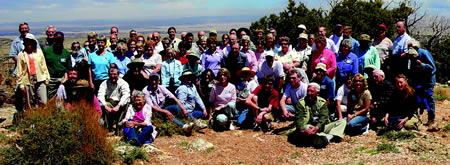
A smiling crowd of creation enthusiasts!
[typeID] => 5
[visible] => t
[pdf] =>
[publishURL] => return-from-grand-canyon
[publishDate] => 0000-00-00
[authorAsterisk] => f
[domainID] => 1
[publication] =>
[volume] =>
[issue] =>
[page] =>
[author] => John D. Morris, Ph.D.
)
-->