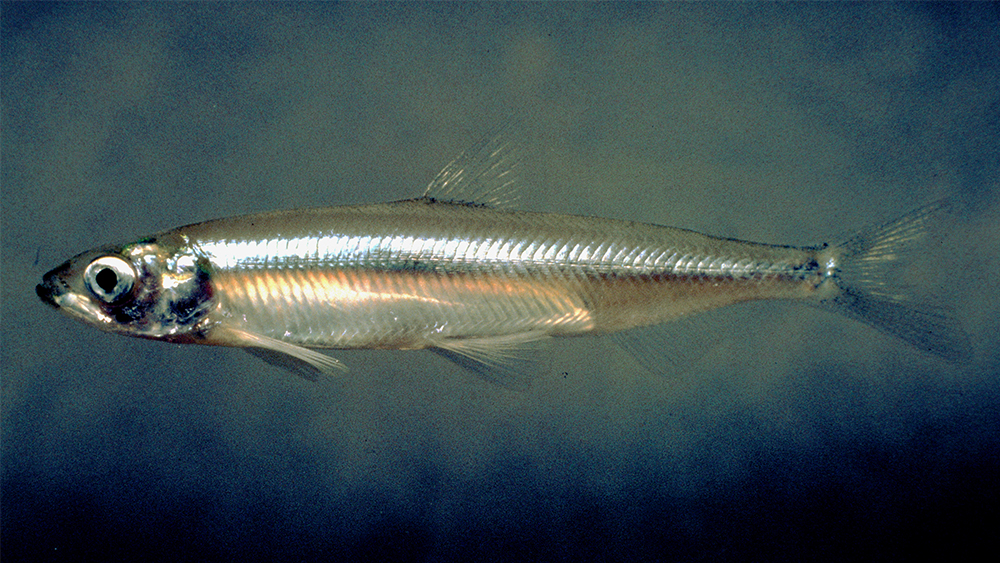
Yet another fish fossil has been discovered. This one was found in the Australian desert and was dated by evolutionists to be “15 million years old.”1 Like finding a 100% dinosaur fossil, this is a 100% fish fossil belonging to the smelt family (Osmeridae).
It’s also significant that this fossil, named Ferruaspis brocksi, was found in Lagerstatte—sedimentary rock containing unique, extraordinarily preserved fossils. McCurry et al. described the geological and environmental setting.
The taphonomic [fossilization] processes that led to the formation of the site are currently under investigation, but it is hypothesized that iron precipitated in the waterbody, resulting in the rapid burial of organisms in a geochemical environment that facilitated the rapid conversion of soft tissues into goethite [a dark reddish-brown iron ore].2
The scientists suggest the conditions of preservation were due to an oxygen-free environment with no bacterial decomposition. This certainly fits the biblical interpretation of the Genesis Flood that catastrophically buried this fish about 4,500 years ago.
Dr. Michael Frese of the University of Canberra, Australia, stated,
“Using a powerful microscope, we were able to see tiny colour-producing structures known as melanosomes. Fossilised melanosomes have previously enabled palaeontologists to reconstruct the colour of feathers, but melanosomes have never been used to reconstruct the colour pattern of a long extinct fish species.”3
F. brocksi looks like fish of the twenty-first century, eating phantom midge larvae that were remarkably preserved in its stomach. It also had a parasite. Study lead author Dr. Matthew McCurry said, “One of the fossils even shows a parasite attached to the tail of the fish. It’s a juvenile freshwater mussel called a glochidium. These juvenile mussels attach themselves to the gills or tails of fish to hitch rides up and down streams.”3
Did this group of fish evolve? McCurry et al. said in the Journal of Vertebrate Paleontology, “The lack of well-preserved body fossils has made it difficult to interpret the evolutionary history of the group [Osmerifomes].”2 This could be said for all fish groups. Professor Jochen Brocks said regarding F. brocksi, “This discovery opens new avenues for understanding the evolutionary history of Australia’s freshwater fish species and ancient ecosystems.”3 But there is no evolutionary history of this freshwater fish. It is classified as a smelt, is exquisitely preserved right down to the microscopic melanosomes, it had a diet of invertebrates like today’s fish, and was even parasitized by the same type of parasites as today.
Indeed, Dr. McCurry stated, “This fossil is part of the Osmeriforms fish family – a diverse group of fish species within Australia that includes species like the Australian Grayling and the Australian Smelt.”3 There is no real evolution of this smelt.
Fish have always been fish. They were designed by the Lord Jesus to adapt to various conditions. However, many were killed and tightly packed together in great fossil graveyards during the Flood. In the case of F. brocksi, the floodwaters transported and rapidly buried them in what is today the Central Tablelands of New South Wales of Australia.
References
- Starr, M. Amazing 15-million-Year-Old Fish Fossil Found in The Australian Desert. ScienceAlert. Posted on sciencealert.com March 23, 2025.
- McCurry, M. et al. 2025. The Paleobiology of a New Osmeriform Fish Species from Australia. Journal of Vertebrate Paleontology. Article e2445684.
- Scientists Discover 15 Million-Year-Old Australian Fish Fossil. Australian National University. Posted on anu.edu.au/news March 18, 2025.
* Dr. Sherwin is a news writer at the Institute for Creation Research. He earned an M.A. in invertebrate zoology from the University of Northern Colorado and received an honorary doctorate of science from Pensacola Christian College.