The new dinosaur bone was found in 2015 near Cape Otway, Victoria, in southeastern Australia by a volunteer named Jessica Parker.2 It was identified as a vertebra from an elaphrosaur, or “light-footed reptile,” and is the first of this kind of dinosaur found in Australia.2 This group of dinosaurs fall in the ceratosaur category of theropod dinosaurs, having similarities with Dilophosaurus, a Jurassic dinosaur common in the Western USA.3
Lead author, Stephen Poropat, from the Swinburne University of Technology in Australia, said,
Elaphrosaurs had long necks, stumpy arms with small hands, and relatively lightly built bodies. As dinosaurs go, they were rather bizarre. The few known skulls of elaphrosaurs show that the youngsters had teeth, but that the adults lost their teeth and replaced them with a horny beak. We don’t know if this is true for the Victorian elaphrosaur yet—but we might find out if we ever discover a skull.2
The lack of teeth is unsurprising because not all theropod dinosaurs had teeth.4 Other elaphrosaurs have been found in Tanzania and China, but these dinosaurs were found in Upper Jurassic rocks, thought by secular paleontologists to be about 150 million years old.2 This new Australian elaphrosaur was found in rocks dated about 40 million years younger in Cretaceous strata.2
One bone can tell a lot, and this one points out the folly in evolutionary theory once again. Elaphrosaurs supposedly went extinct in the Late Jurassic, but here we find them again in Cretaceous layers, much younger than they were supposed to have lived. This is not just a gap of a few million years, but 40 million years! And why did no evolution occur in these dinosaurs for this long? How do elaphrosaurs apparently go extinct and then suddenly reappear, exactly the same, millions of years later? The authors give no satisfactory explanation for this oft over-looked fact. Unsurprisingly, this is a common, unexplained phenomena in paleontology, known as the “Lazarus effect.”5 Long-necked (sauropods) dinosaurs supposedly went extinct and then were found fully-formed in rocks 30 million years younger. Where did these dinosaurs go for 30-40 million years?
Flood geologists have a much better explanation for the so-called “Lazarus effect.” Although most dinosaurs of a certain type were likely buried at about the same time in the Flood, a few escaped and were buried later. This makes a lot of sense if all the dinosaurs were living at the same time and at about the same elevation in the pre-Flood world. It’s simply a product of random probability. But to claim these dinosaurs are found in rocks separated by 30-40 million years, yet still look identical, is preposterous. Especially if you really believe in evolution and that all living things are continually changing with time. Where are these observable and expected changes?
Finally, because this dinosaur bone was found at a site that was supposed to be near the South Pole during the Cretaceous, paleontologists assume this dinosaur could live in extended darkness and colder polar temperatures. The authors explained,
The fact that this site would have been situated at ~76°S towards the end of the Early Cretaceous (~110–107 Ma) implies that elaphrosaurines were capable of tolerating near-polar palaeoenvironments, whereas its age indicates that elaphrosaurines persisted in Australia until at least the late Early Cretaceous.1
In contrast, our research efforts have shown that this part of Australia (Victoria) was only about 35-40 degrees south latitude in the pre-Flood world.6 That’s not very dark or cold. This elaphrosaur was simply torn apart by the floodwaters and buried as the water was reaching its zenith toward the end of the Cretaceous.7
The global Flood makes the most sense of the fossil and the rock record. The signs of this judgement as recorded in Genesis are found all over the globe. God’s Word is true.
Stage image: Jessica Parker holding her discovery in 2015.
Stage image credit: Swinburne University of Technology. Adapted for use in accordance with federal copyright (fair use doctrine) law. Usage by ICR does not imply endorsement of copyright holders.
References
1. Poropat, S. F. et al. First elaphrosaurine theropod dinosaur (Ceratosauria: Noasauridae) from Australia—A cervical vertebra from the Early Cretaceous of Victoria. Gondwana Research. Posted on sciencedirect.com May 6, 2020, accessed May 21, 2020.
2. Staff Writer. Swinburne palaeontologists identify ‘toothless’ Victorian dinosaur. Posted on Swinburne.edu May 18, 2020, accessed May 21, 2020.
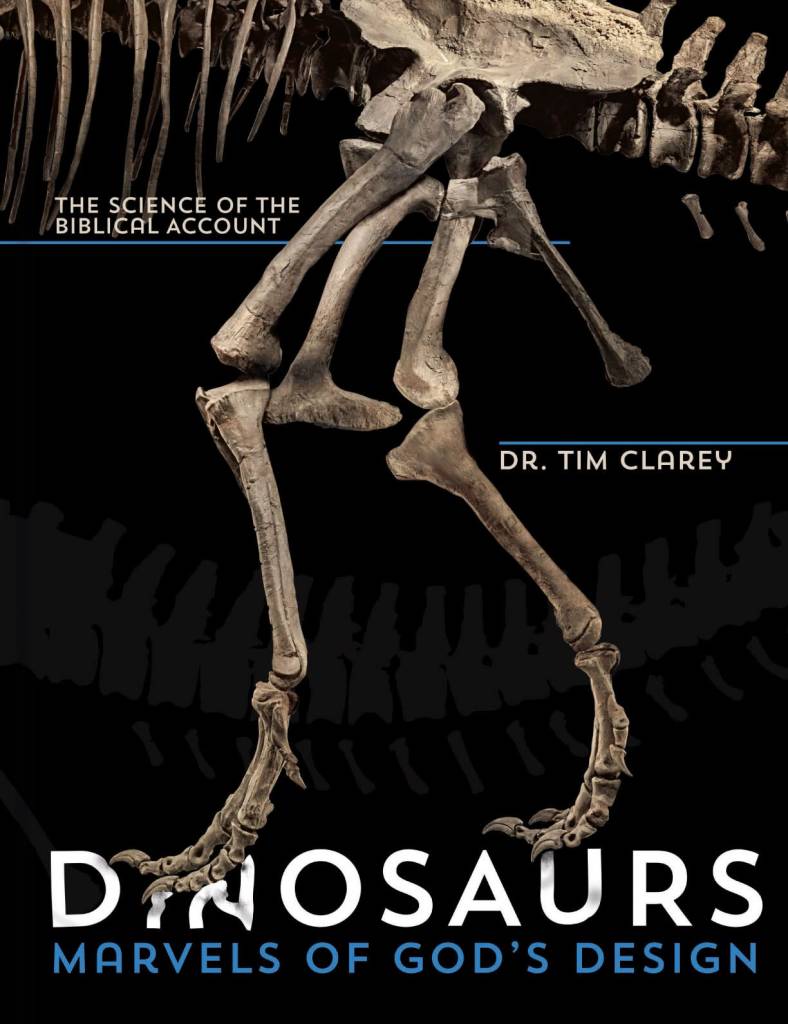
3. Clarey, T. 2015. Dinosaurs: Marvels of God’s Design. Green Forest, AR: Master Books, 72-73.
4. Ibid, 82-83.
5. Ibid, 164-165.
6. Clarey, T. 2020. Carved in Stone. Dallas, TX: Institute for Creation Research, 354-377.
7. Ibid, 308-310.
*Dr. Clarey is Research Associate at the Institute for Creation Research and earned his doctorate in geology from Western Michigan University.