Recent conventional genetic research published in Cell Genomics undeniably confirms findings that were previously reported by the Institute for Creation Research back in 2013.1 Once again, current conventional research has vindicated the prior creation exposure of evolutionarily inconvenient data present (but disregarded) in conventional databases.
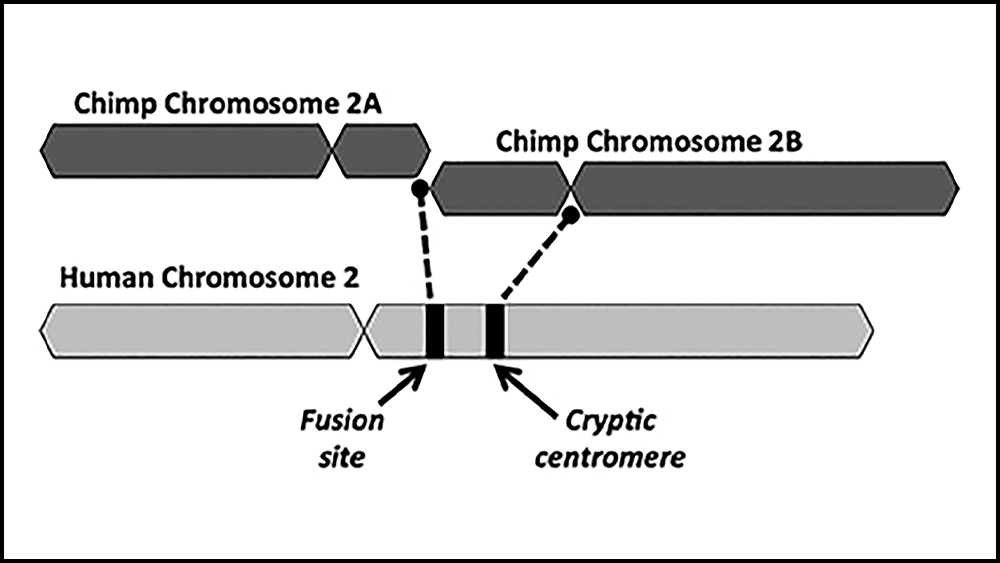
One of the most popular arguments used to support the supposed human evolution from a chimp-like ancestor is the chromosome 2 fusion model. The impetus for this idea is the evolutionary conundrum that all apes have an extra pair of chromosomes—humans have 46 while apes have 48. If humans evolved from an ape-like creature about six million years ago, then why does this extreme discrepancy exist?
The traditional evolutionary explanation claims that in the evolution of humans from apes, two chimp-like chromosomes fused end-to-end to create human chromosome 2. These have been called 2A and 2B, corresponding to chimp/ape chromosomes 12 and 13. This idea was first proposed in the early 1980s, and evolutionists thought that they found the telltale signature in 1991.2,3 A small ~800-base signature site was found on human chromosome 2 and was thought to be the fusion site.
As the human genome project accelerated, the region of the alleged fusion was more fully sequenced in 2002. At the time, the researchers were surprised at how muddled the fusion signature was, saying, “If the fusion occurred within the telomeric repeat arrays less than ~6 Mya [million years ago], why are the arrays at the fusion site so degenerate?”4
In 2013, I published a paper showing that the fusion site was not only small and corrupt—defying evolutionary predictions—but it was also located smack-dab in the middle of an active gene.5 In fact, the fusion site itself is a regulatory feature inside the gene DDX11L2. The site binds proteins called transcription factors that regulate the expression of the gene. I also showed that this particular gene was actively expressed in a wide variety of critical organs throughout the human body. In addition, DDX11L2 was itself nested within a group of many other genes. None of this makes any sense if this genetic feature was a random, accidental chromosome fusion.
In this new study, the researchers verified my previously published findings on the activity of DDX11L2 and demonstrated that the genes surrounding it are also highly functional.1 The paper states,
As the fusion site is nearly fixed in the human genome [non-variable], we speculated that it may confer a functional advantage. . . . Four putative noncoding genes/pseudogenes (PGM5P4, FAM138B, WASH2P, and DDX11L2) have been annotated at the site of the human chr2 fusion. According to GTEx short-read RNA sequencing (RNA-seq), these four genes/pseudogenes are expressed in testis, esophagus, fallopian tube, and cerebellum tissues. Further, both PGM5P4 and WASH2P are supported by long-read isoform sequencing (Iso-Seq) transcript data from CHM13hTERT and kidney tissue from ENCODE. In addition, methylation analysis demarcates a prominent CpG island showing the promoters/enhancers of PGM5P4, as identified using ONT reads from the T2T-CHM13 cell line.1
The researchers even deleted the fusion site region in human neural cells growing in culture to see what would happen. The results reduced gene expression and were highly significant, stressing the functional importance of the fusion site as a regulatory feature in human neural cells. The authors said, “These findings suggest that deletion of the fusion site may influence transcriptional programs involved in neural development, potentially contributing to phenotypic divergence between humans and NHPs [nonhuman primates].”1
In addition to highlighting the functional importance of the so-called fusion site and the entire gene region in which it is situated, the researchers were greatly surprised at the lack of evolutionary similarity in the region’s DNA sequences compared to the great apes (chimps, gorillas, and orangutans). In fact, the entire region surrounding the fusion site offered no direct evidence for human evolution from apes whatsoever.
In trying to come up with an evolutionary story for primate evolution in general, the researchers attempted to find similarity in gene-rich regions toward the ends of ape chromosomes called sub-telomeres. These are positioned close to telomeres (chromosomal end sequences). The researchers speculated the fusion site supposedly emerged from sub-telomeres millions of years ago.
Instead of leading to a tidy evolutionary story of fusion origins, the researchers discovered extreme phylogenetic discontinuity among humans and apes in general for DNA sequences in the fusion site region. In other words, the evolutionary tree based on the regions being studied didn’t lead to a consistent primate evolutionary tree. In one case, a section surrounding the fusion site in humans was more similar to gorillas than chimps.
To explain this phylogenetic conundrum, the researchers invoked the magic phrase “incomplete lineage sorting” (ILS). This is not a real genetic mechanism but merely a restating of the evolutionary problem. It is similar to the meaningless use of “convergent evolution” to describe the appearance of similar traits in organisms with no direct evolutionary connection to each other.1 In fact, the researchers actually admit this, saying, “Previous studies have speculated that ILS may be involved in evolutionary divergence or speciation, although direct evidence and the underlying mechanisms remain to be fully explored.”1
Using ILS and other confusing lines of reasoning and verbiage is the standard operating procedure for evolutionists when the data don’t cooperate and they need to obfuscate the results. Casey Luskin, a highly astute scientist and writer at the Discovery Institute, noted, “The story told in the new paper is awfully complicated and opaque. I’m not sure if it amounts to anything more than just a giant, baroque, after-the-fact 100 percent-evolution-assuming mutational just-so story.”6
Another significant finding in this research is that the entire region surrounding the fusion site was highly similar among 94 different humans that were analyzed. This means that any sort of radical genome rearrangement mechanism is not at play here to account for how this region might have evolved.
While this recent paper has confirmed some aspects of my previous studies that thoroughly negate the idea of fusion, there are many other genetic features that debunk this evolutionary paradigm. I have summarized these below:
- The fusion site is an important transcription factor (TF) binding site inside a second promoter (multiple promoter sites are common in human genes) interacting with at least 11 different transcription factors, including RNA polymerase II.7,8
- Transcription start site data from FANTOM 4, FANTOM 5, and ENCODE CAGE give a classic signal profile for a promoter/transcription start site in the fusion site.7
- A variety of specific histone modifications associated with active gene promotors peaks at both the fusion site and at DDX11L2’s first promoter.5
- My 2018 International Conference on Creationism paper showed that internally located (interstitial) telomeric repeats across the human genome are common, and thousands of them intersect with a wide variety of enhancer elements that bind TFs and other TF binding sites in regulatory regions.8 In fact, 730 are associated with long intergenic RNAs (lincRNAs).
- The 798-base fusion site is very small in size (telomeres are 5,000 to 15,000 bases long)—a head-to-head fusion should have produced something much larger in size.5
- Compared to a pristine fusion signature of the same size (798 bases), the fusion site is highly degenerate (only 70% similarity) for supposedly occurring a few million years ago. It is even more improbable if it occurred pre-Flood by creationist standards (4,500 to 6,000 years ago).5
- The alleged cryptic centromere is itself located in the middle of a gene: a large protein-coding gene named ANKRD30BL (Ankyrin Repeat Domain 30BL). The cryptic centromere sequence constitutes and overlaps both exon and intron sequences.7
- The cryptic centromere contains several retroelements, and the alphoid repeat structure in it is different than that of centromeres.7
- The cryptic centromere is very small (41,608 bases) compared to normal human centromeres that range in size from 250,000 to 5,000,000 bases.7 Minus the two retroelements (SVA-E and LIPA3/LINE), it is only 33,080 bases.7
- Fusions that occur in extant mammals in nature are not head-to-head telomere fusions but involve satellite DNA: telomere-satellite DNA or satelliteDNA-satelliteDNA.5
- And of course, telomeres are not designed to fuse but are very complex, protective, and dynamic features that interact with a variety of cell division processes.9
In conclusion, this recent report is just one more instance of a creationist doing serious research and discovering some aspect of the evolutionary story that has no real scientific support. Another example is the multiple studies I performed between 2015 and 2018 analyzing human-chimp DNA similarity. They showed no more than about 84% genome-wide DNA sequence identity between chimps and humans. This was confirmed as being completely accurate in a study published by conventional scientists seven years later in 2025.10 Once again, the biblical record that humans were created uniquely in God’s image on the sixth day of creation with no evolution involved is upheld by the scientific data.
References
- Yang, Z. et al. 2026. Incomplete Lineage Sorting of Segmental Duplications Defines the Human Chromosome 2 Fusion Site Early During African Great Ape Speciation. Cell Genomics. 6 (1), article 101079.
- Yunis, J. J. and O. Prakash. 1982. The Origin of Man: A Chromosomal Pictorial Legacy. Science. 215 (4539): 1525–1530.
- Ijdo, J. W. et al. 1991. Origin of Human Chromosome 2: An Ancestral Telomere-Telomere Fusion. Proceedings of the National Academy of Sciences of the United States of America. 88 (20): 9051–9055.
- Fan, Y. et al. 2002. Genomic Structure and Evolution of the Ancestral Chromosome Fusion Site in 2q13-2q14.1 and Paralogous Regions on Other Human Chromosomes. Genome Research. 12 (11): 1651–1662.
- Tomkins, J. P. 2013. Alleged Human Chromosome 2 “Fusion Site” Encodes an Active DNA Binding Domain Inside a Complex and Highly Expressed Gene—Negating Fusion. Answers Research Journal. 6: 367–375.
- Luskin, C. Supposed Fusion Site Contains Expressed Genes, Likely Influences Neural Development. Science & Culture Today. Posted on scienceandculture.com February 16, 2026.
- Tomkins, J. P. 2017. Debunking the Debunkers: A Response to Criticism and Obfuscation Regarding Refutation of the Human Chromosome 2 Fusion. Answers Research Journal. 10: 45–54.
- Tomkins, J. P. 2018. Combinatorial Genomic Data Refute the Human Chromosome 2 Evolutionary Fusion and Build a Model of Functional Design for Interstitial Telomeric Repeats. Proceedings of the International Conference on Creationism. 8 (1): 222–228.
- Tomkins, J. P. and J. Bergman. 2011. Telomeres: Implications for Aging and Evidence for Intelligent Design. Journal of Creation. 25 (1): 86–97.
- Hebert, J. #1 Origins News Story of 2025: ICR Dr. Jeff Tomkins’ Chimp Genome Research Confirmed and Vindicated. Creation Science Update. Posted on ICR.org January 14, 2026.
* Dr. Tomkins is a research scientist at the Institute for Creation Research and earned his doctorate in genetics from Clemson University.