Hawaiians call their state fish the humuhumunukunukuapua’a, or humuhumu for short, and snorkelers marvel at its wild paint job as it flits beneath basalt reefs. Scientifically named Rhinecanthus rectangulus, it is one of a variety of triggerfish that are named for a “trigger” used to lock the dorsal spine in an “up” position. Two aspects of the wonderful humuhumu reveal its Creator’s handiwork.

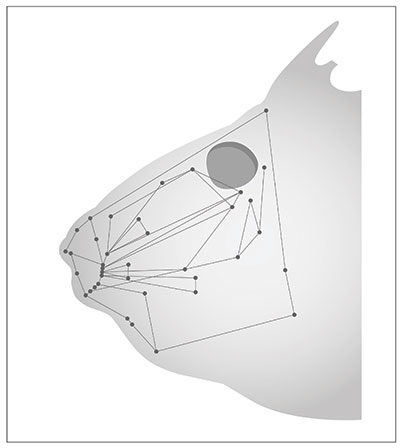
The first clearly created humuhumu aspect is the linkage mechanisms in its jaw. Man-made tools like crank rockers and oil derricks use linkage mechanisms to transmit motion and force. Within the humuhumu’s big, triangular head, flexible cartilage links bony levers and support bars. These mechanisms transfer power from jaw muscles to teeth, allowing triggerfish to chomp invertebrates like lobsters, spiny sea urchins, and snails.
Many animals use all sorts of clever all-or-nothing linkage mechanisms that showcase creation.1 “Linkage mechanisms enable animal joints to perform highly sophisticated and optimised motions” and to “achieve extreme levels of compactness in joints.”2 The humuhumu’s linkage mechanisms mean that it can use muscles far behind the jaw to open and close it, thus keeping the streamlined body shape needed for swimming.
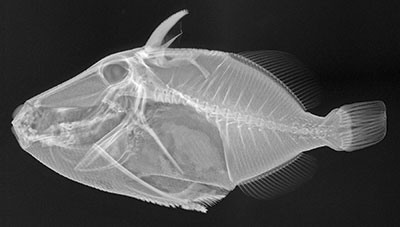
The humuhumu’s bone-cartilage linkages required all-at-once assembly in the beginning. They refute notions of bit-by-bit evolution over eons. To understand exactly why, it helps to first consider manmade linkages. The humuhumu jaw structure has four-bar linkages. From an evolutionary perspective, some triggerfish ancestors would have evolved one-bar, then two-bar, and up to the multiple four-bar linkages the fish now have. How could this work?
Let’s say a new bar (i.e., a bone) somehow evolved. Linked anywhere onto an already-useful linkage mechanism, it would just get in the way. Evolution would have to disassemble the first linkage mechanism and then somehow reconnect the components into a new arrangement with the new bar. This would have left the imaginary triggerfish ancestors with no working jaws! Unable to eat, they would have died.
One evolutionary expert wrote, “Patterns of gain, loss, and functional modification of the key levers and linkages in these diverse fishes are almost entirely unexplored.”3 Evolutionary “patterns” remain unexplored because there were none. The Lord Jesus made the first triggerfish fully intact and functional.
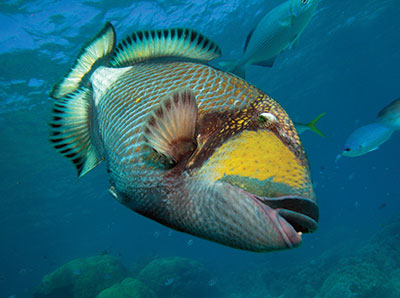
A second humuhumu aspect that points to the Creator is the adaptability of its linkage mechanisms. The humuhumu belongs to the triggerfish family Balistidae. Some triggerfish have shorter snouts with taller heads. Each variation balances pros, like increased mechanical advantage when biting, with cons, like increased drag when swimming. Such tweaks to the head shape help various triggerfish to specialize on different foods they eat. For example, the titan triggerfish Balistoides viridescens jaw is strong enough to bite through rocky coral.
One in-depth study concluded that once the first basic triggerfish evolved, the “triggerfish lineage [has] since oscillated within these morphological maximums of skull morphospace.”4 Oscillations mean that over many generations triggerfish skulls have lengthened, shortened, and then lengthened again. Because the skull adjusts with all parts in concert and without going outside lethal “maximums,” we can be confident this process happens through internal programming.
Human engineers can only dream of designing oscillating architecture. It looks like the Lord Jesus, by whose will the Balistidae “exist and were created,”5 equipped this fish kind with the ability to tweak its own irreducible four-bar architecture across generations.6
References
- Muller, M. 1996. A Novel Classification of Planar Four-Bar Linkages and Its Application to the Mechanical Analysis of Animal Systems. Philosophical Transactions of the Royal Society of London B. 351 (1340): 689–720.
- Burgess, S. 2021. A Review of Linkage Mechanisms in Animal Joints and Related Bioinspired Designs. Bioinspiration & Biomimetics. 16 (4).
- Westneat, M. W. 2004. Evolution of Levers and Linkages in the Feeding Mechanisms of Fishes. Integrative and Comparative Biology. 44 (5): 378–389.
- McCord, C. L. and M. W. Westneat. 2016. Evolutionary Patterns of Shape and Functional Diversification in the Skull and Jaw Musculature of Triggerfishes (Teleostei: Balistidae). Journal of Morphology. 277 (6): 737–752.
- Revelation 4:11.
- Like so many other creatures, triggerfish speciation likely required no mutations but instead the pre-built ability to stabilize a specific set of alleles. See Thomas, B. 2023. Trait Variation: Engineered Alleles, Yes! Random Mutations, No! Acts & Facts. 52 (11): 12–15.
* Dr. Thomas is a research scientist at the Institute for Creation Research and earned his Ph.D. in paleobiochemistry from the University of Liverpool.