by Jeffrey P. Tomkins, Ph.D., and Frank Sherwin, D.Sc. (Hon.)*
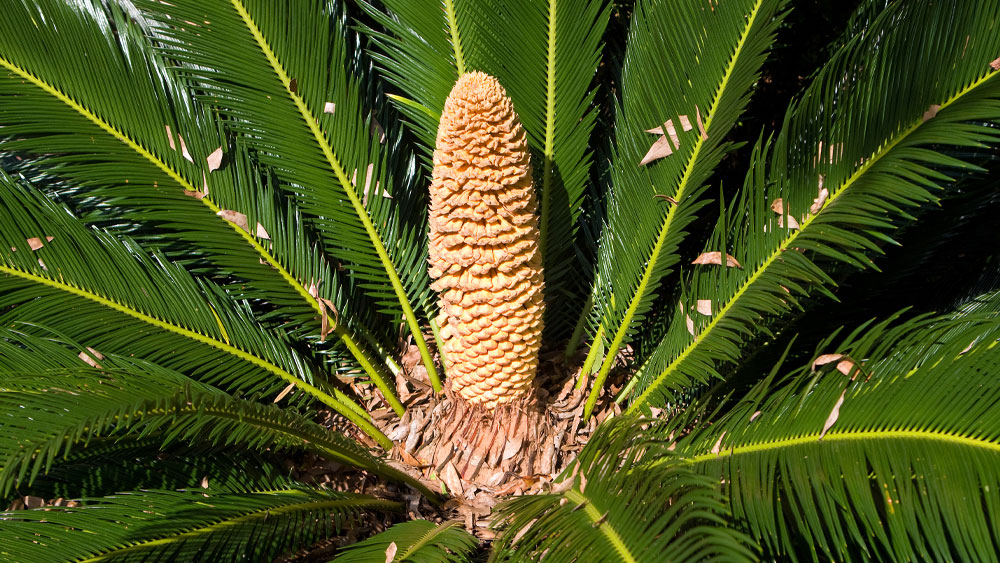
The fascinating pollination of plants has been complex from the beginning of creation. A recent article in Science magazine reported how cycads—large, palm-like seed plants—use infrared radiation as a pollination signal to beetles.1,2
The evolution-defying cycad is finely tuned to emit infrared signals in just the right plants, in the right parts of the plant, and at the right time. This is necessary because the cycad has both female and male plants. The male plants have flowers with just pollen while the female cycads have flowers with just the female parts of flower anatomy.
Therefore, the pollination must be timed perfectly so that the pollen is ready just before the female plant is fully receptive to being pollinated and fertilized. Because these plants are precisely engineered, the male cycad flowers emit infrared light for a short period of time just before the female plants are ready to be pollinated to attract beetles that store up the flowers’ pollen in their specialized body hairs. Once this process is completed, the male plants shut down their infrared flower emission, and the female plants then kick their infrared flower emission into gear. The end result is that the pollen-laden beetles switch their food-foraging efforts to the female plants, resulting in flower fertilization and more baby cycads.
But such an amazing infrared signal would be useless unless the beetle was itself designed with an apparatus that could detect such radiation. Five scientists found that the “beetle antennae contain infrared-activated neurons with thermosensitive ion channels . . . [and] are structurally tuned to match host plant thermogenesis.”2 They described this detection mechanism in the sensory organ of a beetle of the genus Melanophila.
Each sensillum [a tiny hair-like projection composed of receptor cells] contains lipid layers surrounding a protein layer and a unique polysaccharide base that is associated with a neuron to each sensillum. Infrared microscopy showed that the protein region maximally absorbs infrared radiation.3
Evolutionists maintain such an amazing process is an “early pollination signal” and an “ancient sensory channel.”4 Because these researchers are locked into this long-age evolutionary interpretation, they see this relationship between cycad and beetle in terms of deep time. Conversely, the creation model states the cycad-beetle infrared attraction in all its complexity was created in the beginning thousands of years ago.
Indeed, as far as botanists and paleontologists can determine, cycads have always reproduced by infrared signaling, and nocturnal insects (e.g., beetles) have always had the heat-sensing apparatus to pick up elevated temperatures from cycads’ reproductive structures. According to evolution, they must have evolved together, but there is no indication in the fossil record of a gradual progression of this side-by-side ancient pollination signal. In fact, there is no evidence of cycads having evolved from non-cycad ancestors.
Science writer Nell Greenfieldboyce wrote, “Fossils from over 200 million years ago, compared to cycads that exist today, show that ‘the plants look exactly the same,’ [Wendy Valencia-Montoya] says. ‘So they haven’t changed much in hundreds of millions of years.’”5 But Greenfieldboyce also wrote that cycads are “one of the most endangered plant groups.” How can that possibly be? One is expected to believe cycads survived for many millions of years on Earth through every catastrophic event one can imagine many millions of times over. But only in the past century are cycads suddenly declared an endangered species globally! In the context of deep time, this most endangered plant should have become extinct long ago, and yet it is here and doing fine.
The whole scheme of the codependent creature relationship between the beetles and cycads is precisely engineered with biological systems so fine-tuned and complex that inquiring humans are only beginning to understand them and thus publish papers like this. And more amazing discoveries will surely follow. God designed these organisms with their unique mutualism from the beginning, without using evolution or deep time. As the apostle Paul said, “Oh, the depth of the riches both of the wisdom and knowledge of God! How unsearchable are His judgments and His ways past finding out!”6 And in response, we should say along with Paul, “For of Him and through Him and to Him are all things, to whom be glory forever. Amen.”7
References
- Infrared radiation is a type of electromagnetic radiation between visible light and microwaves; common examples include TV remote controls.
- Valencia-Montoya, W. et al. 2025. Infrared Radiation Is an Ancient Pollination Signal. Science. 390 (6778): 1164–1170.
- Israelowitz, M. et al. 2011. Mechanism of Infrared Detection and Transduction by Beetle Melanophila Acuminata. Journal of Bionic Engineering. 8 (2): 129–139.
- Maroso. M. 2025. Editor’s Summary of “Infrared Radiation Is an Ancient Pollination Signal.” Science. 390 (6778): 1164–1170.
- Valencia-Montoya, W. Forget Flowers: These Ancient Plants Attract Pollinators by Getting Hot. NPR. Posted on npr.org December 11, 2025.
- Romans 11:33.
- Romans 11:34.
* Dr. Sherwin is a science news writer at the Institute for Creation Research. He earned an M.A. in invertebrate zoology from the University of Northern Colorado and received an honorary doctorate of science from Pensacola Christian College. Dr. Tomkins is a research scientist at the Institute for Creation Research and earned his doctorate in genetics from Clemson University.