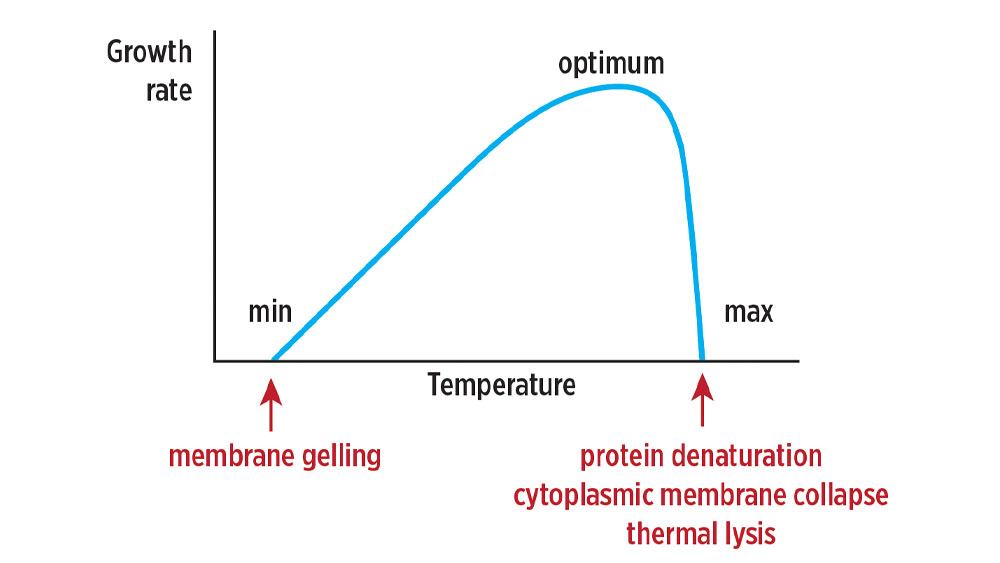
What if every living creature—from coral reefs and cold-water fish to mountain flowers and desert reptiles—followed the same hidden temperature rule? Scientists at Trinity College Dublin recently reported that all life seems to follow a single pattern called the universal thermal performance curve. This curve shows how living things react as temperatures rise and fall.1 The study, published in Proceedings of the National Academy of Sciences, found that as the environment warms, performance improves up to a limit—then quickly drops when proteins and cell membranes start to fail. Many researchers viewed this as proof of nature’s self-organizing order. But when studied closely, it points to something deeper: life’s built-in precision and the clear mark of design.
Every living cell depends on chemical reactions powered by enzymes—tiny molecular machines that fold and move with perfect timing. These enzymes make reactions happen billions of times faster than they would on their own, but they work only within a narrow temperature range. Below that range, the molecules slow down; above it, they fall apart. Across thousands of species, the study found the same pattern: steady improvement, a sharp peak, and then a fast decline.1 This kind of order does not look random. It reveals a shared plan seen throughout all living things.
At the microscopic level, this pattern depends on balanced teamwork between enzymes, membranes, and energy systems. For example, fish that live in icy water keep their cell membranes flexible with special fats, while desert plants protect proteins with natural chemical shields. Even with such differences, the overall pattern stays the same. Each organism was designed with built-in safeguards that keep its systems stable and prevent damage when conditions change. Even the smallest bacterium follows this same plan—working within limits that reveal coordination, purpose, and control. Together, these patterns across all life forms point to an underlying design filled with wisdom and intent.
ICR’s President Dr. Randy Guliuzza has explained that these repeating biological patterns show common design rather than common ancestry.2 When the same feature appears in very different creatures—like the same temperature curve seen in both microbes and mammals—it points to one intelligent Designer using consistent engineering methods throughout creation. These design limits also act like guardrails, keeping systems from breaking down. The Trinity researchers called them “shackles of evolution,” but engineers would see them as safety systems built in to protect stability and balance.3
This idea of built-in limits fits the creation model, where living things were made to adapt only within certain boundaries, not to evolve beyond them. Humanity itself reflects the imago Dei—the image of the Creator’s order and wisdom, which can also be seen throughout biology.4 The same God who gave people the ability to think and create also designed every cell to balance complexity with control.
In every pattern and measurement, science continues to uncover planning and purpose far beyond human skill. These discoveries inspire wonder more than debate, showing that the reliability of creation points back to the reliability of its Maker. As scientists find more “laws of life,” they reveal the structure that holds creation together. The order seen in biology is not an accident—it is sustained by thoughtful design. Every curve, boundary, and limit reflects a Creator who made life to thrive within His perfect plan—stable, strong, and beautifully made.
References
- Arnoldi, J.-F. et al. 2025. A Universal Thermal Performance Curve Arises in Biology and Ecology. Proceedings of the National Academy of Sciences. 122 (43): e2513099122. Posted on pnas.org October 21, 2025.
- “What Goes Up Must Come Down – Scientists Unearth ‘Universal Thermal Performance Curve’ that Shackles Evolution.” Trinity College Dublin News. Posted on tcd.ie October 21, 2025.
- Corrado, J. 2022. Imago Dei: Man’s Designed Role as Image-Bearer. Creation Science Update. Posted on ICR.org April 25, 2022.
- Guliuzza, R. 2010. Similar Features Demonstrate Common Design. Acts & Facts. 39 (11): 10–11.
* Dr. Corrado earned a Ph.D. in systems engineering from Colorado State University and a Th.M. from Liberty University. He is a freelance contributor to ICR’s Creation Science Update, works in the nuclear industry, and is a Captain in the U.S. Naval Reserve.