During the summer of 2023, members of a scientific expedition into the densely tropical Cyclops mountains in Indonesian New Guinea were shocked to discover shrimp living in trees.1 A 2021 report on land cruising shrimp in Thailand had stated, “Shrimp—unlike some crustaceans—cannot survive on land.”2 Well, that’s old news now.
The science group, named “Expedition Cyclops,” found this unique land shrimp in the soil as well as trees. Some specimens were collected hundreds of feet up the steep mountainsides. The group’s expedition website noted similarity between the newfound shrimp and a family of shrimp that inhabits seashores.3
While the expedition’s scientists do the painstaking work of sorting through and identifying all the new critters they found, one wonders how these strange shrimp manage life on land and what powers their pioneering potential.
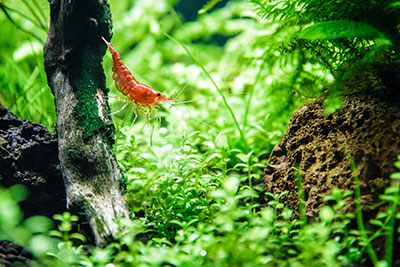
Shrimp have two features that make land life unlikely. First, and unlike insects, they lack a waxy cuticle on their exoskeletons to hold water in. As soon as their surroundings dry out, so do the shrimp. Second, water needs to be in contact with their gill tissues to allow for respiration—the exchange of the vital gases oxygen and carbon dioxide.
Apparently, the humidity along these lush slopes keeps the shrimp gills and bodies wet enough for the shrimp to live. One would also think shrimp are sitting ducks on land, but these can actually use their hind legs to jump away from predators. Now, what would compel these critters to mimic fish out of water?
Well, consider the land-traveling shrimp from Thailand that migrate at night. They can’t swim up their streams’ cascades, so they crawl up the rocks alongside them. All that risk and work is done to find a new home upstream that’s less crowded. Like those in Thailand, these Indonesian tree shrimps have also pioneered upon land.
What traits do pioneers need? First, they must have built-in sensors. They sense crowdedness and humidity, for example. Second, they would need built-in systems to interpret those inputs. Last, any creature that lacks the power to think critically, like shrimp, must have some automated activation of an appropriate response to the interpreted data.4
If further research confirms these pioneer features in shrimp and other animals, then the curious biologist would wonder where all three coordinated traits came from. Did the Lord provide for His creatures to forge ahead like this? Well, He did admonish them to “multiply, and fill the waters in the seas” (Genesis 1:22).5 Perhaps He did such a good job engineering shrimp biology that they are equipped to pioneer past the seas and into trees.
References
- Found at last: bizarre, egg-laying mammal finally rediscovered after 60 years. University of Oxford News and Events. Posted on ox.ac.uk November 10, 2023, accessed November 28, 2023.
- Hu, N. How and Why Do These Shrimp Walk on Land? The Science Survey. Posted on thesciencesurvey.com January 11, 2021, accessed November 28, 2023.
- Expedition Cyclops fact sheet. Posted on expeditioncyclps.org, accessed November 28, 2023.
- For an in-depth exploration of automated activation of appropriate action in a living thing, see: Boyle, M. J. et al. 2023. Testing the Cavefish Model: An Organism-focused theory of Biological Design. Proceedings of the Ninth International Conference on Creationism, J. H. Whitmore, ed. Cedarville, OH: Cedarville University International Conference on Creationism, 120–143.
- Guliuzza, R. 2012. Engineered Adaptability. Acts & Facts. 41 (10): 11–14.
* Dr. Brian Thomas is Research Scientist at the Institute for Creation Research and earned his Ph.D. in paleobiochemistry from the University of Liverpool.