



Archive of Articles

[stage_edit] =>
[body] =>
"And the light shineth in darkness; and
the darkness comprehended it not." (John 1:5)
Common folklore holds that petrification takes "millions and millions of years." Even though every knowledgeable scientist knows differently, this misconception continues. The great ages concept forms the backdrop for the entire evolution worldview, thus there's no desire to lessen the hold "millions and millions of years" has on the lay public. But petrification can and does happen rapidly. At least this argument can and should be removed from evolution's arsenal.
Petrification is that subset of fossilization in which the organic material is encapsulated or replaced by silica. In wood it can best be accomplished by injection of hot, silica-rich water into the wood. The silica fills in the voids left by decaying cells, or, most often, surrounds each cell with an impervious shell, halting all organic activity or decay.
Wood can be petrified in a laboratory in a very short period of time using high pressure injection. Likewise in nature many examples can be given of recent or living objects rapidly petrifying in the presence of silica and hot water. In Yellowstone National Park, hot waters percolating through volcanic ash dissolve the silica contained therein. Trees growing near the bubbling sources naturally draw the waters into their trunks. As the silica penetrates into the pores, organic activity is interrupted, and the tree eventually dies by petrification.
Many, many examples could also be given of human structures, mine timbers, bridge supports, etc., being petrified since their time of emplacement. It obviously doesn't take a long time; it takes the right conditions.
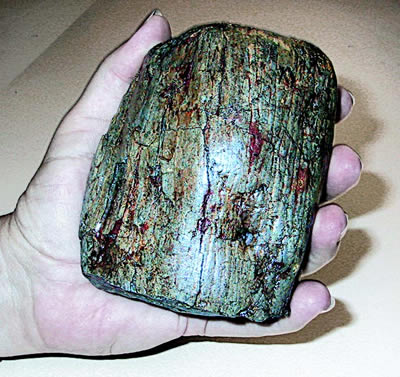
Recently, at a seminar in the state of Washington, I was given a "petrified fence post" pictured above. Subsequent analysis showed that it was definitely petrified wood, had a nail imprint and marks of a strand of barbed wire. It was found along an old fence line probably dating from the late 1800s in an area of central Washington dominated by a thick blanket of volcanic ash. All that remained of the post was a stub four inches long, three inches wide and two inches thick. It was obviously a "worked" piece of wood, for the clearly visible tree rings had been truncated. The log from which it had come was probably two feet or so in diameter, judging from the curvature of the rings.
Does it prove anything? No, not really, but maybe this report will encourage some reader to realize that these long age/evolutionary stories of "millions and millions of years" he's heard over and over again are really just myths. The Biblical truth of creation/flood/young Earth might just be right after all.
[body_edit] =>
"And the light shineth in darkness; and
the darkness comprehended it not." (John 1:5)
Common folklore holds that petrification takes "millions and millions of years." Even though every knowledgeable scientist knows differently, this misconception continues. The great ages concept forms the backdrop for the entire evolution worldview, thus there's no desire to lessen the hold "millions and millions of years" has on the lay public. But petrification can and does happen rapidly. At least this argument can and should be removed from evolution's arsenal.
Petrification is that subset of fossilization in which the organic material is encapsulated or replaced by silica. In wood it can best be accomplished by injection of hot, silica-rich water into the wood. The silica fills in the voids left by decaying cells, or, most often, surrounds each cell with an impervious shell, halting all organic activity or decay.
Wood can be petrified in a laboratory in a very short period of time using high pressure injection. Likewise in nature many examples can be given of recent or living objects rapidly petrifying in the presence of silica and hot water. In Yellowstone National Park, hot waters percolating through volcanic ash dissolve the silica contained therein. Trees growing near the bubbling sources naturally draw the waters into their trunks. As the silica penetrates into the pores, organic activity is interrupted, and the tree eventually dies by petrification.
Many, many examples could also be given of human structures, mine timbers, bridge supports, etc., being petrified since their time of emplacement. It obviously doesn't take a long time; it takes the right conditions.
Recently, at a seminar in the state of Washington, I was given a "petrified fence post" pictured above. Subsequent analysis showed that it was definitely petrified wood, had a nail imprint and marks of a strand of barbed wire. It was found along an old fence line probably dating from the late 1800s in an area of central Washington dominated by a thick blanket of volcanic ash. All that remained of the post was a stub four inches long, three inches wide and two inches thick. It was obviously a "worked" piece of wood, for the clearly visible tree rings had been truncated. The log from which it had come was probably two feet or so in diameter, judging from the curvature of the rings.
Does it prove anything? No, not really, but maybe this report will encourage some reader to realize that these long age/evolutionary stories of "millions and millions of years" he's heard over and over again are really just myths. The Biblical truth of creation/flood/young Earth might just be right after all.
[typeID] => 3
[visible] => t
[pdf] =>
[publishURL] => are-human-artifacts-ever-petrified
[publishDate] => 0000-00-00
[authorAsterisk] => f
[domainID] => 1
[publication] =>
[volume] =>
[issue] =>
[page] =>
[author] => John D. Morris, Ph.D.
)
-->


Within each separate lineage there is some variety, but separateness is the rule. There is no evidence for common ancestry. The "branches" and the "trunk" are non-existent. Rather than a continuous out-folding of new and ever more complex life, we see complexity at the start which continues into the present with some extinction along the way.
No new basic types since the start? How could anything be more embarrassing to evolution theory? The fossil record stands as stark confirmation of creation, not evolution. The only question which remains is when will this demonstrably false piece of propaganda be removed from our textbooks?
[body_edit] =>"For the wisdom of this world is foolishness with God. For it is written,
He taketh the wise in their own craftiness." (I Corinthians 3:19)You see it in every textbook dealing with evolution. There it is, a "tree" implying that life began as a single organism (which itself developed from non-living chemicals). And over time, through completely natural processes such as mutations and natural selection, it branched into the wide variety of life we see in the modern world and in the fossil record. The tree appeared in Darwin's book Origin of Species, as the only illustration. All of life has come from that common ancestor through "descent with modification" over hundreds of millions of years, until now there is a multitude of life forms, all related to one another with the common ancestor at the root of the tree. But does the evidence support this idea, or is it simply a statement of evolutionary dogma?
The evidential support for the branching tree of life certainly cannot be found in the fossil record. Experts readily admit that the fossils record a different history, but textbook writers often ignore the facts, presenting the tree as if it were a non-controversial fact. Thus students are brainwashed into believing it, and indeed that the entire evolutionary worldview has a strong root.
Rather than starting as one form (or a few) and branching into many, all knowledgeable scientists know that the fossil evidence demonstrates a sudden appearance of life in the lowest (i.e., the oldest) layer of strata containing multi-cellular fossils. Termed the "Cambrian Explosion," this layer contains well-preserved fossils of nearly every phyla (basic body type) which ever lived, from hard-shelled clams, to soft-bodied jellyfish, to now-extinct trilobites—even vertebrate fish. Extensive Cambrian layers are underlain by equally extensive and undisturbed pre-Cambrian sedimentary rock, just right for fossil preservation, but which contain only occasionally single-celled organisms, but no ancestors for any of the abundant array of complex marine creatures in the Cambrian! Some are extinct, but essentially nothing has developed ever since the start. Thus, the evolutionary tree is turned upside down.
Within each separate lineage there is some variety, but separateness is the rule. There is no evidence for common ancestry. The "branches" and the "trunk" are non-existent. Rather than a continuous out-folding of new and ever more complex life, we see complexity at the start which continues into the present with some extinction along the way.
No new basic types since the start? How could anything be more embarrassing to evolution theory? The fossil record stands as stark confirmation of creation, not evolution. The only question which remains is when will this demonstrably false piece of propaganda be removed from our textbooks?
[typeID] => 3 [visible] => t [pdf] => [publishURL] => what-grows-evolutions-tree [publishDate] => 0000-00-00 [authorAsterisk] => f [domainID] => 1 [publication] => [volume] => [issue] => [page] => [author] => John D. Morris, Ph.D. ) -->