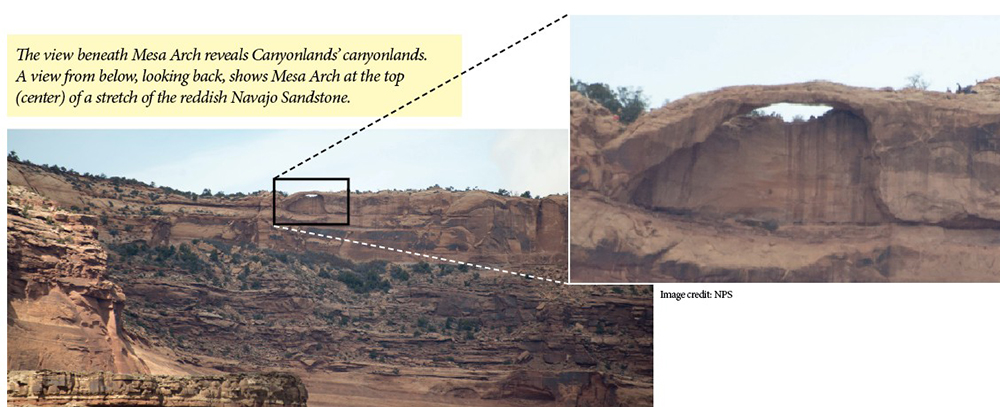
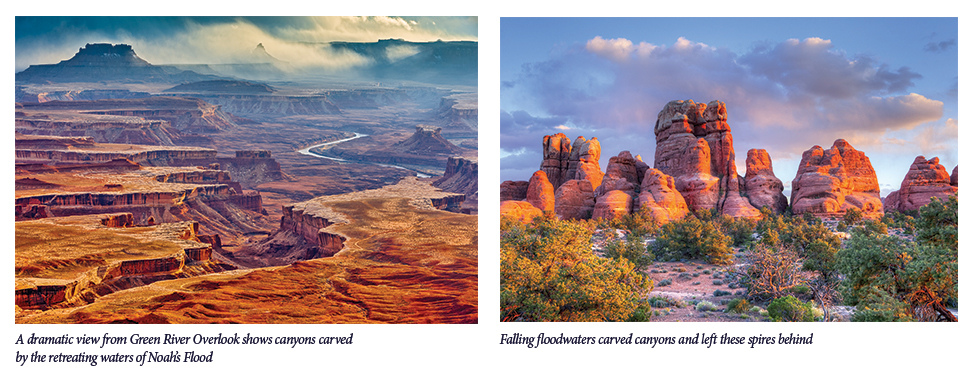
 Certain overlooks at Canyonlands National Park in eastern Utah make you wish you could soar overhead to see and explore more crannies and canyons. Visitors quickly understand why President Lyndon B. Johnson established Canyonlands as the thirty-second national park in 1964. It protects a wide stretch of impressively water-whittled earth. Today’s Colorado and Green Rivers meander between sprawling tan and red sandstones to remind its desert dwellers that water does exist. In 2 Peter 3:1–6, the apostle Peter instructs Christians to treat the Genesis creation and Flood as history.1 And visitors can get up close and personal with two reminders of these events at Canyonlands—one for each of those miraculous moments.
The Raven Kind
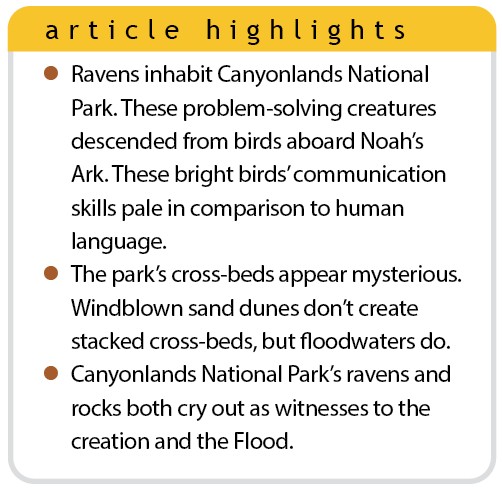
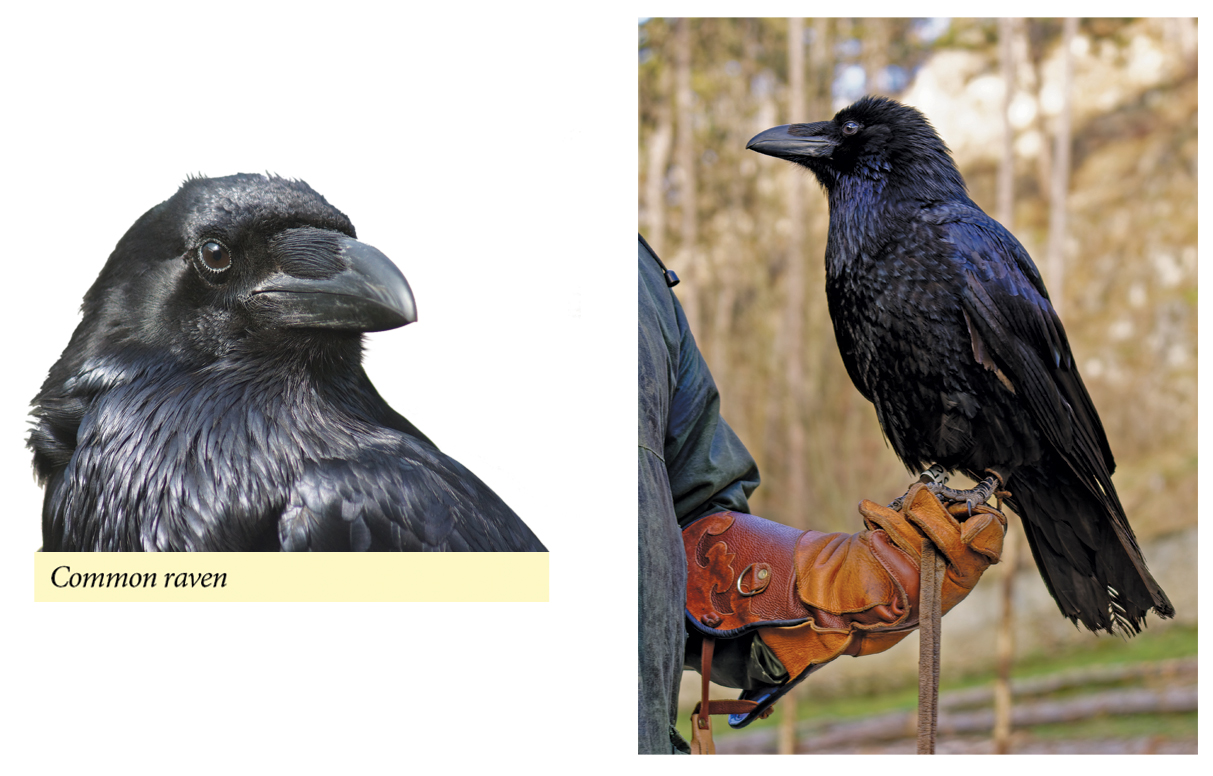
When you pull into one of the park’s parking lots, a raven may warn its faraway friends about you with its rattle-like, long-distance call. The various species of ravens and crows belong to one genus: Corvus. Scientists refer to these birds in the family Corvidae, along with other relatives including jays, magpies, rooks, and jackdaws, as corvids. All of today’s corvids likely descended from the seven pairs of this particular kind on board Noah’s Ark (Genesis 7:3).2
North American ravens are larger than crows. Ravens are the largest corvids, with some exceeding three pounds. They also have a larger beak relative to their head size. Ravens sport a fluff of throat feathers called hackles that crows don’t have. When looking up from the ground, a soaring raven’s tail feathers fan out to a diamond shape, whereas those of the crow look rounded. None of these variations gets in the way of these birds’ essential working parts. The Lord Jesus engineered corvids to diversify, fit, and fill.3
Bird Chat
Corvids are smart. Folks who own ravens often teach them to speak human words. The clever birds use their syrinx—something like a double voice box—to mimic sounds that the single voice box (larynx) makes when we humans speak. Among all animals, including dolphins and chimpanzees, ravens and certain parrots have the widest vocabularies.4 Does that mean these birds talk?
Not at all! Although animals communicate one way or another, no animal uses a language. Language is unique to humans. Languages organize symbols according to conventional rules of grammar for the purpose of conveying complete thoughts. Evolutionary biologist Leonardo Birchenall, in reviewing the top-communicating animals, acknowledged that “animals apparently do not intend to convey information to others when communicating.”5 Well, it’s good to see science catching up with the Bible, which teaches that humans are unique creations, unrelated to any animal. Some of our distinctive characteristics are faith, hope, and language. The Lord created us with everything we need to commune with Him when “God created man in His own image” (Genesis 1:27). So, hearing ravens’ clever calls can remind us of the vast gap between all animals and humans.
Pancakes Baked with Cross-Beds
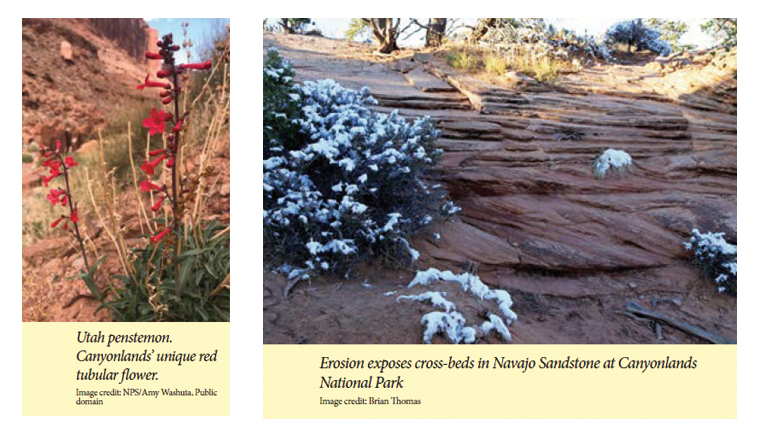
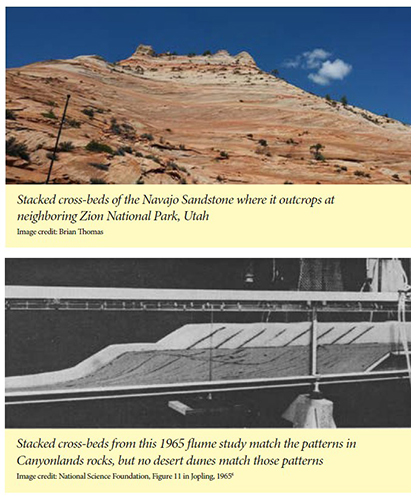 These aren’t the kind of pancakes we can eat! Canyonlands National Park has outcrops of the Navajo Sandstone, a rock formation that contains multiple layers, each one like a colossal pancake. Many of these layers preserve cross-beds. This refers to tilted layering within a flat bed. What caused the sand to get deposited at angles instead of horizontally? Even more mysteriously, what led to each layer’s flat top and the next cross-bedded layer getting stacked atop the one below?
Park signage points to ancient desert sand dunes as the cause. Today’s conventional geologists have no doubt that a series of vast deserts had sand dunes that petrified, one desert atop another, for eons to eventually form the Navajo Sandstone. Creation geologists don’t buy that story for two good reasons.
First, no desert on Earth—not even the Sahara with its enormous, migrating sand dunes—stacks up cross-bedded layers like those in the Navajo and other sandstones. These beds are flat, one atop the other. Nor do we see dunes petrify. Second, geologists were trying decades ago to decide whether water or wind put these patterns there. They did flume experiments, where a pump pushes water and sediment down a track. Water flume sediments best matched the stacked cross-beds found in real rocks.
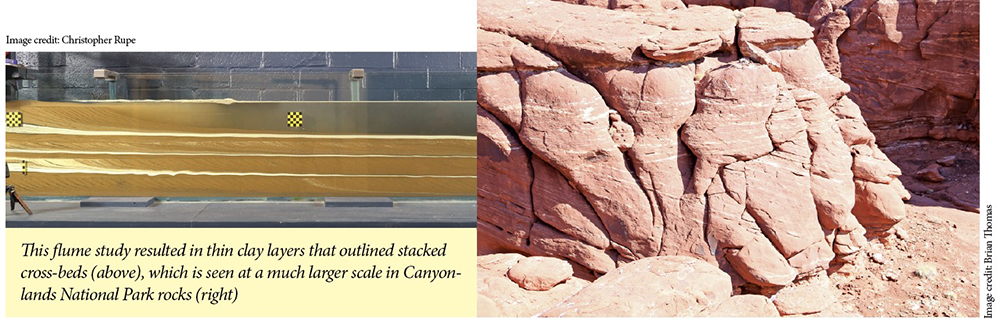
Some Navajo Sandstone cross-beds show thin, whitish clay streaks. Sedimentologist Dr. Christopher Rupe tried to replicate this in a recent but not-yet-published flume study. What a great match he found! His collaborative research verified what earlier efforts had discovered: one must raise the water level to stack a new cross-bedded layer atop an older one. What might we expect to find from the progressively rising waters of Noah’s Flood, when “the waters prevailed and greatly increased” (Genesis 7:18)? Stacked cross-beds. What difference does it make to understand these rocks had a watery, not a windy, origin? Well, it affirms the reality of Noah’s Flood, which deposited all these and similar layers across the globe in just one year only 4,500 years ago.7
Those keen to defend the two key miracles that Peter teaches Christians to believe—creation and the Flood—need look no further than Canyonlands National Park. Its top-level animal communicators fall short of uniquely human language, reminding us of the truth that God made us in His own image so we can have a relationship with Him. And its stacked cross-beds confront stories about ancient deserts with experimental results that confirm God’s Word about the Flood judgment. Peter was right on, and our culture needs his message more now than ever.8
References
- “ . . . be mindful of the words which were spoken before by the holy prophets, and of the commandment of us, the apostles of the Lord and Savior . . . that by the word of God the heavens were of old, and the earth standing out of water and in the water, by which the world that then existed perished, being flooded with water” (1 Peter 3:2–6).
- Johnson, J. J. S. and Clarey, T. L. 2021. God Floods Earth, Yet Preserves Ark-Borne Humans and Animals: Exegetical and Geological Notes on Genesis Chapter 7. Creation Research Society Quarterly. 57 (1): 248–262.
- Continuous Environmental Tracking: An Engineering-Based Biological Model. Fact sheet. Posted on ICR.org, accessed March 3, 2026.
- “In reviewing the literature, the general pattern that emerges shows that different corvid and parrot species indeed perform similarly in a range of cognitive tasks to the extent that one may call them ‘feathered apes.’” Lambert, M. S. et al. 2019. Birds of a Feather? Parrot and Corvid Cognition Compared. Behaviour. 156: 505.
- Birchenall, L. B. 2016. Animal Communication and Human Language: An Overview. International Journal of Comparative Psychology. 29: 1–27.
- Jopling, A. V. 1965. Hydraulic Factors Controlling the Shape of Laminae in Laboratory Deltas. Journal of Sedimentary Petrology. 35 (4): 777–791.
- Clarey, T. 2020. Carved in Stone: Geological Evidence of the Worldwide Flood. Dallas, TX: Institute for Creation Research.
- His argument, in essence, was that since we know that the Creator flooded the world because of wickedness, then we know He will judge the world again. Therefore, everyone should get right with God and stay right!
Dr. Thomas is a research scientist at the Institute for Creation Research and earned his Ph.D. in paleobiochemistry from the University of Liverpool.