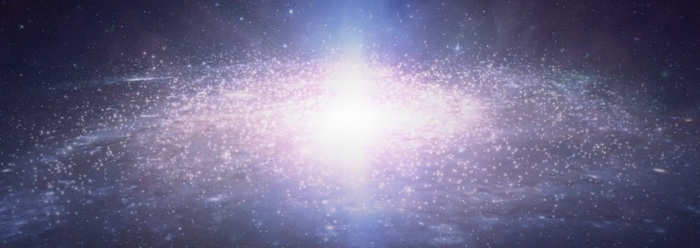
2015 was not kind to Big Bang cosmology. This popular idea holds that the universe began from a small point that exploded, accelerated, slowed, and continues to expand. All the while, random energies organized into atoms, which organized into stars, which generated other elements and coalesced into galaxies—all taking billions of years. In stark contrast, the Bible clearly says God spoke all those atoms, stars, and galaxies into existence out of no pre-existing material in a miraculous creation only several thousand years ago. News from outer space this year confronts those who assume that science backs a Big Bang history, and casts doubt on the suggestion that Genesis 1 should be understood in some way other than actual history.
New Hubble telescope images captured the "Pillars of Creation"—a feature within the Eagle Nebula—in unprecedented detail. The name comes from the belief that new stars are being created there. The Hubble satellite first imaged the nebula in 1995, but took new and improved pictures for the Hubble's 20th anniversary. The gaseous region contains young-looking stars and still-moving shockwave fronts, all of which surprised secular astronomers who expected little activity in an unimaginably ancient outer space.
Hubble's new picture revealed no new stars. In fact, no study has ever shown a single new star forming anywhere in the universe. Stars should be constantly "blinking on" somewhere out there in a Big Bang cosmos. But if God created stars, then we would expect to see basically the same stars He made in the beginning.1
In March 2014, widespread reports of gravitational waves that supposedly confirmed Big Bang cosmology delighted both secular and Christian Big Bang supporters. But the results of a more careful analysis of those observations revealed that mere dust in outer space—not the Big Bang—caused them.2 This Big Bang reversal received none of the global recognition that it deserved.
Scientists this year also discovered a ring of nine galaxies that span across an incredible distance of five billion lightyears. This gargantuan ring of galaxies is just too big for the Big Bang. Secular scientists assume that matter is distributed uniformly throughout space on cosmic scales. Lead author of the report in Monthly Notices of the Royal Astronomical Society Lajos Balázs told Space.com, "If we are right, this structure contradicts the current models of the universe. It was a huge surprise to find something this big—and we still don't quite understand how it came to exist at all."3
A separate study reached a similar conclusion. This one discovered an enormous swath in space that is sparsely populated with galaxies while the rest of the universe has plenty. What about the Big Bang assumption that matter is distributed evenly across space? Like the gargantuan ring of nine galaxies, the relatively few galaxies in this vast region of the viewable sky undermined the Big Bang in 2015.4
That same study threw an indirect wrench into the "smoking gun" for Big Bang: cosmic microwave background radiation (CMB), expressed as a temperature of space. A Big Bang would have given all of space virtually the same temperature, but this vast galaxy-poor region is also colder than the rest of the universe.
Finally, scientists developed a new cosmology that counters the Big Bang and models a universe with no beginning and no end. This illustrated that even some secular scientists are not satisfied with the standard models and continue to search for better explanations.5
Observations from 2015 revealed even more problems with already beleaguered Big Bang cosmology. But creation solves these problems. These observations confirm creation by disclosing regions and structures in space as the unique works of an artist instead of formulaic works of a chance explosion.
References
- Hebert, J. The Hubble 'Pillars of Creation' Revisited. Creation Science Update. Posted on icr.org January 19, 2015, accessed December 3, 2015.
- Hebert, J. Big Bang Evidence Retracted. Creation Science Update. Posted on icr.org February 12, 2015, accessed December 3, 2015.
- O'Neill, I. Giant Mystery Ring of Galaxies Should Not Exist. Space.com. Posted on space.com August 7, 2015, accessed December 3, 2015. Cited in Hebert, J. Giant Galaxy Ring Shouldn't Exist. Creation Science Update. Posted on icr.org August 24, 2015, accessed December 3, 2015.
- Hebert, J. A Cosmic 'Supervoid' vs. the Big Bang. Creation Science Update. Posted on icr.org May 7, 2015, accessed December 3, 2015.
- Thomas, B. Secular Study: No Big Bang? Creation Science Update. Posted on icr.org February 23, 2015, accessed December 3, 2015.
Image credit: Copyright © 2014 NASA/ESA/Hubble Heritage Team. Adapted for use in accordance with federal copyright (fair use doctrine) law. Usage by ICR does not imply endorsement of copyright holders.
*Mr. Thomas is Science Writer at the Institute for Creation Research.
Article posted on December 14, 2015.