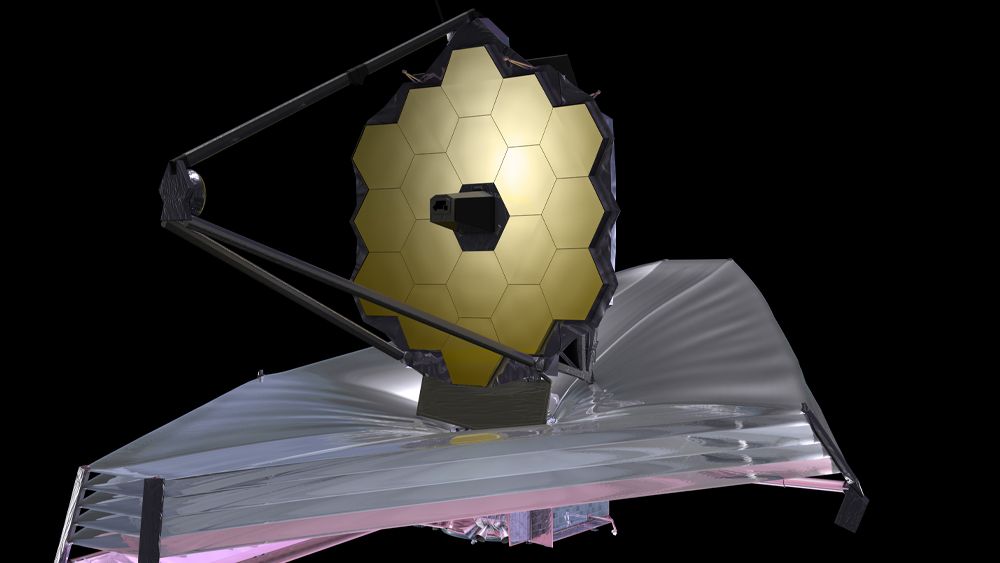
A galaxy with the designation MoM-z14 has recently been confirmed as the most distant galaxy ever detected.1,2 By Big Bang reckoning, we are seeing this galaxy as it was just 280 million years after the supposed Big Bang. This shocked conventional scientists, because slow, gradual, evolutionary processes should not have been able to form such a “remarkably luminous”2 galaxy in such a short time.
Big Bang scientists have been greatly surprised by the number of “surprisingly bright” distant galaxies revealed by the James Webb Space Telescope (JWST), which seems to be about a hundred times greater than predicted by theoretical models.1 Such data from JWST has greatly exacerbated the “mature distant galaxy problem” that has long plagued Big Bang cosmologists.3 The most distant galaxies are billions of light-years away, so Big Bang cosmologists assume that light from those galaxies took billions of years to reach Earth. Although this may seem reasonable, this assumption is open to serious challenge.4 Nevertheless, according to Big Bang cosmology, we should be seeing these very distant galaxies, not as they are now, but as they were shortly after the Big Bang. Since star and galaxy formation should take many millions of years, theorists were not expecting to see many galaxies in the “early” universe, and those that did exist were expected to be unevolved and immature. Yet data from the James Webb Space Telescope have been shattering these Big Bang expectations.5,6
The existence of these “early mature” galaxies is so surprising that astronomers designed the Mirage or Miracle (MoM) survey to test whether these galaxies really are as distant as they appear. Hence, this most distant galaxy is designated MoM-z14, with the “z14” referring to its apparent high redshift of 14. Astronomers recently confirmed that this galaxy’s very high redshift is real, and this implies that it is indeed very, very far away. This is why the title of their paper declares MoM-z14 to be a “cosmic miracle.”2 Thus, Big Bang scientists must now attempt to explain how such a bright galaxy can exist just 280 million years after the Big Bang, when until just very recently, it was mainstream dogma that the first stars—let alone galaxies—did not appear until 400 million years after the Big Bang.6
It should also be noted that MoM-z14’s nearby surroundings seem to be partly ionized, with atoms that have gained or lost electrons. Yet, virtually every Big Bang reionization model predicted very little ionization 280 million years after the Big Bang.2
Despite popular hype, the Big Bang model is in tatters, with a “growing chasm between theory and observation.”1,7 Bible-believing Christians should be encouraged by this. The existence of mature distant galaxies is better explained by biblical creation than the Big Bang, since the Lord Jesus could create whatever kind of galaxies He wished, wherever He desired. He created our universe and continues to “[uphold] all things by the word of His power” (Hebrews 1:3), and, despite the misguided assertions of some Christian apologists, He did not need the help of the Big Bang to do so!
References
- Downer, B. Webb Pushes Boundaries of Observable Universe Closer to Big Bang. Phys.org. Posted on phys.org January 28, 2026, accessed January 30, 2026.
- Naidu, R. P. et al. 2026. A Cosmic Miracle: A Remarkably Luminous Galaxy at zspec = 14.44 Confirmed with JWST. Open Journal of Astrophysics. Preprint. Posted on arxiv.org January 28, 2026, accessed January 30, 2026.
- Hebert, J. ‘Early’ Spiral Galaxy Surprise. Creation Science Update. Posted on ICR.org May 1, 2020, accessed August 22, 2022.
- Dennis, P. W. 2018. Consistent Young Earth Relativistic Cosmology. Proceedings of the International Conference on Creationism. 8: 14–35.
- Hebert, J. 2022. James Webb Telescope vs. the Big Bang. Acts & Facts. 51 (11): 14–17.
- Hebert, J. Webb Telescope Continues to Challenge Big Bang. Creation Science Update. Posted on ICR.org January 26, 2023, accessed June 6, 2025.
- Hebert, J. New York Times Editorial: Big Bang Unraveling? Creation Science Update. Posted on ICR.org September 14, 2023, accessed January 30, 2026.
* Dr. Hebert is a research scientist at the Institute for Creation Research and earned his Ph.D. in physics from the University of Texas at Dallas.