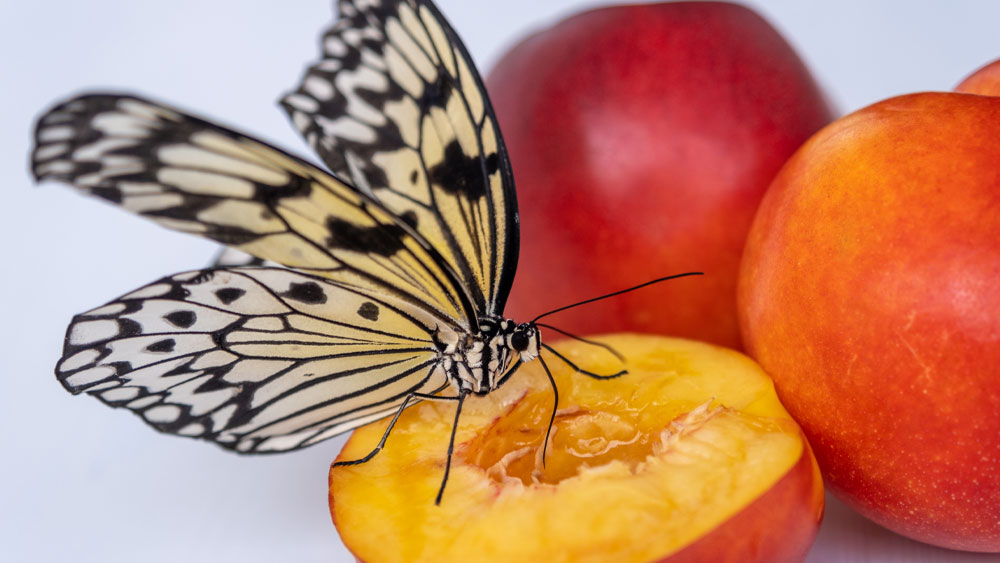
Insects such as the ubiquitous butterfly belong to the huge phylum Arthropoda (creatures having paired, jointed appendages and a chitinous exoskeleton). There is no indication this phylum evolved from some other group. Indeed, arthropods “have a rich fossil record extending to the very late Precambrian period” as arthropods.1
The fossil record confirms this, showing that butterflies (Lepidoptera) have always been butterflies; they did not evolve from anything else.3,4 As delicate as these insects are, butterfly remains (e.g., scales, wings) have been found in the sedimentary rocks.
The Journal of South American Earth Sciences has recently reported “the oldest physical evidence of butterflies or moths ever discovered”5 in preserved dung from what is now named Talampaya National Park in Argentina. The waste material—collected from “a prehistoric communal latrine”—possibly came from a hippo-sized herbivore dated by evolutionists to be 236 million years old. The latrine was dated in what evolutionists call the Triassic Period (252 to 201 million years ago), an additional 36 million years behind previous discoveries.
This amazing discovery includes “tiny wing scales trapped in fossilized dung suggest[ing] butterflies evolved long before flowers appeared.”5 It suggests nothing of the sort unless one believes that butterflies came from non-butterflies and that flowers evolved from an unknown ancestor!
Microscopic investigation of the waste material revealed tiny, hollow, decorative, and fully-formed scales that could only belong to the Lepidoptera. The scales were so unique that they were declared to have belonged to a new species: Ampatiri eloisae.
But because flowers supposedly had not evolved 236 million years ago, evolutionists must assume the butterfly proboscis—the tiny tongue-like tube used to feed from flowers—had not evolved until millions of years later.
Based on this, the researchers estimate that the proboscis may have first evolved between 260 and 244 million years ago, right after the mass extinction. That adaptation may have helped early butterflies and moths survive the harsh new world, allowing them to feed off pollination drops and setting the stage for a future partnership with blooming flowers, which wouldn’t appear until nearly 100 million years later.5 (Emphasis added)
Such a description is pure conjecture. Regardless, Lehmann stated, “In the Triassic, however, forests only consisted of conifers and cycads; flowers didn’t even exist yet.”5 In other words, they believe that for 100 million years butterflies fed off pollination drops, but when flowers evolved into existence about 250 million years ago, the butterfly’s proboscis somehow evolved into being, too. This is nothing but a just-so story.
The creation model states that God created flowers and butterflies about 6,000 years ago. Specifically, butterflies with their proboscis—created on day five—existed along with the angiosperms (flowering plants)—created on day three of the creation week.
References
- Hickman, C. et al. 2024. Integrated Principles of Zoology. New York: McGraw Hill, 414.
- Ibid, 480.
- Sherwin, F. Butterfly Evolution? Creation Science Update. Posted on ICR.org July 18, 2006.
- Tomkins, J. Butterfly Wing Design Repudiates Evolution. Creation Science Update. Posted on ICR.org February 18, 2021.
- Lehmann, J. 236-Million-Year-Old Poop Fossil Reveals a Hidden Treasure — Oldest Evidence of Butterflies. Discover Magazine. Posted on discovermagazine.com June 5, 2025.
- Grimaldi, D. and M. Engel. 2005. Evolution of the Insects. Cambridge: Cambridge University Press, 556.
* Dr. Sherwin is a science news writer at the Institute for Creation Research. He earned an M.A. in invertebrate zoology from the University of Northern Colorado and received an honorary doctorate of science from Pensacola Christian College.