Updated and modified from Guliuzza, R. J. 2016. Major Evolutionary Blunders: Evolutionists Can’t See Eye Design. Acts & Facts. 45 (10): 16–18.
 Robert H. Goddard was a visionary trailblazer in modern rocketry. He built the first liquid fuel rocket, launched the first rocket payload, and received 214 patents. NASA lauded his accomplishments: “Now known as the father of modern rocketry, Goddard’s significant achievements in rocket propulsion have contributed immensely to the scientific exploration of space.”1
Despite his impeccable scientific work, Goddard was treated shamefully by newspaper reporters who, by comparison, understood nothing about rocketry.
In 1920, the Smithsonian published his original paper, ‘A Method for Reaching Extreme Altitudes,’ in which he included a small section stressing that rockets could be used to send payloads to the Moon. Unfortunately, the press got wind of this and the next day, the New York Times wrote a scathing editorial denouncing his theories as folly. Goddard was ridiculed and made to look like a fool.1
This editorial foolishly mocked Goddard by insinuating he knew less than a high school student. These newspaper reporters were incredibly arrogant and had overestimated their own self-importance, leading them to criticize a man clearly out of their league. What do they have in common with scientists today who are writing error-laden articles ridiculing God’s engineered biology? A lot. One word sums up both: folly.
In 1920, editors failed to reign in reporters from printing opinions on space flight, about which they knew little. Similarly, books and articles by poorly informed evolutionists peddling criticisms that biological organs like the human eye are poorly designed slip through the review of evolutionary biologists today. Some include: The Not-So-Intelligent Designer by Abby Hafer, Human Errors by Nathan Lents, or astrophysicist Neil deGrasse Tyson’s “Stupid Design” argument.2 Does scientific evidence justify their assertions or expose them as unscholarly bluster about biological systems they don’t understand?
Evolutionists Play “Gotcha” with God: Human Eyes Are “Wired in Backwards”
Evolutionary biologists suppose that organisms evolved bit by bit over long ages in ruthless struggles to survive. They visualize a purposeless process where death is embraced as the means of iteratively fractioning out random genetic mistakes to build creatures. Brown University’s Kenneth Miller explained how evolutionary beliefs contrast with the position that organisms are engineered by an intelligent Creator: “Though some insist that life as we know it sprang from a Grand Designer’s Original blueprints, Biology [sic] offers new evidence that organisms were cobbled together layer upon layer by a timeless tinkerer called evolution.”3
A tinkerer would have made many mistakes—especially compared to the creations of craftsmen. Of all craftsmen, God certainly tops the list. Thus, evolutionary theory predicts organisms are poorly designed. If the biological world is riddled with flawed designs, then evolutionary biologists argue that’s powerful evidence for evolutionary tinkering, not the work of God.
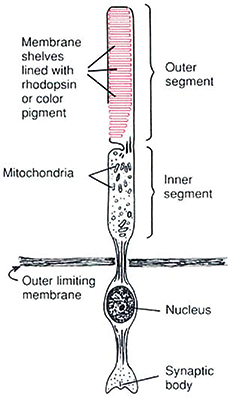
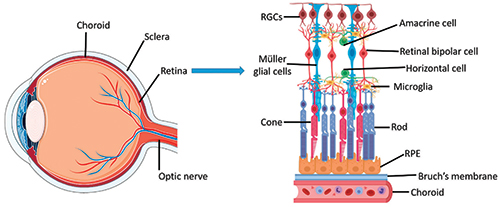
So, evolutionists determined to show that even human eyes emerged by tinkering. Cells in your eye that detect incoming light (that engineers would call photodetectors or photosensors) have photosensitive elements at one end and convey that data by a nerve fiber at the other (Figure 1). In some creatures, the photosensitive elements face incoming light, and nerves exit the back. This arrangement is called verted. Other eyes, including those belonging to vertebrates, are inverted. Here, photosensitive elements face the back, while nerves exit the front. These nerve fibers converge at some location to form the single large optic nerve; they then make a right-angle turn and exit the back of the retina (Figure 2).
Since the evolutionary theory predicts poor design in organisms, evolutionary biologists readily envision supposed design flaws in the inverted arrangement. Richard Dawkins believes anyone can simply look at an inverted retina and see that it’s obviously wired backwards. Since he undoubtedly knows some things about engineering, he believes himself skilled enough to make judgments about the bioengineering of eyes, much like how the reporters criticizing Goddard knew some things about physics. Dawkins opines,
Any engineer would naturally assume that the photocells would point towards the light, with their wires leading backwards towards the brain. He would laugh at any suggestion that the photocells might point away from the light . . . yet this is exactly what happens in all vertebrate retinas. Each photocell is, in effect, wired in backwards . . . the wire has to travel over the surface of the retina, to a point where it dives through a hole in the retina (the so-called ‘blind spot’) to join the optic nerve. This means that the light, instead of being granted an unrestricted passage to the photocells, has to pass through a forest of connecting wires, presumably suffering at least some attenuation and distortion (actually probably not much, still, it is the principle of the thing that would offend any tidy-minded engineer!).4
To Dawkins, creationists—and God—are caught in a dilemma: either God didn’t design the human eye, or He made a sloppy mistake.
“The Eye Shows Poor Design” Becomes an Evolutionary Mantra
Kenneth Miller took the baton from Dawkins, claiming, “Evolution, unlike design, works by the modification of pre-existing structures . . . [it] does not produce perfection.”3 His example? “The eye, that supposed paragon of intelligent design, is a perfect place to start.” Miller parrots Dawkins’ disapproval:
Given the basics of this wiring, how would you orient the retina with respect to the direction of light? Quite naturally, you (and any other designer) would choose the orientation that produces the highest degree of visual quality. No one, for example, would suggest that the neural wiring connections should be placed on the side that faces the light, rather than on the side away from it. Incredibly, this is exactly how the human retina is constructed.3 (emphasis in original)
The former president of the American Association for the Advancement of Science, Francis Ayala, joined the parade. For more effect, he started claiming that visual problems were caused by poor design: “Moreover, we know that some deficiencies are not just imperfections, but are outright dysfunctional, jeopardizing the very function the organ or part is supposed to serve. In the human eye, the optic nerve forms inside the eye cavity and creates a blind spot as it crosses the retina.”5 Then in a broad-brush flail against the Creator, he pronounced that “it is not only that organisms and their parts are less than perfect, but also that deficiencies and dysfunctions are pervasive, evidencing ‘incompetent’ rather than ‘intelligent’ design.”6
Joining “the eye is wired backward” chant while also mocking God was the zoologist and evolutionary biologist Dr. Abby Hafer. She claimed the human eye would deserve an “F-grade in any decent design class.”7 An increasingly vocal denigrator of real biological design is the physiologist and evolutionary biologist Dr. Nathan Lents. He summed up evolutionary biologists’ ridicule by alleging that all of “human anatomy is a clumsy hodgepodge of adaptations and maladaptations.”8
Science Literature Doesn’t Confirm Dysfunctional Eyes
But Ayala doesn’t document his claim that the human retina is dysfunctional. Nor would an online search of scientific literature show that neuroscientists are identifying any type of dysfunction. Like Dawkins, Miller honestly admits that there’s no evidence of dysfunction: “None of this should be taken to suggest that the eye functions poorly. Quite the contrary, it is a superb visual instrument that serves us exceedingly well.”3 By objective standards the eye is superb. But apparently the eye couldn’t be engineered because it’s not built the way Miller thinks it should be: “The key to the argument from design is not whether or not an organ or system works well, but whether its basic structural plan is the obvious product of design. The structural plan of the eye is not.”3
Scientific literature published concurrent with the assertions of Dawkins, Miller, Hafer, and Lents included thousands of articles describing complex biological systems, with each having multiple parts working purposefully together. In this sea of documented biological complexity and absence of documented poor performance, evolutionary biologists’ contentions of poor eye design ring hollow.
Bad Design or Optimized Design?
Simply put, if our eyes were built according to the opinions of evolutionists, we’d all be blind. There is no excuse for this blunder. When they were writing, there was abundant information about how retinal tissues marvelously address competing physical challenges to convert light fluctuations into useful information.
Engineers regularly need to satisfy numerous competing interests concurrently. A hallmark of sophisticated engineering is deriving solutions to several conflicting demands in a single optimized design.9 Dawkins and the others never discuss eye optimization. Since the performance of one particular trait isn’t maximized, then it’s irrelevant to them to investigate the entity as a whole. This practice leaves them ignorant of good reasons for design tradeoffs and keeps them from recognizing other factors that need research.
For human eyes, an inverted retina optimally balances a minimum of five major factors for the retina to work properly.10 Photosensors must be inverted and embedded in the retinal pigment epithelium (Figure 2). This vital tissue removes waste from rapidly regenerating photosensors and helps remove heat.11 Its black granule pigment stops light from scattering. The choroid’s extensive network of blood vessels supports the high metabolic needs of photosensors and functions like a car radiator to absorb additional heat.12 Researchers have known for decades that the layer of “uninsulated” nerve fibers that leave photosensors are transparent.13 In addition, retinal Müller cells conduct light from front to back like fiber optic cables. One paper described their remarkable properties to include “the increasing refractive index together with their funnel shape at nearly constant light guiding capability [which] make them ingeniously designed light collectors.”14 Thus, light-sensitive molecules detect light regardless of which way the retina is oriented.
Claims of the Eye’s Poor Design Are Spectacularly Wrong
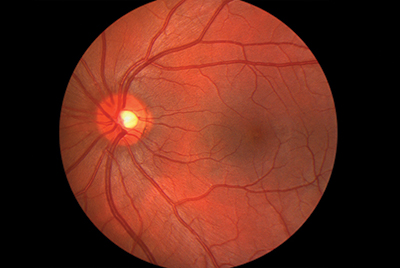
Some of the claims are just amateurish factual mistakes, like Lents’ claim that “right smack in the middle of the retina, there is a structure called the optic disc . . . this creates a blind spot in each eye.”15 First-year medical students know that what Lents said would make us mostly blind and that the optic disc isn’t “smack in the middle” of the visual axis but is offset by about 15° to the nasal side.
One neurophysicist effectively summed up how, “remarkably,” human eyes couldn’t be more sensitive to light:
“If you imagine this, it is remarkable: a photon, the smallest physical entity with quantum properties of which light consists, is interacting with a biological system consisting of billions of cells, all in a warm and wet environment,” says [Alipasha] Vaziri. “The response that the photon generates survives all the way to the level of our awareness despite the ubiquitous background noise. Any man-made detector would need to be cooled and isolated from noise to behave the same way.”16
Another research team simply concludes, “The retina is revealed as an optimal structure designed for improving the sharpness of images.”17 Extraordinary performance prompted another biophysicist to remark, “Photoreceptors operate at the outermost boundary allowed by the laws of physics, which means they are as good as they can be, period.”18
A report in 2014 about scientific evidence contradicting longstanding claims of poor eye design concludes,
Having the photoreceptors at the back of the retina is not a design constraint, it is a design feature. The idea that the vertebrate eye, like a traditional front-illuminated camera, might have been improved somehow if it had only been able to orient its wiring behind the photoreceptor layer, like a cephalopod, is folly.19
Every statement by Dawkins, Miller, Ayala, Hafer, Lents, and others that involves claims that photocells are wired backward and the eye is “outright dysfunctional” is scientifically incorrect.5 “Folly” accurately describes their blunder.19 Their mistake exceeds mere expressions of ignorance. Their folly surpasses that of the journalists criticizing the aeronautical genius of Goddard. By asserting that our eye’s design isn’t what a sensible human engineer would do, these evolutionary biologists audaciously mock God. Their smug ridicule of eye anatomy and their claims that it is Exhibit A for poor design are now embarrassingly exposed as a conceited scientific blunder.
Time and truth go hand in hand. Goddard was right, and the journalists were wrong. NASA notes that
a day after Apollo 11 set off for the Moon, in July of 1969, the New York Times printed a correction to its 1920 editorial section, stating that “it is now definitely established that a rocket can function in a vacuum as well as in an atmosphere. The Times regrets the error.”16
Though greatly belated, the Times’ humble retraction is honorable. Science shows that God is also due a retraction.
References
- Marconi, E. M. Robert Goddard: A Man and His Rocket. NASA. Posted on NASA.gov March 9, 2004, accessed July 15, 2016.
-
Hafer, A. 2016. The Not-So-Intelligent Designer: Why Evolution Explains the Human Body and Intelligent Design Does Not. Lanham, MD: Cascade Books; Lents. N. H. 2018. Human Errors: A Panorama of Our Glitches, from Pointless Bones to Broken Genes. Boston, MA: Houghton Mifflin Harcourt; TurpisHaereticus. Neil deGrasse Tyson - Stupid Design. Posted on youtube.com November 8, 2009, 4:56. https://www.youtube.com/watch?v=4238NN8H
MgQ. - Miller, K. R. 1994. Life’s Grand Design. Technology Review. 97 (2): 24–32.
- Dawkins, R. 1987. The Blind Watchmaker. New York: W. W. Norton & Co, 93.
- Ayala, F. J. 2007. Darwin’s Gift to Science and Religion. Washington, D.C.: Joseph Henry Press, 22.
- Ibid, 155.
- Hafer, 45.
- Lents, 5.
- Guliuzza, R. 2012. Clearly Seen: Constructing Solid Arguments for Design. Dallas, TX: Institute for Creation Research, 32–33.
- These are mechanisms to: (1) detect light, (2) quickly replenish that mechanism enabling extended use in large quantities of light (which tends to destroy tissue), (3) remove heat from highly metabolic processes before it destroys protein function, (4) remove heat from light focused on the retina, and (5) prevent reflecting light inside the eye after passing through photosensors.
- Anderson, D. H., S. K. Fisher, and R. H. Steinberg. 1978. Mammalian Cones: Disc Shedding, Phagocytosis and Renewal. Investigative Ophthalmology and Visual Science. 17 (2): 117–133.
- Parver, L. M., C. R. Auker, and D. O. Carpenter. 1983. Choroidal Blood Flow: III. Reflexive Control in Human Eyes. Archives of Ophthalmology. 101 (10): 1604–1606.
- Hamilton, H. S. 1985. The Retina of the Eye—An Evolutionary Roadblock. Creation Research Society Quarterly. 22 (2): 59–64.
- Franze, K. et al. 2007. Müller Cells Are Living Optical Fibers in the Vertebrate Retina. Proceedings of the National Academy of Science. 104 (20): 8287–8292.
- Lents, 81.
- Study Suggests Humans Can Detect Even the Smallest Units of Light. Rockefeller University news release. Posted on newswire.rockefeller.edu July 20, 2016, accessed July 21, 2016.
- Labin, A. M. and E. N. Ribak. 2010. Retinal Glial Cells Enhance Human Vision Acuity. Physical Review Letters. 104 (15): 158102.
- Angier, N. Seeing the Natural World With a Physicist’s Lens. New York Times. Posted on nytimes.com November 1, 2010, accessed July 26, 2012. For the extended quote, see Thomas, B. Eye Optimization in Creation. Creation Science Update. Posted on ICR.org November 23, 2010.
- Hewitt, J. Fiber Optic Light Pipes in the Retina Do Much More Than Simple Image Transfer. Phys.org. Posted on phys.org July 21, 2014, accessed July 21 2016.
Dr. Guliuzza is the president of the Institute for Creation Research. He earned his doctor of medicine from the University of Minnesota, his master of public health from Harvard University, and received an honorary doctor of divinity from Southern California Seminary. He served in the U.S. Air Force as 28th Bomb Wing flight surgeon and chief of aerospace medicine. Dr. Guliuzza is also a registered professional engineer and holds a B.A. in theology from Moody Bible Institute.