 In 2004, the paleontological community—and the world—was presented with what many evolutionists considered to be a dyed-in-the-wool missing link between fish and land animals (tetrapods). Evolutionary biologist Neil Shubin and evolutionary paleontologists Edward Daeschler and Farish Jenkins found an incomplete fossil of a creature called Tiktaalik on Ellesmere Island in northern Canada.1 The specimen was supposedly 375 to 383 million years old (Devonian layers). Since then over 60 Tiktaalik specimens have been discovered.
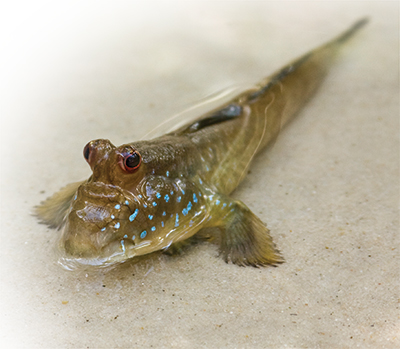
Tiktaalik is a unique lobe-finned fish designed with gills, fin rays, and fishy body scales. But could it “walk” on land? Since it’s extinct, paleontologists can only speculate that it might have pushed itself up onto land like mudskippers do with their fins today. But like Elpistostege watsoni (an extinct lobe-finned fish), creationists believe Tiktaalik was simply a fish uniquely designed to live in shallow water near the edge of the sea.
The Tiktaalik missing link celebration was short-lived. Much to the dismay of the evolutionary community, a 2010 study in the journal Nature examined fossil track evidence that tetrapods were walking on open ground “397 million years ago” in what is now Poland.2 This date is about 18 million years before the appearance of Tiktaalik based on the evolutionary narrative and so is much earlier than expected.
The paleontologists concluded these Polish trackways “force a radical reassessment of the timing, ecology and environmental setting of the fish-tetrapod transition, as well as the completeness of the body fossil record.”2 But whatever made the tracks in Poland doesn’t look transitional because it was walking with stout legs. How could fully formed land walkers have evolved from lobe-finned fish if they were walking around millions of years before the fishes’ ancestors were alive?
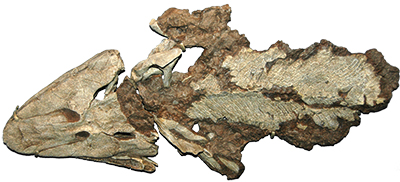
In 2014, evolutionary science writer Colin Schultz stated that Tiktaalik had “mobile rear fins,” not legs.3 In addition, a diagram of the fossilized pelvis—while elaborate and enlarged—clearly shows that it’s not attached to the spinal column as one would expect with a true tetrapod.4
The late evolutionary paleontologist Jennifer Clack said, “The paired fins of Tiktaalik still retain fin rays: Loss of fin rays is part of the way in which limbs are distinguished from fins.”5 It’s no wonder biochemist Michael Denton said, “The gap between the tetrapod limb and the fin remains.”6 In 2024, Hickman et al. said, “evolutionary relationships of early tetrapod groups [e.g., Tiktaalik] remain controversial.”7
Now a finding in Australia has only compounded the problem.
The origin of reptiles on Earth has been pushed back by an astonishing 40 million years. Fossilized tracks unearthed in Australia provide compelling evidence that reptilelike animals existed far earlier than previously thought.8
This caused evolutionary paleontologist John Long to say, “The implications of this discovery for the early evolution of tetrapods are profound.”8
Evolutionary theory states lobe-finned fish came out of the shallow sea 420 to 360 million years ago, with amniotes and amphibians separating about 355 million years ago. This Australian slab of reptile-like animal tracks, dated to between 359 and 350 million years ago, challenges the widely accepted tetrapod crown group and amniote crown group timeline.9 Conventional research claims that tetrapods were walking on open ground 397 million years ago,2 but Tiktaalik didn’t appear until around 18 million years after that! Clearly, Tiktaalik was a non-player in this evolutionary saga.
Tiktaalik needs to be removed from textbooks and museum displays where it’s currently crowned as a creature with key transitional features. The evolutionary history of fish sprouting limbs and walking onto dry land is back to square one. In the meantime, the Genesis account of creation stands.
So God created great sea creatures and every living thing that moves, with which the waters abounded, according to their kind….And God made the beast of the earth according to its kind, cattle according to its kind, and everything that creeps on the earth according to its kind. And God saw that it was good. (Genesis 1:21, 25)
References
- Their report was published in Daeschler, E. B., N. H. Shubin, and F. A. Jenkins Jr. 2006. A Devonian Tetrapod-Like Fish and the Evolution of the Tetrapod Body Plan. Nature. 440 (7085): 757–763.
- Niedzwiedzki, G. et al. 2010. Tetrapod Trackways from the Early Middle Devonian Period of Poland. Nature. 463 (7277): 43–48.
- Schultz, C. Ancient Walking Fish May Have Walked on All Fours. Smithsonian Magazine. Posted on smithsonianmag.com January 14, 2014.
- Shubin, N. H., E.B. Daeschler, and F. A. Jenkins Jr. 2014. Pelvic Girdle and Fin of Tiktaalik roseae. Proceedings of the National Academy of Sciences. 111 (3): 893–899.
- Clack, J. A. 2009. The Fish-Tetrapod Transition: New Fossils and Interpretations. Evolution: Education and Outreach. 2 (2): 213–223.
- Denton, M. 2016. Evolution: Still a Theory in Crisis. Seattle, WA: Discovery Institute Press, 159.
- Hickman, C. et al. 2024. Integrated Principles of Zoology. New York, NY: McGraw Hill, 557.
- Fossil Tracks Show Reptiles Appeared on Earth up to 40 Million Years Earlier. Flinders University. Posted on sciencedaily.com May 14, 2025.
- Long, J. et al. 2025. Earliest Amniote Tracks Recalibrate the Timeline of Tetrapod Evolution. Nature. 641 (8065): 1193–1200.
Stage image: Illustration of Tiktaalik emerging from the water
Stage image credit: Zina Deretsky, National Science Foundation, Public domain. Used in accordance with federal copyright (fair use doctrine) law. Usage by ICR does not imply endorsement of copyright holder.
Dr. Sherwin is a science news writer at the Institute for Creation Research. He earned an M.A. in invertebrate zoology from the University of Northern Colorado and received an honorary doctorate of science from Pensacola Christian College.