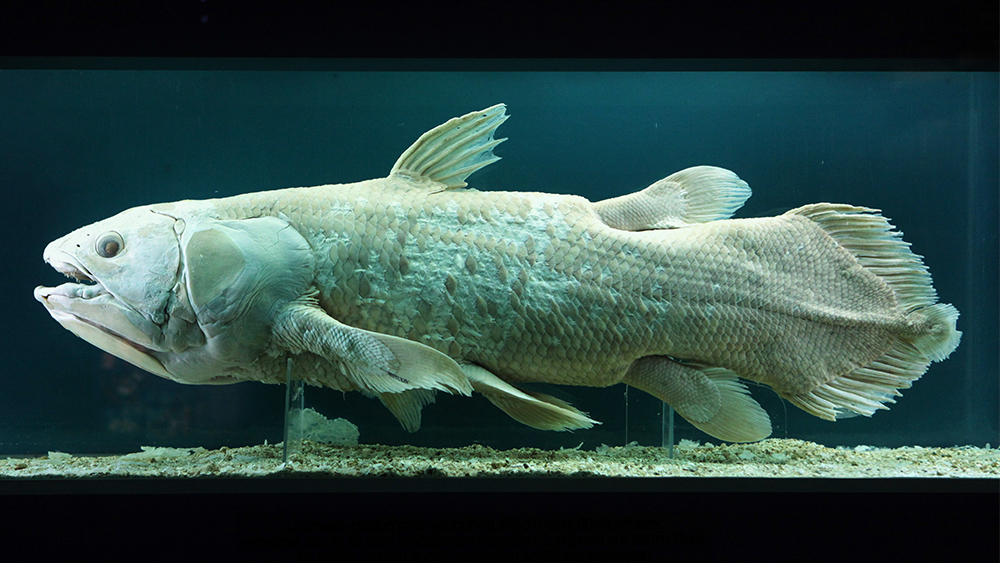
The bizarre lobe-finned coelacanth (Latimeria chalumnae) “that flourished some 350 million years ago”1 continues to be a thorn in the evolutionists’ side. Paleontologists can only say these amazing fish evolved from a vague, unidentified “Sarcopterygian ancestor.”2 Creationists say they have always been coelacanths since their creation thousands of years ago.
Recently, this living fossil3,4 “has been photographed in Indonesia[n] [waters] for the first time.”5 Indeed, in past decades, Indonesia has become a focal point of coelacanth sightings. In 1997, marine biologist Mark Erdmann was walking through an outdoor market in North Sulawesi, Indonesia, when he spied a coelacanth on display. A year later, another one was caught in Indonesian waters, leading ichthyologists to name these as a new species: Latimeria menadoensis.6
Science writer Goldberg reported,
The Indonesian coelacanth (Latimeria menadoensis), once considered extinct for 70 million years, was photographed in the Maluku Archipelago, Indonesia, and marks the first time the coelacanth species has been caught on camera in Indonesian waters. The rare fish was spotted by divers searching approximately 475 feet below the ocean's surface.5
Perhaps the biggest jaw-dropping statement in Goldberg’s article is, “Coelacanths are highly sensitive to their environment, so the exact location of [undersea photographer Alexis] Chappuis’ discovery will remain confidential until further environmental protections are in place.”5
Not only are these living fossils sensitive to their environment, but they are highly sensitive. So sensitive that conventional scientists believe there should be environmental protections for this very delicate species. But if they really are as sensitive as claimed by the evolutionary community, how have coelacanths been able to survive for the last 415 million years? This necessarily means they have been successfully enduring extreme instabilities of every sort (underwater volcanoes, anoxic events, violent deep-sea tectonic activity, dead zones, marine heat waves, habitat destruction, parasites, predation by sharks, and more), all without any environmental protections! Instead, could it be a small population of coelacanths has survived in their deep-water habitat since the Flood 4,500 years ago?
You rule the raging of the sea; when its waves rise, You still them.7
References
- Hickman, C. et al. 2024. Integrated Principles of Zoology. New York, NY: McGraw Hill, 542.
- Hickman, Figure 25.1.
- Thomas, B. Should We Drop the Term ‘Living Fossil’? Creation Science Update. Posted on ICR.org July 18, 2016.
- Sherwin, F. Yet Another Living Fossil Found. Creation Science Update. Posted on ICR.org December 12, 2022.
- Goldberg, M. ‘Living Fossil’ Fish Species Once Thought Extinct for 70 Million Years Photographed in Rare Sighting. Yahoo! News. Posted on yahoo.com May 2, 2025.
- DeSmit, O. Fish Story: How a Coelacanth Discovery Set Off a Flurry of Science, Subterfuge. Conservation International. Posted on conservation.org January 16, 2019.
- Psalm 89:9.
* Dr. Sherwin is a science news writer at the Institute for Creation Research. He earned an M.A. in invertebrate zoology from the University of Northern Colorado and received an honorary doctorate of science from Pensacola Christian College.