 Radiocarbon (C-14) keeps popping up in the wrong places. Carbon-dating labs have struggled to find ancient samples with zero radiocarbon levels. C-14 has turned up in coal, natural gas, and fossils. Naturalists believe all these specimens are many times older than radiocarbon can theoretically last, which is fewer than 100,000 carbon years.
In contrast, biblical scientists believe Noah’s Flood deposited these materials thousands, not millions, of years ago. A colleague and I expected to find radiocarbon in similarly old samples, and we did.1 Dinosaur and fish bones, wood, shell, and diamonds have detectable C-14.
Each of these measurements poses a dilemma for deep-time defenders. Logically, they must either reject their millions-of-years age assignments or claim that something is wrong with the measurements—for example, modern contamination. Secular experts argued in 2018 that those who report radiocarbon in coal and diamonds—without referencing ICR’s RATE results, their obvious target2—misunderstand background measurements for the instruments used in carbon dating.3 Dr. Vernon Cupps and I refuted their arguments in a 2019 technical article.4 Here are some highlights.
Measurements compare unknown samples with background samples. A perfect background sample has every component of the unknown sample except the one being measured—in this case, C-14. Levels of radiocarbon in materials such as diamonds are very close to the low levels found in background samples. The 2018 authors insisted that enough modern radiocarbon lurks in the lab, plus a few other places, to account for the low amounts measured in materials like diamonds.
But did they use lab measurements to back that assertion? No, they used circular reasoning in place of good measurement science. They argued that because background samples are millions of years old, they have no radiocarbon left in them. Therefore, any C-14 detected in an unknown sample of great age had to come from some place other than the sample.
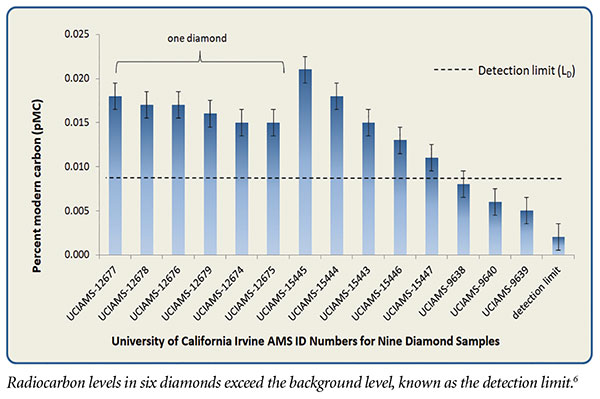 Ironically, their own results refuted this logic. The same experts had measured C-14 in their own diamond samples.5 We compared their results to a standard background C-14 level, shown in the figure. Their 95% confidence error bars show C-14 above the background. Instead of reporting 99% confidence that their diamonds had more radiocarbon than the background, they said their C-14 came from lab contamination. Could it?
Background samples already account for lab contamination. Thus, the team bears two burdens of proof: 1) They need to show that in-lab C-14 can elevate levels high enough above the background to match the levels they found in their diamonds. 2) They need to show that lab contamination affects only the unknown samples and not background samples. Meanwhile, the reason Earth materials look thousands of years old is because they are thousands of years old!
References
- Thomas, B. and V. Nelson. 2015. Radiocarbon in Dinosaur and Other Fossils. Creation Research Society Quarterly. 51 (4): 299-311.
- Baumgardner, J. 2005. Carbon-14 Evidence for a Recent Global Flood and a Young Earth. In Radioisotopes and the Age of the Earth: Results of a Young-Earth Creationist Research Initiative. L. Vardiman et al, eds. San Diego, CA: Institute for Creation Research and Chino Valley, AZ: Creation Research Society, 587-630.
- Taylor, R. E., J. R. Southon, and G. M. Santos. 2018. Misunderstandings Concerning the Significance of AMS Background 14C Measurements. Radiocarbon. 60 (3): 727-749.
- Cupps, V. R. and B. Thomas. 2019. Deep Time Philosophy Impacts Radiocarbon Measurements. Creation Research Society Quarterly. 55 (4): 212-222.
- Taylor, R. E. and J. R. Southon. 2007. Use of natural diamonds to monitor 14C AMS instrument backgrounds. Nuclear Instruments and Methods in Physics Research B. 259: 282-287.
- Cupps and Thomas, Deep Time Philosophy Impacts Radiocarbon Measurements, 219. Data from Taylor and Southon, 2007.
* Dr. Thomas is Research Associate at the Institute for Creation Research and earned his Ph.D. in paleobiochemistry from the University of Liverpool.