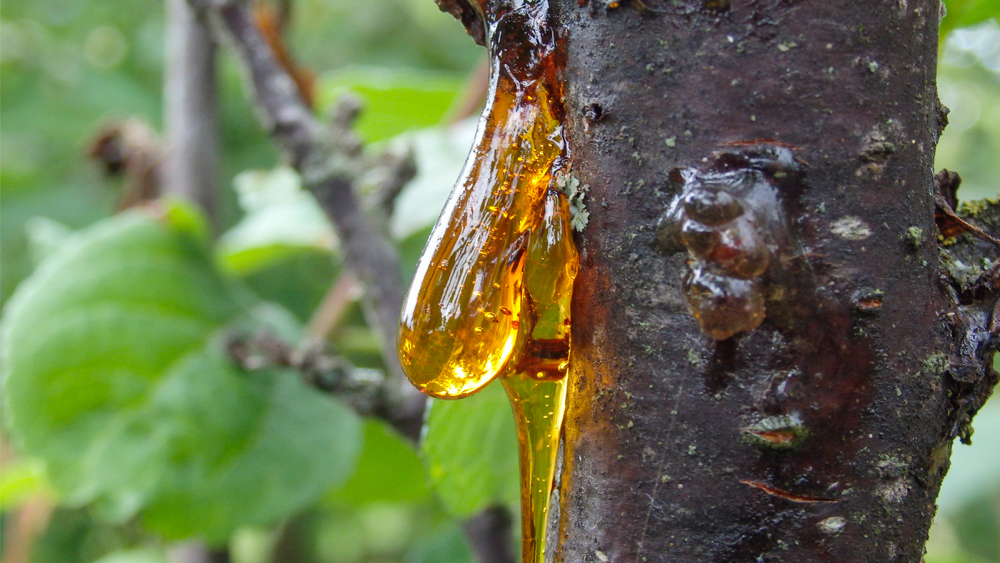
A recent study published in Scientific Reports found strange globs of tree resin (amber) mixed within claimed ancient (Cretaceous) deep-water sediments on Hokkaido Island in northern Japan.1 This is the first reported instance of amber in what’s interpreted as a deep ocean setting.
The research team, led by Aya Kubota from the Research Institute for Geo-Resources and Environment and on faculty at Chuo University, Tokyo, found amber in 30 separate layers with thicknesses varying from 0.75–106 inches within sandstone.1 Most of the amber was highly deformed and the sediments it was mixed with showed signs of soft-sediment deformation, including sand injections and flow and slump structures.1 These features are indicative of rapid deposition.
But these sedimentary rocks contain more than amber. The researchers found abundant plant debris, including pieces of large tree trunks, some longer than four feet, mixed into the layers.1 The tree trunks showed no sign of erosion from transport or borings from shallow marine organisms, indicating they moved fast out to the deep water and were quickly buried.1
Other researchers have found that amber exposed to air hardens and dries in about a week, but amber under water generally stays soft for a considerable period.2 The strangely deformed nature of the amber found at this location indicates it was quickly transported out to deep water, remaining soft while being interned in the sedimentary succession.
The authors wrote, “Abundant amber in the pelagic [deep-water] settings reported here implies the existence of exceptional sedimentary processes,”1 adding, “The novel perspective of resin as a soft-sediment constrains its transportation process, which cannot be recorded directly from clastic/carbonate sediments, and reveals the large-scale paleo-tsunamis archived in deep pelagic sea settings.”1 In other words, it requires large tsunamis to transport amber and tree pieces so far out to sea.
Moreover, the science team concluded that a series of tsunamis were responsible for the “weird” deposit, offering a seven-part model as an explanation:
(1) the occurrence of major earthquakes and tsunamis; (2) the complete destruction of forested coastal settings, (3) the discharge of a large amount of plant debris, fresh resin, and siliciclastic sediments into the ocean, (4) direct delivery to the deep sea floor by tsunami-induced turbidity currents; while simultaneously, (5) wood and resin drifted on the sea surface, which (6) later sank to seafloors; and finally (7) repetition of such tsunami events.1
Flood geologists have a similar but better explanation. ICR scientists have developed a progressive Flood model, where sea level rose for 150 days during the Flood year about 4,500 years ago. The amber and tree pieces found in Japan were deposited as the Flood was nearing its high water point at the top of the Zuni Megasequence, close to day 150 of the Flood.3
Many thousands of massive tsunamis were generated by rapid movement of the tectonic plates that spread across the continents.3 This better accounts for the massive and repetitive tsunami events. And this model also explains the soft sediment deformation that is observed because there was so little time between each successive tsunami.
As tsunami waves crashed across the land, they tore the trees from the ground, breaking them and releasing the amber. Then, the amber and tree pieces were rapidly transported and mixed in with other deep-water sediments carried inland by the tsunamis. It’s likely these amber deposits were never truly carried out to the deep sea. That’s why we find them on the island of Hokkaido today. No up-and-down or yo-yoing of the land is needed in this explanation.
Accepting the Flood as a real historical event allows a much-improved interpretation of the data, one unhindered by uniformitarian thought. It explains why there were so many closely-spaced destructive tsunamis, the presence of deep-water sediments on land, and the presence of the amber and tree fragments. God left unambiguous evidence of His judgment in the sediments for the world to see.
References
- Kubota, A. et al. 2025. Amber in the Cretaceous Deep Sea Deposits Reveals Large-Scale Tsunamis. Scientific Reports. 15, article 14298.
- Schmidt, A. R. and D. L. Dilcher. 2007. Aquatic Organisms as Amber Inclusions and Examples from a Modern Swamp Forest. PNAS USA. 104 (42): 16581–16585.
- Clarey, T. 2020. Carved in Stone: Geological Evidence of the Worldwide Flood. Institute for Creation Research: Dallas, TX.
* Dr. Clarey is the director of research at the Institute for Creation Research and earned his doctorate in geology from Western Michigan University.