


Marine invertebrate animals (jellyfish, crabs, snails, etc.) thrive within our global ocean, the largest habitable space on Earth. Their adult forms are commonly found on or within seafloor (benthic) habitats worldwide, from intertidal zones to the deepest plains and trenches that have been explored. It is estimated that these creatures account for more than 92% of marine animal diversity across all major ocean basins.1 The discovery of such a broad variety and distribution is no mystery: “God blessed them, saying, ‘Be fruitful and multiply, and fill the waters in the seas’” (Genesis 1:22a). In fact, there is ample evidence that many of the adult marine invertebrate forms originally created are still thriving within the world’s ocean today, having endured the Genesis Flood.
However, the key to their broad diversity and worldwide distribution isn’t due to the adult stages we are most familiar with but the complex life history patterns described within almost every marine invertebrate phylum (animals with similar body plans). Among the current list of 35 recognized phyla,2 60% have free-swimming larval stages. And within one of the most diversified subgroups of animals (Spiralia), unique larval stages have been identified in ~75% of those phyla.3 So just what are life history patterns? What is a larval stage? Are larval forms essential to the command to multiply and fill the seas on our planet?
All multicellular organisms (e.g., fungi, plants, animals) have a life history that includes a pattern of morphological changes during their lifetime. Life history patterns may vary, but they all begin at fertilization and extend from early development through growth, maturation, and death. Within the life history of some marine invertebrates, early development proceeds directly from an embryo to a juvenile. However, indirect development includes one or more distinct larval stages and is the most common developmental pattern among invertebrate animals.3
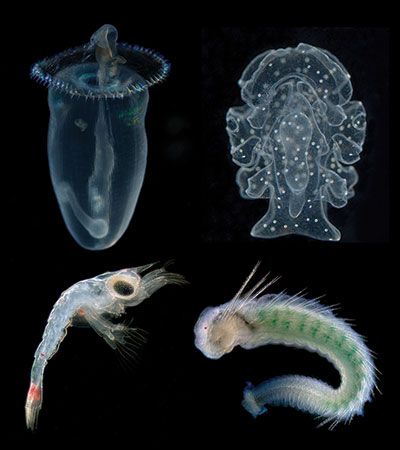
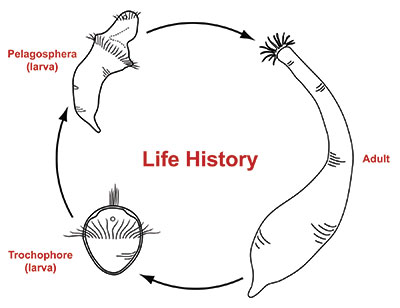
Within modes of indirect development, larvae are typically nonfeeding (lecithotrophic, feeding on yolk) or feeding (planktotrophic, feeding on plankton). With few exceptions, indirect development progresses through embryonic, larval, and metamorphic stages before reaching the final adult form (Figure 1). In almost every example, these larvae are microscopic, possess bands or fields of cilia (tiny hair-like structures) for limited swimming, and are dispersed by water currents. Therefore, larvae are distinct in form and function from adult stages, and they occupy different environmental conditions, including open water, surface currents, and sunlight.4
Several centuries of larval collection and research within polar, temperate, tropical, and deep-sea environments have revealed that larval stages are often the most critical for the continuation of marine invertebrate species. Larvae are essential for finding new food resources, establishing new populations, and maintaining genetic conductivity among existing populations.5,6 So the motile larval stage carries within itself the next generation of adults. Hence, adults with limited mobility disperse and connect with remote populations through larvae with potentially unlimited mobility. The distribution of adult marine species through the development and dispersal of larval stages is thus effective in ensuring “fruitful” sharing of DNA (genomes) within the ocean.
Far-Wandering Larvae
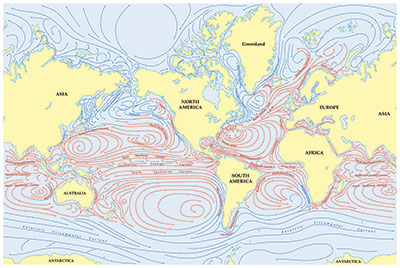
One of the most wondrous accounts of marine larval transport includes the teleplanic larvae (teleplanos, far-wandering) of the open ocean (Figure 2). Far offshore, there are innumerable invertebrate larvae adrift within oceanic currents of Atlantic, Pacific, and Indian Ocean basins (Figure 3). As with other larvae, teleplanic forms develop from embryos within coastal habitats and exhibit “little resemblance in form and behavior” to their adult stages.7
As teleplanic and other invertebrate larvae ascend through the water column, tides, waves and nearshore currents carry them offshore. Away from land, they are transported over long distances by powerful ocean currents that can extend hundreds to thousands of miles along continents or between hemispheres as equatorial currents and countercurrents.
Global Oceanic Transport
Once captured within major ocean currents (e.g., Gulf Stream, North Atlantic Current), larvae adjust to the open ocean far above the seafloor. There, sediment-born chemicals would not be detected to initiate a response for settlement and metamorphosis.4 The larvae retain the ability to settle while passively drifting thousands of feet above the sediments, sometimes delaying metamorphosis for many months.7 In this way they’re adaptive and appear as though they were designed to ensure wide distribution of their respective species or created kinds.
Ocean currents also exhibit evidence of intentional and purposeful design to help marine invertebrates fill the earth (Psalm 8:8). Collectively, there is an interconnected global network of both surface and deep ocean currents spanning every major region of the world’s oceans (Figure 3). Minor currents extend from the larger network toward seas and island chains (archipelagos) and along the intricate shorelines of embayments, channels, inlets, and estuaries that interface with land. Thus, a multitude of oceanic currents and coastal waterways disperse planktonic larvae across ~71% of Earth’s surface. That same network eventually facilitates larval settlement upon all seafloor habitats, from polar seas to the tropics and from rocky intertidal zones to abyssal plains.
Invertebrates Confirm the Genesis Flood
Turning back to Genesis, a major question remains unanswered: Are there definitive similarities between today’s global marine biome and the pre-Flood world? Throughout the global record of Flood sediments, fossilized remnants of marine invertebrates extend from the bottom layer (e.g., Cambrian) to the upper Flood boundary upon the continents—even in rocks that contain dinosaurs. Clearly, seawater covered this planet above the highest mountains in existence at the peak of the Flood (Genesis 7:11–12; 19–20). And upon careful review of both written and online global paleontological records (paleobiodb. org), we now find that marine invertebrates were as diverse and abundant before the Flood as they are today, more than 4,300 years later. We also find further confirmation of the Lord’s judgement upon beasts, creeping things, and the fowls of the air (Genesis 6:7). Accordingly, the diversity of fossilized creatures provides unambiguous testimony that the Noachian Flood was a global catastrophe!
As to the question above, the answer is yes. The diverse kinds of marine invertebrates in the pre-Flood world were highly similar in their body plans to living representatives that we observe in the post-Flood world. The purpose of their creation should not be underestimated. They are instrumental in species connectivity, play vital roles in global marine food webs, provide services as ecosystem engineers of marine habitats, and are delicacies for human nutrition. Even more importantly, these amazing invertebrate creatures are essential test pilots for biomedical research on human disease and health issues on a global scale. And without their irreplaceable larval forms, the earth’s oceans would be significantly impaired. By design, the Lord created myriad larval forms to “fill the waters” and transfer their unique genomic instructions to each subsequent generation while the earth remains (Genesis 8:22).
References
- Chen, E. S. 2021. Often Overlooked: Understanding and Meeting the Current Challenges of Marine Invertebrate Conservation. Frontiers in Marine Science. 8 (690704).
- Giribet, G. and G. D. Edgecombe. 2020. The Invertebrate Tree of Life. Princeton, NJ: Princeton University Press.
- Boyle, M. J. 2025. Origins and Diversification of Marine Invertebrate Larvae. In Atlas of Marine Invertebrate Larvae. M. J. Boyle, C. M. Young, and M. A. Sewell, eds. Cambridge, MA: Academic Press.
- Young, C. M., M. A. Sewell, and M. J. Boyle. 2025. Fundamentals of Larval Biology. In Atlas of Marine Invertebrate Larvae. M. J. Boyle, C. M. Young, and M. A. Sewell, eds. Cambridge, MA: Academic Press.
- Scheltema, R. S. 1986. On Dispersal and Planktonic Larvae of Benthic Invertebrates: An Eclectic Overview and Summary of Problems. Bulletin of Marine Science. 39 (2): 290–322.
- Scheltema, R. S. 1971. Larval Dispersal as a Means of Genetic Exchange between Geographically Separated Populations of Shallow-Water Benthic Marine Gastropods. The Biological Bulletin. 140: 284–322.
- Rice, M. E. 1981. Larvae Adrift: Patterns and Problems in Life Histories of Sipunculans. American Zoologist. 21 (3): 605–619.
* Dr. Boyle is a research scientist at the Institute for Creation Research and earned his Ph.D. in zoology from University of Hawaii at Manoa.