Drs. Michael Boyle, Tim Clarey, Randy Guliuzza, Frank Sherwin (Hon.), Brian Thomas, Jeff Tomkins, and I represented ICR at the 2025 Creation Research Society (CRS) meeting in July. One hundred ninety people attended the meeting at Missouri Baptist University in St. Louis. With the exception of the Creation Science Fellowship in the UK, the CRS, founded in 1963, is the world’s oldest creationist organization.
Preconference astronomy, biology, and geology workshops were held Thursday afternoon, with an opening reception Thursday evening. The geology workshop was led by ICR’s Dr. Tim Clarey and Davis J. Werner.
Friday morning, I was privileged to give the first plenary talk, highlighting evidence of extreme longevity in fossil animals, which is consistent with the extreme human lifespans recorded in Genesis 5 and 11.
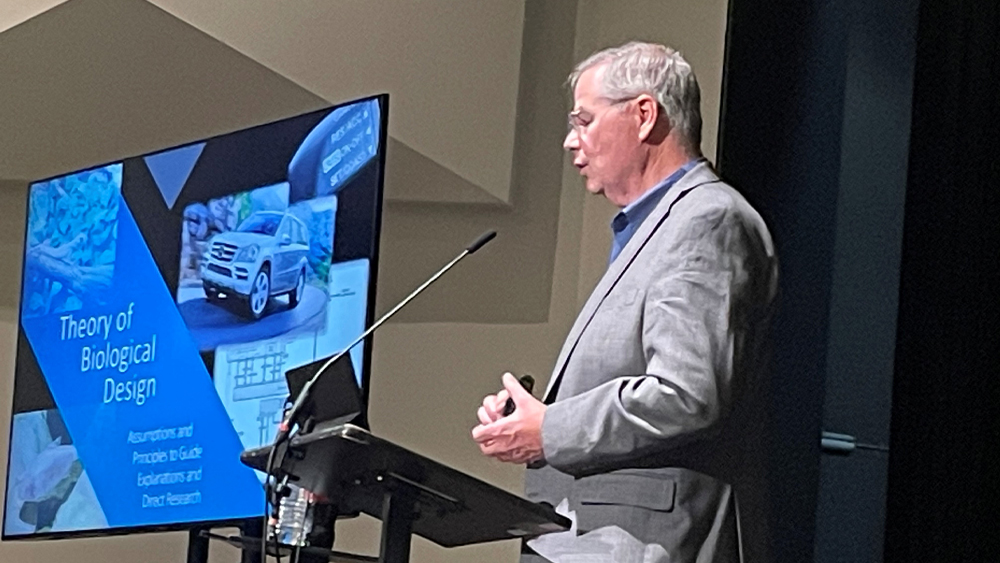
Following my talk, Dr. Michael Boyle presented new and ongoing ICR research on the Mexican tetra (blind cavefish), and ICR President Dr. Randy Guliuzza discussed the importance of applying engineering principles to ICR’s organism-focused theory of biological design. Dr. Frank Sherwin discussed possible examples of continuous environmental tracking (CET) in flatworms, and Dr. Jeff Tomkins refuted the evolutionary claim that human chromosome 2 resulted from the fusion of two small chimp-like chromosomes. Somewhat surprisingly, some creationists had criticized Dr. Tomkins’ work in this area as well as his debunking of the frequent claim that human and chimp DNA are 98–99% similar. However, a recent paper in Nature grudgingly acknowledged that the true similarity is at best 85%,1,2 just as Dr. Tomkins’ results revealed long ago. We were pleased to see recognition of this verification of Dr. Tomkins’ work.3
Saturday morning Dr. Joseph Deweese of Freed-Hardeman University gave the second plenary talk, discussing refinement of DNA extraction protocols in hopes of extracting DNA from “ancient” fossils. Successful and confirmed extraction of DNA from a fossil purportedly millions of years old would be devastating evidence that the conventional ages assigned to these fossils are greatly inflated, since DNA under reasonable conditions cannot survive even 10,000 years, let alone millions.
Dr. Tim Clarey discussed his megasequence research across Australia, New Guinea, and New Zealand, and Dr. Brian Thomas discussed how higher ambient temperatures can accelerate collagen decay in dinosaur fossils.
Other talks included discussion of thicknesses of volcanic ash layers in the deep Antarctic ice cores, which could provide evidence against “millions of years”; high-resolution computer modeling of tsunami transport and deposition of sediments during the Genesis Flood; soft tissue preservation/ancient DNA extraction; the modeling of a fire suppression system after the bombardier beetle; and sophisticated computer modeling of a steam jet above a spreading center during the Genesis Flood. Such steam jets have been suggested as a source for the Flood’s torrential rain.
Friday evening, Bill Hoesch (Mount St. Helens Creation Center) shared his memories of ICR and CRS founder Dr. Henry M. Morris in the Henry M. Morris Memorial Lecture. On a personal note, Mr. Hoesch played a significant role in my own journey as a creation scientist—he wisely advised me during a 1994 visit to ICR to get the highest degree in science that I could. As always, this event was open to the general public.
Many thanks to the CRS Conference committee and staff, especially staff members Diane Anderson and Dr. Joel Brown for all their hard work in making this year’s CRS meeting a success!
References
- Yoo, D. et al. 2025. Complete Sequencing of Ape Genomes. Nature. 641 (8062): 401–418. See Tables III.19 and III.20 (pp. 33–36) in the supplementary material for this open access paper.
- Tomkins, J. P. Chimp Genome Markedly Different from Human. Creation Science Update. Posted on ICR.org May 29, 2025, accessed August 5, 2025.
- Carter, R. Humans and chimpanzees are NOT 99% identical. Posted on creation.com July 3, 2025, accessed August 5, 2025.
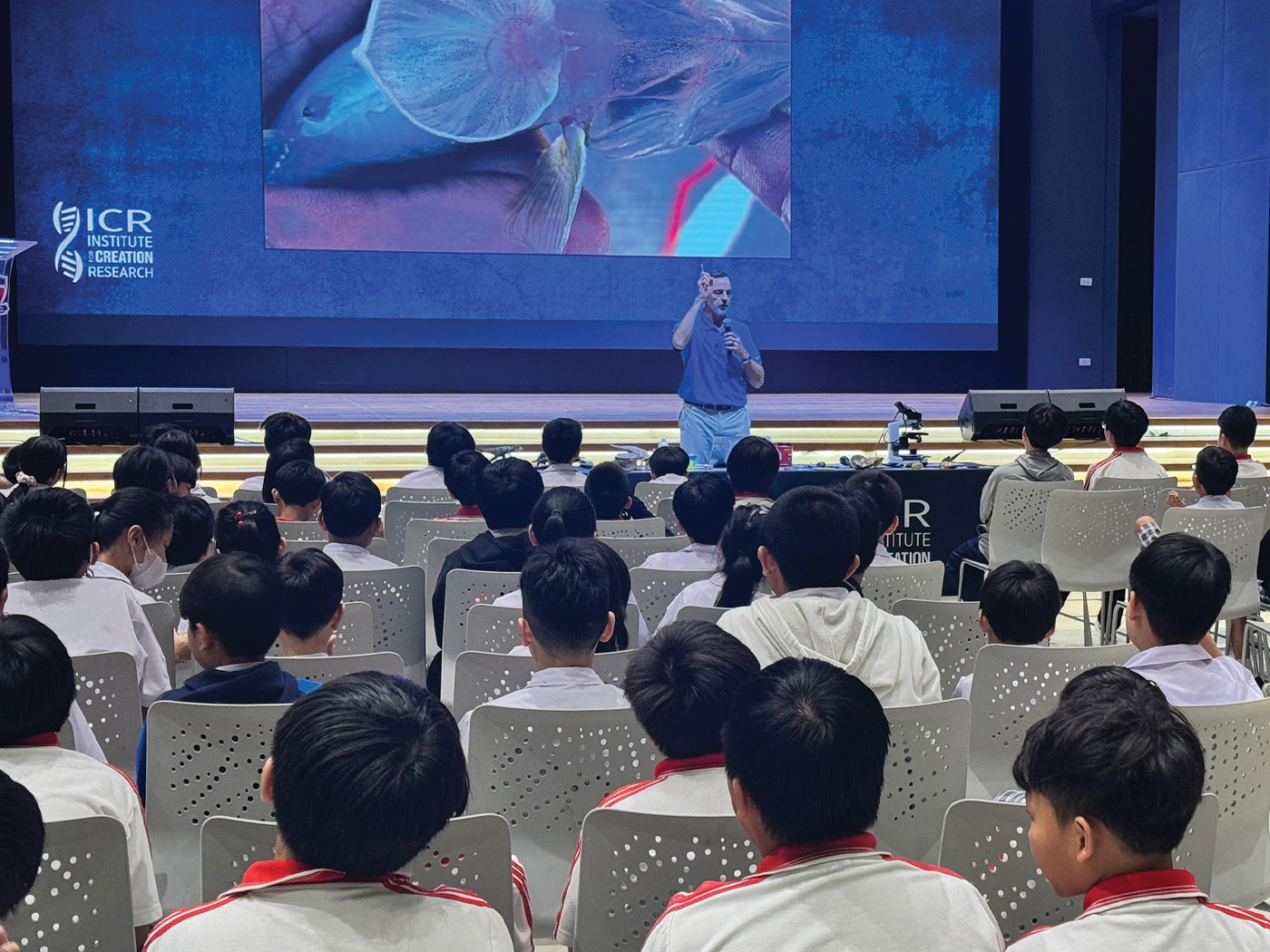
Stage image: ICR President Dr. Randy Guliuzza speaks at CRS
Stage image credit: Jake Hebert
* Dr. Jake Hebert is a Research Scientist at the Institute for Creation Research and earned his Ph.D. in physics from the University of Texas at Dallas.