 If an acquaintance at your church asked you to accompany them to share the gospel with a coworker who’d expressed deep guilt for his sins, would you go? All Christians should jump at that chance. Let’s say you go. Russ, your acquaintance, shares the gospel. The coworker expresses a desire to believe in Jesus but throughout the conversation voices skepticism about some Christian beliefs. What are your thoughts as Russ addresses these concerns?
The coworker is first concerned about communion. He thinks it is creepy for Christians to commemorate the beaten body and blood of another person. Russ says that Christians have varying beliefs about communion. Because it’s just a remembrance of Jesus, there’s no need to participate. Anytime we remember Jesus, we’re actually partaking in communion. He adds that the coworker needn’t worry about attending church if he is disinclined since Jesus is with all believers when they’re spiritually united in thought about Him.
 The next objection is accepting that the whole Bible is inspired by God. Russ responds that even theologians hold differing opinions about what inspiration actually means and what parts of the Bible it applies to. He assures the coworker that some Christians believe that inspiration only applies to what a person learns as they read the Bible—not to the Bible itself. He says that some Bible commentators don’t believe the Bible is God’s actual words. So, if the coworker doesn’t want to accept that the Bible is inspired, then he is in good company.
The coworker then has a real hang up that Jesus will literally return to Earth in the future. Russ answers that Christians of good will differ greatly in their views on Christ’s return. These extreme differences suggest that Bible passages about Jesus’ return are more likely using didactic figurative language. Thus, the coworker doesn’t need to believe that Jesus will actually come back since it’s the Christians themselves that constitute Christ’s body. As long as Christians are on Earth in the future, then Jesus will be manifest there as well.
Finally, of course, the coworker expresses abhorrence about hell being a real place of eternal punishment. Once again, Russ expounds that numerous Christians have historically expressed various opinions on the nature of hell. He tells the coworker to not get worked up over the extreme view of God’s holiness. Those beliefs persist as an invention of uptight early church fathers taking Jesus’ words way too literally. Today’s extrabiblical resources now give scholars a better picture of a tolerant God. Hell is a metaphor depicting the unfulfilled feelings of unbelievers living in the lonely state of unforgiven sins—not a literal place. In the end all unbelievers will just cease to exist since the Bible says that when God casts death and hell into the lake of fire, both will be annihilated.
 Russ’s clarifications satisfy the coworker. He acknowledges that he is a sinner needing forgiveness. He confesses his new belief that Jesus died for his sins according to the Scriptures, was buried, and rose again from the dead as full payment for his sins. Russ assures him that by truly believing in Jesus, he will never perish but have eternal life. Then the meeting ends.
Hmm. I wonder what most Bible-believing Christians and pastors would be thinking through that experience. Perhaps riding back with Russ, they may express astonishment that core evangelical beliefs were swept aside just to make it easy for someone to believe the gospel.
If so, then they’d better be ready for a reply from many evangelical “Russes” today who will likely enumerate why their approach is best and why everything Russ said to the coworker was true. Perhaps their reasoning would be something like the following:
- Christian theologians do hold contrary views about every topic of concern that the coworker brought up.
- Any need for deeper insights on those topics is a sanctification—not a salvation—issue.
- As an evangelical Christian, do you really insist that a person believe in communion, church attendance, biblical inspiration, Christ’s return to Earth, God’s absolute holiness, or eternal, conscience torment in a literal hell to be saved?
- Biblical truths related to salvation are primary. The rest are secondary issues.
- After becoming a Christian, the coworker will find it much easier to get along with the widest number of Christians if he distinguishes the important primary issues from insignificant secondary doctrines. Vital church unity will be better cultivated. Besides, isn’t it true that today many evangelical pastors themselves also sweep aside biblical teachings once thought to be clearly understood for both the gospel’s sake and peace within their church?
You may be wondering how you’d respond. What may consume your attention is the disturbingly cavalier disregard for basic doctrines. In the rest of this article, we’ll see how this is only a nasty symptom of an underlying disease. The sinister root of the issue is a haughty approach to the Bible that subordinates its clear teaching to human thinking. We’ll learn how Christians begin to develop this attitude and will address two common responses ICR receives for pushing back against this proud approach to Scripture.
Disbelieving God’s Word Is Sinful: Pride Strikes at Biblical Authority
What needs to be addressed right at the outset of this discussion is why the approach to the Bible held by the well-meaning Russ (that fostered his unbiblical interpretations) is so detestable. Biblical authority is the recognition that the Bible is the only total source of truth and is the standard to determine the truthfulness of all other sources of information and correctness of behaviors. Biblical authority rests on the pillars of belief that biblical teaching can be clearly understood, all the Bible’s original words are verbally inspired by God, it’s true about everything it talks about, and it has been supernaturally preserved.1 Thus, biblical authority carries the imperative that all of its teachings are to be believed, obeyed, and—most importantly—used as the ultimate source of truth for a believer.
Training people from the outset that they’re free to disbelieve their Bible or, based on “science,” to pick and choose which passages to accept undercuts biblical authority. It causes severe, long-term damage to any Christian and to the church. Setting the stage for a new believer to have little regard for the authority of the Bible is a type of Christian malpractice. It corrodes the necessary, biblical steps to becoming a disciple of Jesus and can raise questions in the minds of converts (recognizing that nobody can see another person’s heart) about the reality of their new birth. Damage to new believers can be irreparable.
Over the last 2,000 years, individuals have personally placed the Bible’s authority under the pronouncements of religious authority figures, philosophers, or political leaders. Science is today’s deified fount of truth that tolerates no challenges—especially from biblical authority. People must “obey the science” because it’s claimed to be the measure of all rational thought. Never mind that many scientists’ pronouncements are factually wrong or are merely religious statements masquerading as science. Nothing seems to be more frightening for many Christians, particularly their leaders, than to be labeled a science denier.
“Must Someone Believe in Creation to Be Saved?”
ICR scientists hear this question a lot when advocating for a plain reading of Genesis. This salvation-related question is usually just a smokescreen. What often emerges from further discussion is a deeper fear that drives their real underlying question: “Given that science shows Genesis is wrong, is there a way I can make the doctrine of creation an unimportant issue so that I don’t have to engage in this embarrassing topic?” This is how many Christians think of the doctrine of creation along with other challenging biblical teachings like a literal hell or Jesus being the only way to heaven. To justify this path of thinking, many Christians ask a simple question: is the doctrine of creation a salvation issue? If yes, then it’s important. If no, then it’s unimportant and is promptly classified as a secondary issue.
 In light of this reasoning, if creation is not a salvific issue and is therefore unimportant, do Christians need to care about ICR’s message? Many say no. They think that Christians can sincerely hold different opinions about Genesis. Thus, ICR’s message is only divisive. But ICR’s scientists recognize that our message is important because Genesis is foundational to many key Christian doctrines.
Creationists should always keep in mind the really crucial question: is the Bible’s criteria for what’s important limited to salvation issues? Many Christians say yes. Why? The primary mission of the church is to preach the gospel so people can get saved and go to heaven. A second principle mission of the church is to preserve Christian unity. But ICR’s scientists understand that the primary mission of the church does not stop at preaching the gospel. It extends to making disciples of Jesus (Matthew 28:19–20). Thus, all of the Bible’s truths are important. Non-salvific issues and importance are not mutually exclusive. Cultivating belief in and obedience to the whole Bible, beginning with salvation, is foundational to being Jesus’ disciple.
“Are You Saying That They’re Not Saved?”
This question points out that, just like Russ in the story, leaders of numerous Christian apologetics organizations devise interpretations of Genesis to dodge the straightforward reading of the Bible. It also once again intends to use salvation to discriminate between important and unimportant biblical truths. Not being God, we don’t take the bait to unwisely question anyone’s salvation.
ICR scientists endeavor to teach biblical truth. We seek to address the major error of someone claiming authority to consign Bible passages as secondary issues or label them “mythohistory” because the normal understanding of those Scriptures conflicts with the accepted science of the day. Some biblical truth bears on this topic.
“All Scripture is given by inspiration of God,
and is profitable for doctrine, for reproof, for correction,
for instruction in righteousness.” (2 Timothy 3:16)
Without a doubt, Romans 14:1–15:7 teaches that there truly are man-made secondary issues, and this text outlines our behavior toward one another in light of them. Galatians also denounces human-derived legalistic counterfeits to true doctrine. Given that these beliefs derive from our unseen enemy, it’s no surprise that near-mandatory acceptance of these human-generated practices are often included in the false gospel message of those who adhere to them.
For Christians trying to distinguish between the important and unimportant biblical truths, consider 2 Timothy 3:16: “All Scripture is given by inspiration of God, and is profitable for doctrine, for reproof, for correction, for instruction in righteousness.” It’s easy to zero in on the inspiration portion, but let’s not overlook the words germane to our discussion, “all Scripture . . . is profitable.”
These passages raise another rhetorical question: how many Christians have been delegated the authority to determine which biblical truths are important? The take-home message from Scripture is that if the meaning of a biblical text is clearly understandable, then it’s important.
The fact is that many of the truths that Christians hold dear as we grow in Christ aren’t often discussed when presenting the gospel. As someone grows in the grace and knowledge of Jesus, foolish thinking and confusion are replaced with truth, assuming they believe and submit to the authority of God’s Word. Similarly, I see mature Christians, in an effort to be an iron sharpening iron, passionately but lovingly contend about the meaning or application of a passage totally unrelated to salvation. Both kinds of believers care deeply enough to disagree about a text—not discard it—because they believe that all of the Bible is important.
Conclusion: Why ICR?
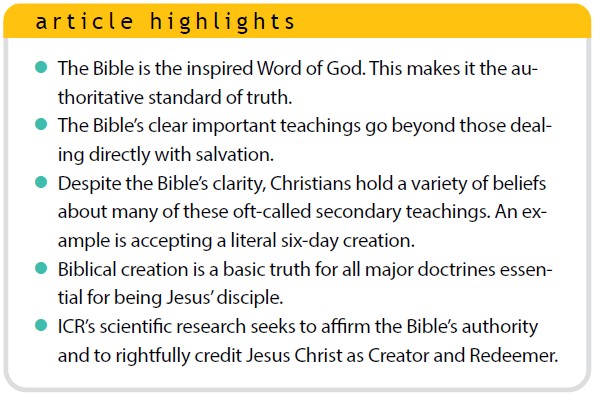
ICR’s scientists have always been biblical creationists. We exist to do scientific research, but not just to show that God exists. Research is coupled with faithful exposition of the Bible to affirm its authority as the standard of truth, rightfully credit the Lord Jesus as Creator, and make disciples that follow Jesus as Savior and Lord.

Starting with Adam, it has always been sinful to disbelieve God’s Word and worse to supersede its authority by subordinating its truth to any other source. Big Bang cosmology, geological uniformitarianism, and Darwinian selectionism express human thinking specifically crafted to be anti-theistic, antibiblical, and idolatrous. It’s futile to try to reconcile the Bible to this world’s thinking. All attempts to do so reveal a pride striking at biblical authority when Christians twist Scripture or disregard passages as secondarily unimportant.
When asked “Is belief in creation necessary for salvation,” I used to simply answer no. But I now respond differently. Today’s more informed answer is: “Though belief in creation isn’t necessary for salvation, that does not mean it is unimportant. The Bible does not set the criteria for ‘important teachings’ as only those dealing with salvation. All clear truths are important, yet many don’t touch on salvation. Biblical creation is the basic truth for all major Christian doctrines essential for being a Bible-believing disciple of Jesus.”
Reference
- Why list biblical clarity (i.e., perspicuity) ahead of inspiration? If people really cannot understand what the Bible means, or if the Bible’s words don’t really mean what they say (which some apologetics organizations claim), then how is an inspired—but unintelligible—Bible relevant? In addition, the doctrine of inspiration is a self-certifying biblical claim, i.e., the Bible claims to be God’s Word. This first assumes that people can understand what the words “all scripture is given by inspiration” mean (2 Timothy 3:16).
Dr. Guliuzza is the president of the Institute for Creation Research. He earned his doctor of medicine from the University of Minnesota, his master of public health from Harvard University, and received an honorary doctor of divinity from Southern California Seminary. He served in the U.S. Air Force as 28th Bomb Wing flight surgeon and chief of aerospace medicine. Dr. Guliuzza is also a registered professional engineer and holds a B.A. in theology from Moody Bible Institute.