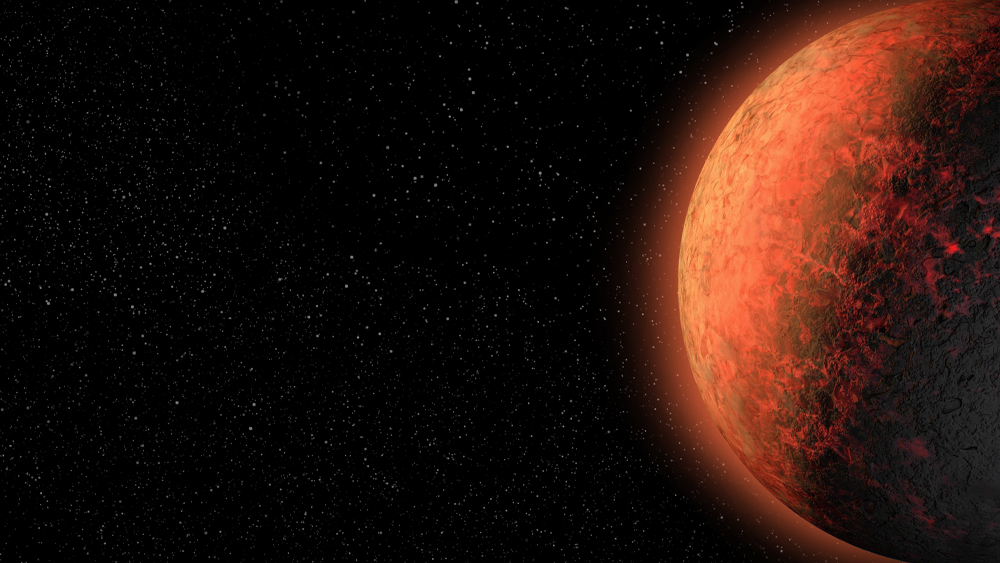
Astronomers have discovered an earth-sized exoplanet, designated TOI-2431 b, that is so close to its host star that it completes a full orbit in just 5 hours and 22 minutes.1,2 Or, to put it another way, this planet’s year is less than six hours long! Astronomers designate exoplanets having orbital periods less than one Earth day long as ultra-short period (USP) exoplanets. Out of the approximately 6,000 known exoplanets, about 150 are confirmed USPs, and TOI-2431 b has one of the shortest of all USP periods.1,2
The intense heat received by TO1-2431 b as it orbits so closely to its host star probably means that its surface is molten lava.1 The planet is experiencing strong gravitational tugs that are noticeably deforming its shape. These tugs are also causing its orbit to decay. Eventually, these tugs will be strong enough to tear the planet apart. TOI-2431 b is “circling the drain,” both literally and figuratively. Conventional astronomers estimate that the time for this to happen is approximately 31 million years. As a science news article noted, “That’s perilously close to destruction, in astronomical terms, where 31 million years is only a tiny fraction of Earth’s 4.5-billion-year lifespan.”1
It is for this very reason that conventional astronomers have repeatedly expressed surprise that we have been “lucky” enough to observe multiple exoplanets teetering, so to speak, so close to their eventual destruction.3–5 In a universe that is supposedly billions of years old, what are the odds that humans, who have only had the technology to discover these exoplanets for a few decades, would be fortunate enough to observe not just one but multiple such planets presently in the process of being destroyed? Some are hot gas giants that are rapidly losing their atmospheres6 and “shouldn’t exist” after billions of years.7 Others are rocky bodies so close to their host stars that their rocky crusts are literally being vaporized by the intense heat.3,8 It isn’t possible for such destructive processes to continue for billions of years.
Transient, fleeting phenomena are found both in deep space and within our solar system.9,10 But such short-lived phenomena make “researchers uncomfortable, because it is statistically unlikely that humans would catch any one object engaged in unusual activity – let alone several.”11
Uniformitarian researchers may be uncomfortable, but creation scientists are delighted. Short-lived space phenomena are evidence of relative youth, just as one would expect since the Lord Jesus Christ created our universe just a few thousand years ago.
References
- Gough, E. This Earth-Sized Exoplanet Is on a Death Spiral. Universe Today. Posted on phys.org July 15, 2025, accessed July 15, 2025.
- Ta?, K. H. et al. An Earth-Sized Planet in a 5.4h Orbit Around a Nearby K Dwarf. Unpublished manuscript, July 14, 2025, typescript.
- TESS and JWST Unveil Disintegrating Planetary Interiors. American Astronomical Society. Posted on phys.org January 23, 2025, accessed January 29, 2025.
- Hebert, J. New Exoplanet’s Year Is Just 16 Hours. Creation Science Update. Posted on ICR.org December 13, 2021, accessed January 29, 2025.
- Hebert, J. “Super-Puff” Exoplanets: Evidence of Youth? Creation Science Update. Posted on ICR.org January 6, 2025, accessed July 15, 2025.
- Hebert, J. “Hot Jupiter” on the Verge of Destruction. Creation Science Update. Posted on ICR.org March 19, 2020, accessed January 29, 2025.
- Hebert, J. Hot Neptune Atmosphere “Shouldn’t Exist.” Creation Science Update. Posted on ICR.org November 5, 2020, accessed January 29, 2025.
- Kohler, S. Are We Watching a Planet Disintegrate? AAS NOVA. Posted on aasnova.org May 27, 2020, accessed January 29, 2025.
- Hebert, J. 2018. Our Young Solar System. Acts & Facts. 47 (9): 10–13.
- Hebert, J. 2019. Deep-Space Objects are Young. Acts & Facts. 48 (9): 10–13.
- McKee, M. 2013. Caught in the Act. Nature. 493 (7434): 592–596.
* Dr. Hebert is a research scientist at the Institute for Creation Research and earned his Ph.D. in physics from the University of Texas at Dallas.