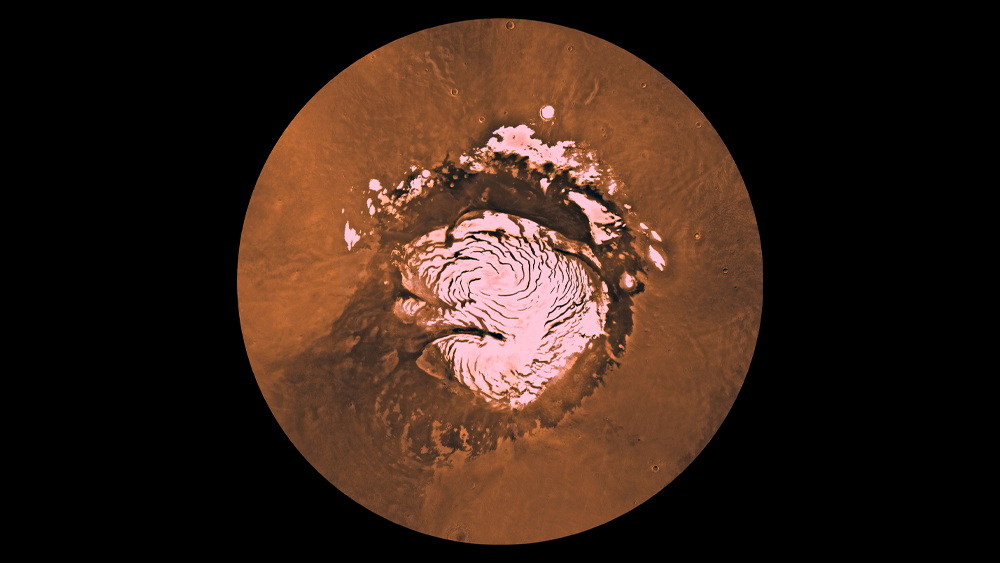
A team of German planetary scientists has concluded that a three-kilometer-thick northern polar ice cap on Mars has a “surprisingly young” age of between 2 and 12 million years.1,2 This age is much younger than uniformitarian age estimates for any other large feature on the red planet1 and is consistent with other clues suggesting that Mars is relatively young, not billions of years old.
As an ice sheet grows, it depresses the underlying crustal rocks, pushing them deeper into the mantle. As the ice sheet continues to grow, the weight of the ice sheet increases, and the rock sinks still a little deeper. Even after the ice sheet stops growing, it will continue to depress the underlying rock until the weight is fully balanced by the upward buoyant force. Likewise, the crust can rebound when the ice melts, and this process can continue even after the ice sheet is gone. For instance, Scandinavia and Finland are rebounding upward as an after-effect of the melting of thick ice sheets at the end of the Ice Age.3 Although the rate of rebound is tiny, just millimeters per year, it can be measured with sensitive GPS instruments. Uniformitarian scientists, who hold to an old earth, claim the Ice Age ended 11,000 years ago. Creation scientists, on the other hand, think the Ice Age was triggered by the Genesis Flood and ended a little less than 4,000 years ago.4,5
The Martian polar ice cap is no longer noticeably growing, but these planetary scientists concluded that the Martian polar crust is still sinking downward at a very slow rate, no more than 0.13 millimeters per year. This downward rate was calculated, not measured, based on assumptions about Mars’s past history and interior structure. The scientists concluded that the ice sheet could be no younger than 1.7 million years but no older than 12 million years. Although this is longer than the Bible’s 6,000-year timescale, it is noteworthy that, even with measurement uncertainties and possible uniformitarian assumptions, they were forced to conclude that the ice sheet was “surprisingly young.”1
Uniformitarian scientists have been “surprised” over and over again by the apparent youth of planets and moons in our solar system, including Mars.6–8 This surprise is a clear indication that there is something wrong with their old-age models.9 And how much more evidence of youth could creation researchers find if we had greater resources and manpower? ICR scientist Brian Thomas realized years ago that measured values of oxygen isotopes in the Martian atmosphere could be indicative of youth,10 but creationists have not (to the best of my knowledge) pursued this possibility to make it (if you’ll pardon the pun) “airtight.”
Despite limited resources, creation scientists continue to find evidence of youth both here on Earth and out in space. This shouldn’t be surprising, given that the Lord Jesus created the universe just 6,000 years ago.11,12
References
- Petersen, C. C. Mars’s Northern Ice Cap Is Surprisingly Young, Planetary Scientists Say. Phys.org. Posted on phys.org February 28, 2025, accessed February 28, 2025.
- Broquet, A. et al. 2025. Glacial Isostatic Adjustment Reveals Mars’s Interior Viscosity Structure. Nature. DOI: 10.1038/s41586-024-08565-9.
- Land Uplift. National Land Survey of Finland. Posted on maanmittauslaitos.fi, accessed February 28, 2025.
- Hebert, J. 2018. The Bible Best Explains the Ice Age. Acts & Facts. 47 (11): 10–13.
- Hebert, J. 2025. New Antarctic Ice Core: Good News for Creationists. Creation Science Update. Posted on ICR.org January 30, 2025, accessed February 28, 2025.
- Hebert, J. Youthful Solar System Bodies Puzzle Evolutionary Scientists. Creation Science Update. Posted on ICR.org February 13, 2013, accessed February 28, 2025.
- Hebert, J. Martian Lander Discovers “Surprising” Martian Volcanism. Creation Science Update. Posted on January 2, 2023, accessed February 28, 2025.
- Hebert, J. Mars Rover Records Dramatic Solar Eclipse. Creation Science Update. Posted on ICR.org May 5, 2022, accessed February 28, 2025.
- Coppedge, D. F. Don’t Trust Scientist Who Were Wrong; Fire Them. Creation Evolution Headlines. Posted on crev.info June 25, 2017, accessed February 28, 2025.
- Thomas, B. Mars Atmosphere Could Be Young. Creation Science Update. Posted on ICR.org October 4, 2010, accessed February 28, 2025.
- Genesis 1; Psalm 19:1–2; Colossians 1:13–18.
- Johnson, J. J. S. 2008. How Young is the Earth? Applying Simple Math to Data Provided in Genesis. Acts & Facts. 37 (10): 4.
Stage image: Mars digital-image mosaic merged with color of the MC-1 quadrangle, Mare Boreum region of Mars. The central part is covered by a residual ice cap that is cut by spiral-patterned troughs exposing layered terrain.
Stage image credit: NASA/JPL/USGS, public domain. Used in accordance with federal copyright (fair use doctrine) law. Usage by ICR does not imply endorsement of copyright holder.
* Dr. Jake Hebert is a research associate at the Institute for Creation Research and earned his Ph.D. in physics from the University of Texas at Dallas.