Two recent studies by different groups have concluded essentially the same thing: there are mysterious cold rock slabs at the bottom of Earth’s mantle that cannot be explained by conventional theories.1,2 Geophysicists typically color these colder rocks blue, as shown in the image.
For decades, the mantle was thought to be fairly homogenous, or well-mixed. Most geology students are taught that the mantle, which composes about 80% of the earth by volume, is stirred thoroughly by convection currents.3 But since the 1990s, images of the mantle began to show strange slabs of rock deep in the mantle that appear to be very cold compared to the temperature of the surrounding rock. Some of these reside at the base of the mantle, 1,800 miles below the surface. And there are equally mysterious hot masses called LLSVPs (large low shear velocity provinces).
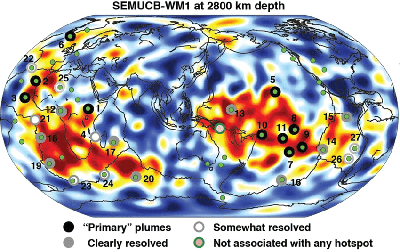
But it’s the presence of the cold slabs that have created the most consternation among conventional Earth scientists. These sunken slabs are thought to be subducted ocean seafloor that made it all the way through the mantle and are essentially resting on the top of the core. They are only about 60 miles thick. At today’s rates of a few inches or less per year, it would take about 70–100 million years for a slab to reach the base of the mantle. How can these slabs still be so cold when the surrounding mantle is so hot (3,500°C)?
And there is a second mystery that these studies revealed. It involves the location of some of these cold slabs. Science writer Harry Baker explained,
However, unlike previously identified subducted slabs, which are found in areas where tectonic plates currently collide or have previously smashed together, some of the new anomalies are located in places where no known tectonic activity has ever occurred, such as below the western Pacific Ocean. As a result, it is unclear how they ended up there.4
The first study concluded,
Many of these previously undetected anomalies [both cold and hot areas] are situated below major oceans and continental interiors, with no geologic record of subduction, such as beneath the western Pacific Ocean. Moreover, we find no statistically significant correlation positive anomalies as imaged using full-waveform inversion and past subduction. These findings suggest more diverse origins for these anomalies in Earth’s lower mantle, unlocking full-waveform inversion as an indispensable tool for mantle exploration.1
The second study came to a similar conclusion.
Comparing our model with wave speeds and attenuation predicted by a laboratory-based viscoelastic model suggests that the circum-Pacific is a colder and small-grain-size region, surrounding the warmer and large-grain-size LLSVPs.2
“That’s our dilemma,” said Thomas Schouten, a doctoral candidate at the ETH Zurich Geological Institute in Switzerland, who was involved in the first of the two studies.1,4 He added, “With the new high-resolution model, we can see such anomalies everywhere in the Earth's mantle. But we don’t know exactly what they are.”4
Cold slabs of rock deep in the mantle may be a dilemma for conventional Earth scientists, but not for Flood geologists. ICR’s Dr. Jake Hebert aptly summarized the findings from mantle tomography.
An imaging process called seismic tomography has revealed a ring of dense rock at the bottom of the mantle. Since its location corresponds approximately to the perimeter of the Pacific Ocean, it appears to represent subducted ocean crust [lithosphere]. Located inside this ring of cold rock is a blob of less-dense rock that appears to have been squeezed upward toward the crust. If one assumes that the density of the cold ring is comparable to that of the surrounding material, which is the most straightforward assumption, this ring is 3,000 to 4,000 °C colder than the inner blob. This is completely unexpected in the conventional plate tectonic model since it can take about 100 million years for a slab to descend all the way to the base of the mantle. In that time, one would expect any such temperature differences to have evened out. However, in the catastrophic plate tectonics model, such a temperature difference is to be expected if the slab rapidly subducted into the mantle just a few thousand years ago.5
Mantle imaging showing blobs of cold subducted rock confirm the predictions of creation scientists, validating runaway subduction.6,7 The cold slabs beneath the Pacific Ocean are likely remnants of Earth’s pre-Flood ocean seafloor that were rapidly subducted (at yards per second).7 Furthermore, ocean crust data suggest that the entire pre-Flood seafloor was subducted into the mantle during the Flood year.8 And it’s possible that some subduction zones came and went during the Flood year, producing slabs of seafloor that are no longer near today’s subduction zones.
Once the original pre-Flood ocean seafloor was completely consumed by subduction and a new, hotter seafloor was produced, runaway subduction ceased.8 Today we witness only residual plate motion of a few inches per year or less. Seismic tomography images showing cold subducted plates deep in the mantle remind us that these events took place rapidly and in the time frame of the Bible.
References
- Schouten, T. L. A. et al. 2024. Full-Waveform Inversion Reveals Diverse Origins of Lower Mantle Positive Wave Speed Anomalies. Scientific Reports. 14, article 26708.
- Talavera-Soza, S. et al. 2025. Global 3D Model of Mantle Attenuation Using Seismic Normal Modes. Nature. 637: 1131–1135.
- Convection is similar to how a lava lamp works. Heat from below heats the material which causes it to rise. Then as it cools, it sinks again, creating a circular motion.
- Baker, H. Scientists Discover ‘Sunken Worlds’ Hidden Deep within Earth’s Mantle That Shouldn’t Be There. Posted on Live Science January 14, 2025, accessed January 29, 2025.
- Hebert, J. 2017. The Flood, Catastrophic Plate Tectonics, and Earth History. Acts & Facts. 46 (8): 11–13.
- Baumgardner, J. R. 2003. Catastrophic Plate Tectonics: The Physics Behind the Genesis Flood. Proceedings of the International Conference on Creationism. 5, article 13: 113–126.
- Baumgardner, J. 1994. Runaway Subduction as the Driving Mechanism for the Genesis Flood. Proceedings of the International Conference on Creationism. 3, article 14: 63–75.
- Clarey, T. 2020. Carved in Stone: Geological Evidence of the Worldwide Flood. Dallas, TX: Institute for Creation Research.
* Dr. Clarey is the director of research at the Institute for Creation Research and earned his doctorate in geology from Western Michigan University.