 In 2001, the first rough draft of the human genome was published in a collaborative effort between private industry and the public sector.1,2 At that time, conventional scientists classified much of the human genome as junk DNA because they understood very little of the function of its three billion DNA letters. A more complete sequence of the human genome was published in 2004—but it was only about 92% finished.3 Since that time, new long-range DNA sequencing technologies produce much longer DNA snippets. Researchers finally sequenced the missing areas in 2022 and closed the chromosomal gaps.4
In the initial 2001 draft, scientists determined that only about 1%–2% of the genome contained protein-coding sequences. However, in 2007 the ENCODE project researchers published their first round of papers that only studied 1% of the genome for function.5 The authors in the lead paper reported that their “studies provide convincing evidence that the genome is pervasively transcribed, such that the majority of its bases can be found in primary transcripts, including non-protein-coding transcripts.”6 Five years later, a genome-wide study by ENCODE researchers determined that at least 80% was biochemically active.7 Ewan Birney, ENCODE’s lead analysis coordinator, stated concerning the remaining 20% that “it’s likely that 80 percent will go to 100 percent,” and “we don’t really have any large chunks of redundant DNA. This metaphor of junk isn’t that useful.”8
In a 2021 Nature report subsection titled “Not Junk,” the authors wrote,
With the HGP [human genome project] draft in hand, the discovery of non-protein-coding elements exploded. So far, that growth has outstripped the discovery of protein-coding genes by a factor of five, and shows no signs of slowing.9
In the same paper they stated,
Thanks in large part to the HGP, it is now appreciated that the majority of functional sequences in the human genome do not encode proteins. Rather, elements such as long non-coding RNAs, promoters, enhancers and countless gene-regulatory motifs work together to bring the genome to life.9
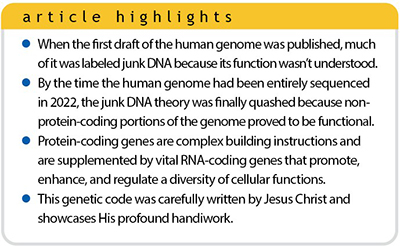
The current status of the human genome is near 100% functional with the following main takeaway points.
- The entirety of the human genome is a spectacular and diverse storehouse of life-critical information. This alone refutes the concept of junk DNA.
- Protein-coding genes are essentially a basic set of instructions within a complex and vast repertoire of regulatory DNA sequences.
- Many more RNA-coding genes exist compared to protein-coding genes, and they produce functional and structural RNA molecules that perform a wide variety of purposes in the cell.
- A vast amount of strategically placed regulatory switches and control elements exist all over the human genome to help regulate its function.
The mind-boggling complexity and intricate design of the human genome is exactly what the Bible refers to in Psalm 139:14: “I will praise You, for I am fearfully and wonderfully made; marvelous are Your works, and that my soul knows very well.”
References
- Venter, J. C. et al. 2001. The Sequence of the Human Genome. Science. 291: 1304–1351.
- International Human Genome Sequencing Consortium. 2001. Initial Sequencing and Analysis of the Human Genome. Nature. 409: 860–921.
- International Human Genome Sequencing Consortium. 2004. Finishing the Euchromatic Sequence of the Human Genome. Nature. 431 (7011): 931–945.
- Nurk, S. et al. 2022. The Complete Sequence of a Human Genome. Science. 376: 44–53.
- Stanford University. ENCODE Project Overview. ENCODE. Posted on encodeproject.org, accessed May 13, 2025.
- The ENCODE Project Consortium. 2007. Identification and Analysis of Functional Elements in 1% of the Human Genome by the ENCODE Pilot Project. Nature. 447 (7146): 779–816.\
- The ENCODE Project Consortium. 2012. An Integrated Encyclopedia of DNA Elements in the Human Genome. Nature. 489 (7414): 57–74.
- Yong, E. ENCODE: The Rough Guide to the Human Genome. Discover Magazine. Posted on discovermagazine. com September 8, 2012.
- Gates, A. J., et al. 2021. A Wealth of Discovery Built on the Human Genome Project—By the Numbers. Nature. 590: 212–215.
Stage image credit: SSilver | BigStock. Used in accordance with federal copyright (fair use doctrine) law. Usage by ICR does not imply endorsement of copyright holder.
Dr. Tomkins is a research scientist at the Institute for Creation Research and earned his Ph.D. in genetics from Clemson University.