New surprises revealing complex bio-engineering keep emerging as evolutionary scientists continue to unwittingly obey the biblical command to "observe the ant"(Proverbs 6:6; 30:25). The latest bio-engineering discovery is that a key component of ant colony survival is based on sound (acoustic) communication systems.1
One of the long-standing paradigms of animal communication is the use of airborne chemical messages called pheromones. Ants use pheromones to leave chemical trails that can be followed by other members and to also identify which nest an ant is from, along with its social status in the colony. Now, scientists can add yet another layer of complexity and communication in ant colonies based on acoustics.
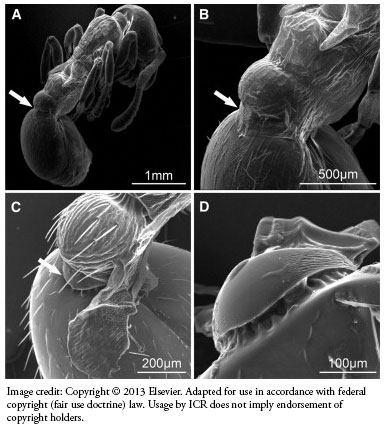
Scientists have been studying a type of ant commonly found in Europe. This ant has a specialized appendage on its abdomen that it strokes with its hind legs to create sound signals. Other ants can detect and process these signals, resulting in various complex social responses that are key to survival of the colony. Several years ago, researchers found that, in adult ants, these signals can act like an emergency beacon when an ant is threatened by a predator.2
If the discovery of this complex signaling in adult ants was not enough of a surprise, scientists have now determined that developing larvae back in the nest also use this technique, which is important for the ant colony's survival. Everything in an ant colony is performed in an orderly manner.
When an ant nest is disturbed and threatened, the worker ants immediately go about rescuing the nest. First, they grab and remove the mature larvae and then the immature larvae and pupae. As it turns out, the mature larvae use acoustic communication via their early maturing acoustic appendage, which the younger larvae and pupae lack, to signal their social status to the worker ants, enabling them to be extricated first (see image below). In the event of settling a new colony, the mature larvae would hatch first and thus be more valuable assets than the younger larvae, which require more resources.
It is also noteworthy that the acoustic signals are not performed in isolation, but co-processed along with other pheromone sensory signals using complex internal bioprocessing systems. Several other news articles from the Institute for Creation Research have discussed the complexity of ant colonies and their management through highly engineered bioprocessing systems.3,4,5
The combination of various sensory communication and processing systems are a clear example of an all-or-nothing suite of features referred to as irreducible complexity. All the ants would die in one generation if you remove any one of these features: 1) early maturing abdominal acoustic appendage, 2) instinct to "strum"it, 3) sensors in adults to detect it, 4) ant brains to interpret the sounds, and 5) the instinct to protect the mature larvae.
These new discoveries are amazing testimonies to the intelligence of the powerful Creator who engineered these remarkable living systems that utterly defy evolutionary dogma.
References
- Casacci, L. P. et al. Ant Pupae Employ Acoustics to Communicate Social Status in Their Colony's Hierarchy. Current Biology. Published online before print, February 7, 2013.
- Barbero, F. et al. Myrmica Ants and Their Butterfly Parasites with Special Focus on the Acoustic Communication. Psyche. 2012 (2012).
- Thomas, B. Scientists Discover the 'Anternet.' Creation Science Update. Posted on icr.org September 14, 2012, accessed February 11, 2013.
- Thomas, B. Ant Algorithms Argue Against Evolutionary Origins. Creation Science Update. Posted on icr.org February 17, 2009, accessed February 11, 2013.
- Tomkins, J. Communal Nutrition in Ants: Strong Evidence for Creation. Creation Science Update. Posted on icr.org July 8, 2009, accessed February 11, 2013.
* Dr. Tomkins is a Research Associate and received his Ph.D. in Genetics from Clemson University.
Article posted on February 22, 2013.