The prestigious journal Science has published evidence that a planet orbiting a red dwarf star has an atmosphere.1,2 This extrasolar planet, or exoplanet, is located 48 light-years from Earth and has been given the designation LHS 1140b, because it is the first exoplanet discovered around the star LHS 1140 (the designation “a” is reserved for the exoplanet’s host star). Biblical creationists should be excited about this discovery. Helium was detected escaping from the planet, and modeling suggests the helium is escaping from the upper levels of an atmosphere surrounding the planet. Yet given the planet’s presumed billions-of-years age, the helium should have already completely escaped!3 A popular science article stated, “The planet’s age suggests it would have run out of helium unless it was replenishing its own supply, pointing to the potential of an atmosphere.”1
That statement is a little misleading. The presence of escaping helium in no way proves that the helium is being replenished. Helium is a very “light” chemical element that should quickly escape from an atmosphere. And because helium doesn’t react well with other elements, this escape can’t be slowed or stopped by the reaction of helium with other heavier elements. Conventional astronomers think the red dwarf star is more than 3 billion years old, and the planet’s age would presumably be comparable to this.2 But if that’s the case, no original helium should be left.
It’s not clear whether heavier elements than helium are present in LHS 1140b’s atmosphere, nor that they could even still remain after billions of years:
M [red] dwarfs are more active than Sun-like stars, emitting high energy radiation that can drive atmospheric escape from closely orbiting planets. It is therefore unclear whether such planets can retain their atmospheres for billions of years. Observations of small, rocky exoplanets have mostly revealed airless worlds or atmospheres too tenuous to detect, with some debated evidence for atmospheres.2
It is striking that the Science paper only presents evidence for the presence of this escaping helium and says absolutely nothing about mechanisms that could somehow replenish it.2 Speculation of possible helium replenishment is alluded to only in the popular science article.1 One such mechanism would involve helium generated by radioactive decay that enters the atmosphere from the crust and then leaks away to space. Is it possible that new helium, generated by radioactive decay, is entering and then escaping the atmosphere of LHS 1140b? Yes. Is there any evidence that this is happening? No. Think about it: how can astronomers have direct evidence that new helium is being generated in the crust and is escaping from the crust into the “leaky” atmosphere of a planet that is 48 light-years away? They can’t.
Old-universe astronomers must believe the helium is being replenished somehow, but they presented no actual scientific evidence for such replenishment. This is sheer speculation necessitated by their belief that LHS 1140 and its planets are billions of years old. But if LHS 1140b is just thousands of years old, no such hypothesized helium replenishment is necessary; the planet could still retain some of the helium its atmosphere had when the Lord Jesus created it about 6,000 years ago.
Based on its size and mass, astronomers think LHS 1140b is a rocky world somewhat like Earth, rather than a gas giant like Jupiter or Saturn. Additionally, no other atmosphere has ever been detected around a rocky exoplanet. This planet is also within its star’s habitable zone, a range of distances from the star in which liquid water could exist.2 Since life as we know it requires water, conventional scientists think discovering Earthlike worlds improves the chances of finding extraterrestrial life, which they mistakenly believe would vindicate the evolutionary story.3 They also think locating such places improves humanity’s chances of one day colonizing outer space, to help ensure mankind’s survival should some cataclysm eventually befall the earth.4 But as the Bible says, “Surely the wrath of man shall praise You [the Lord]” (Psalm 76:10). Despite the atheistic motivations behind some in the space program, space exploration continues to reveal information that strengthens the case for biblical creation.5
Previous Creation Science Update articles have highlighted other exoplanets that also look “surprisingly” young.6–9 Contrary to popular perception, there are many physical processes within our solar system and even in deep space that are problematic for the belief that the universe is 13.8 billion years old.10,11
References
- University of Florida. Nearby Rocky Planet May Be Replenishing Helium from Atmosphere, Study Finds. Phys.org. Posted on phys.org July 16, 2026, accessed July 17, 2026.
- Cherubim, C. et al. 2026. Helium Escaping from the Atmosphere of a Nearby Rocky Exoplanet Orbiting in a Habitable Zone. Science.
- There are strong theological arguments that extraterrestrial life (especially intelligent extraterrestrial life) does not exist, but even if it did, its existence would require a miracle of creation just as surely as our existence does.
- Because evolutionary “scoffers” (2 Peter 3:3–4) deny the Lord Jesus is coming back to complete the “restoration of all things” (Acts 3:21), they believe the survival of the human race depends upon us successfully colonizing outer space before some Earth-destroying calamity befalls us. Since they deny that Christ is the Savior, they believe we must save ourselves.
- We praise the Lord for the Bible-believing Christians who have been involved in space exploration, including astronauts like General Charlie Duke, Colonel Jeff Williams, and Captain Barry Wilmore.
- Hebert, J. Earth-Sized Lava World “Circling the Drain.” Creation Science Update. Posted on ICR.org August 7, 2025, accessed August 7, 2025.
- Hebert, J. New Exoplanet’s Year Is Just 16 Hours. Creation Science Update. Posted on ICR.org December 13, 2021, accessed January 29, 2025.
- Hebert, J. “Super-Puff” Exoplanets: Evidence of Youth? Creation Science Update. Posted on ICR.org January 6, 2025, accessed January 29, 2025.
- Hebert, J. Rocky Planets Are Literally Being Vaporized. Creation Science Update. Posted on ICR.org February 13, 2025, accessed July 17, 2026.
- Hebert, J. 2018. Our Young Solar System. Acts & Facts. 47 (9): 10–13.
- Hebert, J. 2019. Deep-Space Objects Are Young. Acts & Facts. 48 (9): 10–13.
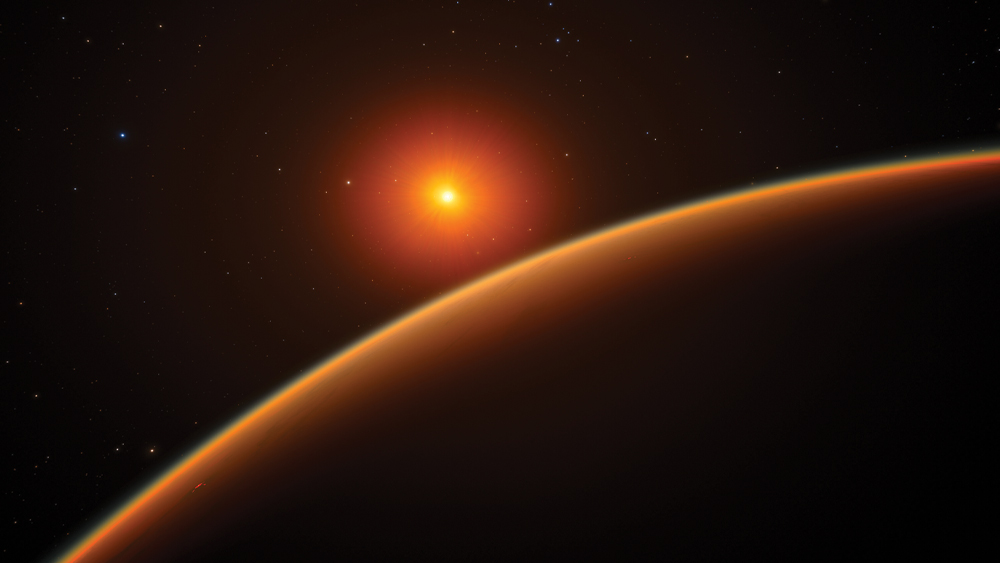
Stage image: This artist’s impression shows the exoplanet LHS 1140b, which orbits a red dwarf star 48 light-years from Earth
Stage image credit: ESO/spaceengine.org, CC BY 4.0. Used in accordance with federal copyright (fair use doctrine) law. Usage by ICR does not imply endorsement of copyright holder.
* Dr. Hebert is a research scientist at the Institute for Creation Research and earned his Ph.D. in physics from the University of Texas at Dallas.