Editor’s note: ICR warmly welcomes paleontologist Dr. Gabriela Haynes to our science faculty. Her testimony of a shrinking faith brought back to the Lord through creation science resonates with what we’re all about. Her article topic for this issue points toward a couple books coming soon from ICR Publishing Group, such as If It Walks Like a Bird by Dr. Tim Clarey.

That some dinosaurs had feathers may initially appear purely scientific and factual. However, this concept was not formed in isolation and from direct evidence. It comes from a particular interpretive framework. What beliefs shape this conclusion?
Each of us sees the world through a specific framework. Our foundational beliefs, principles, education, culture, and recognized sources of authority influence our interpretations and conclusions. Two particular frameworks impact the feathered dinosaur conclusion. One begins with God and His Word. Scripture reveals Jesus as the Creator of all things and as sovereign over His creation (Genesis 1:1; John 1:3). When we interpret the world through the lens of Scripture, our thinking is anchored in the testimony of the One who was there from the beginning. The other starting point relies on human reasoning as the highest authority. However, human understanding is limited, and our thinking is affected by living in a fallen world (Romans 1:21–25). These two starting points lead to very different conclusions about the same facts.
The history of the dinosaur-to-bird narrative traces back to Charles Darwin, who used the humanistic framework, in 1859. In On the Origin of Species, Darwin proposed that life evolved gradually from simple to more complex forms. That theory suggests birds evolved from reptiles. Darwin acknowledged that transitional forms should exist in the fossil record as evidence of this, even though Darwin himself admitted they were not evident.
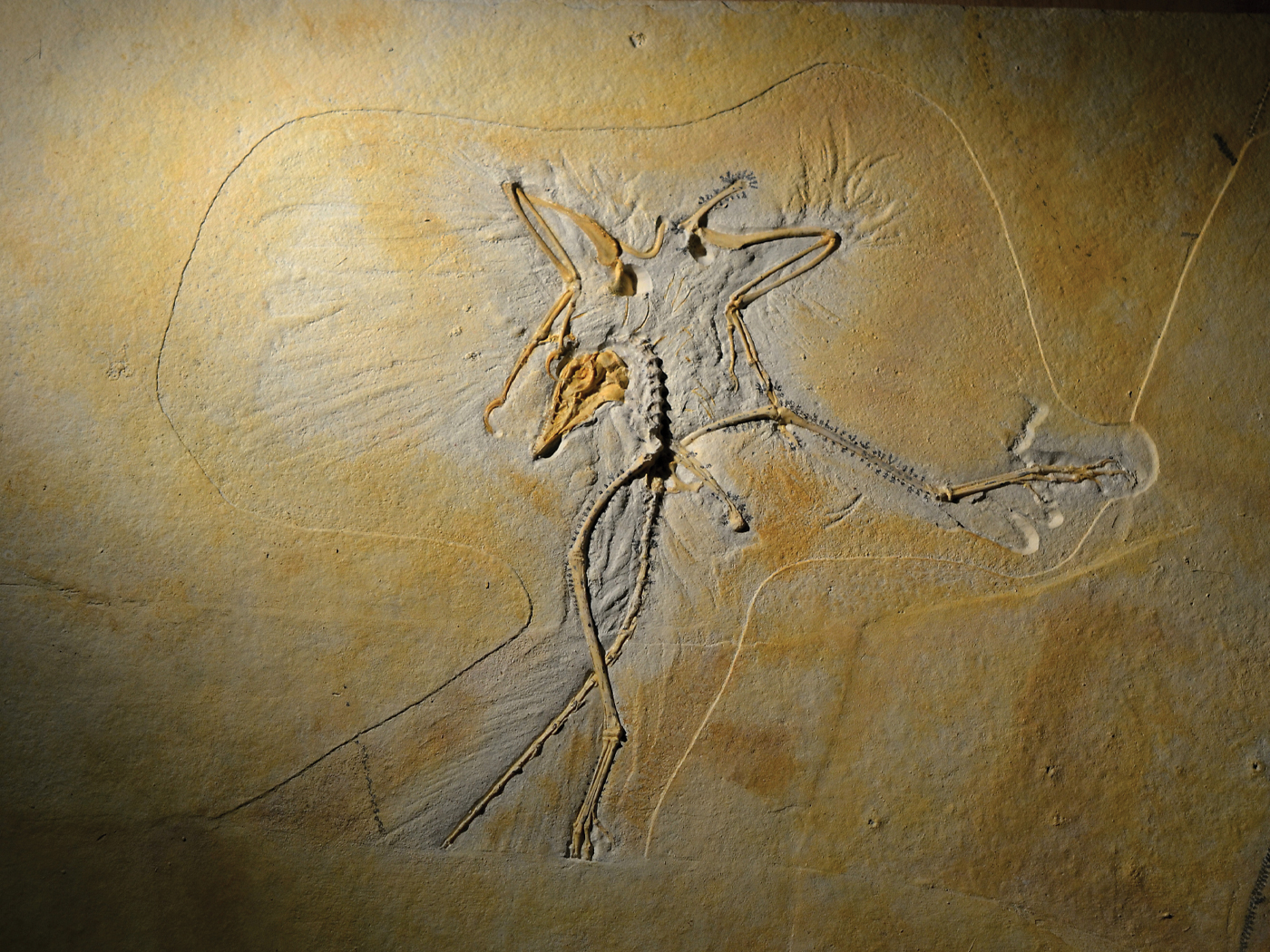
When the fossil Archaeopteryx was discovered in 1861, many interpreted it as an evolutionary transition between reptiles and birds, confirming Darwin’s theory. That was the beginning of the dinosaur-to-bird hypothesis. However, Richard Owen, a contemporary of Darwin who believed in creation, thought it was definitively and wholly a bird.1 Continued studies demonstrated that Archaeopteryx presents avian characteristics. But despite this and other contested transitional fossils, the evolutionary framework continues to claim birds evolved from dinosaurs.
A classification method called cladistics, created in 1950, further supported this perspective.2 In cladistics, organisms get grouped based on shared characteristics within an evolutionary model. It does not test evolution but organizes organisms according to evolutionary expectations. This is circular reasoning, since it assumes evolution before arguing that it is true.
Thus, the conclusion that dinosaurs had feathers has evolutionary roots. It stems from both a faulty analysis that Archaeopteryx was not fully a bird and circular reasoning. Feathered dinosaurs are tied to the assumption that some reptiles evolved into all birds—an assumption that has no objective supporting evidence. It is necessary to recognize which worldview influences and shapes what seem to be scientific claims. This is the first step toward critically evaluating the fossil record.
As Christians, the truth of God’s Word should be our guide to interpreting the world. This is why we consider the Genesis Flood when studying bird fossils. After all, the fact that we have any fossil birds at all, a creature that never fossilizes today, requires some kind of unprecedented watery catastrophe. The creation and Flood accounts from Genesis best explain what we see: created birds with feathers that the Flood knocked out of the sky and buried.
References
- Haynes, G. 2022. The Debate over Classification of Archaeopteryx as a Bird. Answers Research Journal. 15: 285–300.
- Hennig, W. 1966. Phylogenetic Systematics, D. Davis and R. Zangerl, trans. Urbana, IL: University of Illinois Press. The original book was published in German in 1950.
* Dr. Haynes is a research scientist at the Institute for Creation Research and earned her Ph.D. in paleontology from Universidade Federal do Ceará in conjunction with University of Kentucky.
Stage image: Archaeopteryx lithographica, Jurassic Solnhofen Limestone, Germany
Stage image credit: James L. Amos, public domain