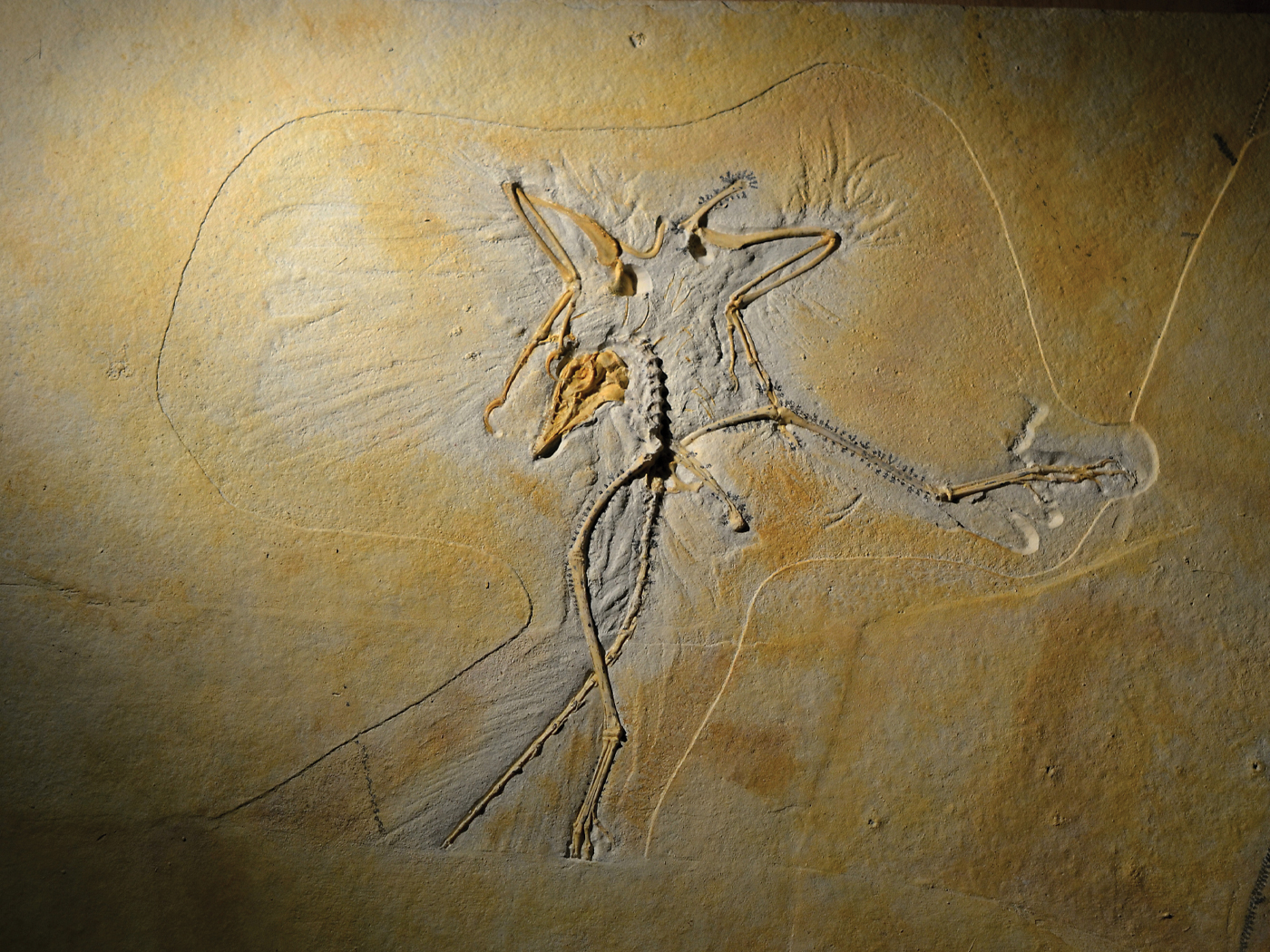
Was the famous extinct fossil named Archaeopteryx a bird or an evolutionary link that led to birds? And how confident should scientists and others feel about the 150-million-year age assigned to this world-famous fossil? A new report on the latest specimen confirms two Bible-friendly trends that creation scientists have been tracking for a long time.1
Researchers discovered subtle, bird-specific features in the fourteenth specimen of this extinct bird—making its designation of “bird” even more secure. The international team, with core members at Chicago’s Field Museum, published their research in the online journal The Innovation, which belongs to the prestigious Cell Press family of journals.1 According to this report, Archaeopteryx, like most modern birds, used a coordinated set of structures when they ate. Their tongues anchored to a specialized bone that affords the tongue extra range of motion. This partnered with sensitive bumps in their mouths called oral papillae that position food down the throat. No dinosaur has these features.
This fits with ICR scientists’ longstanding observation that Archaeopteryx never did represent any transitional form; it was just an extinct bird.2 Thus, this news confirms the first Bible-friendly trend: even evolutionary experts dispute each proposed transitional form.3
The next trend concerns original tissues. Should anyone even consider that fossils like this have tissue remnants? After all, the measured decay rates of organic features like skin, blood vessels, and the biochemicals that form them show they can last no more than hundreds of thousands of years under ideal conditions.4 Regardless, fossils with soft tissues that bear age assignments of millions of years keep piling up.5
Fossil experts had already described “soft tissue” in this same Archaeopteryx specimen, including “skin,” “foot pads,” and apparently original claw material they called a “keratinous sheath.”6 Some years ago, a separate specimen of the same creature kind showed indirect evidence of feather proteins right where the feather impressions lay but none in the rock right next to them.7
Now, in The Innovation article, this team described “soft tissue traces interpreted as evidence for oral papillae.”1 Although they did not confirm original organics with a method other than UV light, the evidence builds on my past arguments about their burial only thousands of years ago.8
The person who says it’s outlandish to even entertain the idea that keratin, skin, bone, and now tiny skin bumps lasted for 150 million years has chemistry on his side. These birds must have been buried much more recently than their assigned age.
The two trends from this new report inadvertently confirm two biblical ideas. First, since Genesis 1:20–22 states that God created birds to multiply according to their kinds, it’s no wonder that Archaeopteryx was just an extinct representative of a single bird kind instead of any evolutionary link. Second, since the Bible’s chronology cues set the Flood at only about 4,500 years ago, the chemical argument that this fossil comes from that time period gives no cause to pause at its likely tissue remnants.
References
- O’Connor, J. K. et al. 2026. Avian Features of Archaeopteryx Feeding Apparatus Reflect Elevated Demands of Flight. The Innovation. 7 (2).
- See for example, Morris, H. M. 1974. Scientific Creationism. Green Forest, AR: New Leaf Publishing Group, 85.
- Morris, J. D. and F. J. Sherwin. 2009. The Fossil Record. Dallas, TX: Institute for Creation Research.
- Buckley, M. et al. 2008. Comment on “Protein Sequences from Mastodon and Tyrannosaurus rex Revealed by Mass Spectrometry.” Science. 319 (5859): 33.
- See our curated list of papers reporting soft tissues in fossils online for free. Thomas, B. and J. Tay. List of Biomaterial Fossil Papers. Google doc. Posted on docs.google.com, accessed February 2, 2026.
- O’Connor, J. et al. 2025. Chicago Archaeopteryx Informs on the Early Evolution of the Avian Bauplan. Nature. 641: 1201–1207.
- Bergmann, U. et al. 2010. Archaeopteryx Feathers and Bone Chemistry Fully Revealed via Synchrotron Imaging. Proceedings of the National Academy of Sciences. 107 (20): 9060–9065.
- Thomas, B. Bone, Skin, Claw Lasted…150 Million Years? Creation Science Update. Posted on ICR.org June 16, 2025, accessed February 3, 2026.
* Dr. Brian Thomas is a research scientist at the Institute for Creation Research and earned his Ph.D. in paleobiochemistry from the University of Liverpool.