by Brian Thomas, Ph.D., and Chris Rupe, Ph.D.*
 Most folks consider our ape ancestry as established science, with Lucy as the main link. However, the story that we evolved from the same animal ancestors as today’s apes flies in the face of both science and the Bible.
Those with a high view of Scripture need only read Genesis 2:5 to settle the matter: “There was no man to till the ground.” There were no humans before Adam. Adam came not from an animal but from dust (Genesis 2:7).
Do fossils related to Lucy—the most popular human evolutionary ancestor candidate—demand that God got His history wrong? No. And certain fossil details vindicate creation.
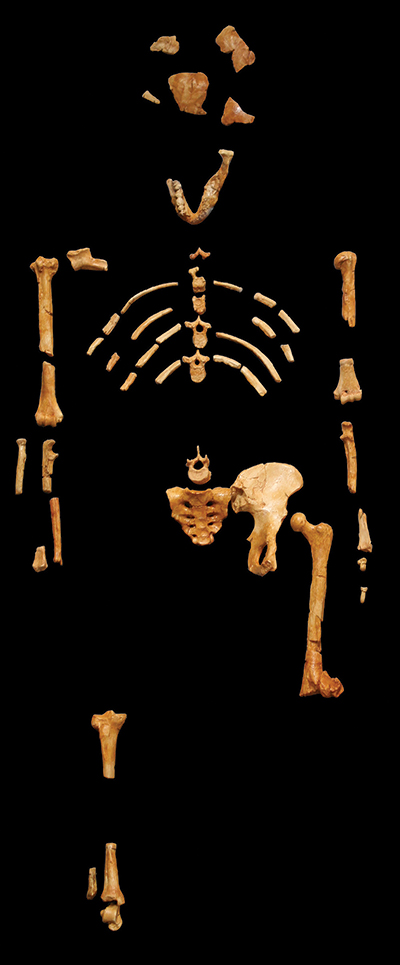
Lucy is the nickname that discoverer Donald Johanson’s team gave to a partial skeleton of assembled bone fragments extracted from a large, mixed bone bed in 1974.1 Lucy is believed to belong to the species Australopithecus afarensis, represented by over 400 fossil specimens. However, many people are unaware that before naming the new species, Johanson and his colleague attributed the total fossil assemblage to two different creatures. They reported, “The collection suggests that Homo and Australopithecus coexisted.”2 In other words, the fossils consisted of a mixture of ape and human bones.
But in 1978–1979, Johanson and a new partner reassigned the entire collection—including the human-shaped bones and fragments—to a single new species they named Australopithecus afarensis. This enabled them to portray australopiths as ancestors of modern humans.3
To this day, evolutionary researchers who assume Lucy and her kind came from a single species confidently speculate about the apelike skull and human-like walking ability. Others, however, recognize that the fossil collection includes both human and ape pieces, just as Johanson first acknowledged.4
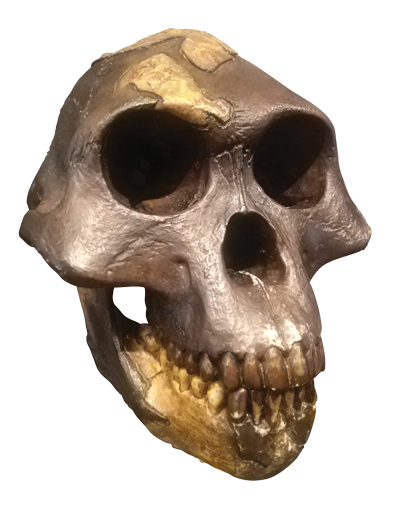
What kind of primate do the non-human parts labeled A. afarensis belong to? Well, in 2015 a team identified one of Lucy’s vertebrae as from a baboon—a 40-year-long oversight.5 Other non-human bones found in Lucy’s layers show ape qualities, including an adult male and female skull with a spine insertion angle consistent with knuckle-walking apes.6 This angle is a diagnostic feature, distinguishing apes from humans.
Foot design is another such feature. Apes’ big toes are angled for grasping, whereas our big toes point forward for running. One composite foot from the same locality that Johanson originally attributed to Homo bears classic features of modern human feet.7
So what conclusions do these fossil details yield? First, some clearly human fossils got lumped into a collection of bones attributed to Lucy’s species. Second, clearly ape fossils got lumped into that same collection. The concept of Lucy as our ancestor is merely a myth—long on imagination and short on good science. While the world may scoff at Genesis, these fossils fit God’s creation of creatures according to their kinds.
References
- Johanson, D. 1976. Ethiopia Yields First “Family” of Early Man. National Geographic. 150 (6): 790–811.
- Johanson, D. C. and M. Taieb. 1976. Plio—Pleistocene Hominid Discoveries in Hadar, Ethiopia. Nature. 260 (5549): 293–297.
- Johanson, D. C. and T. D. White. 1979. A Systematic Assessment of Early African Hominids. Science. 203 (4378): 321–330.
- Rupe, C. and J. Sanford. 2019. Contested Bones. Canandaigua, NY: FMS Publications, 113.
- Meyer M. R. et al. 2015. Lucy’s Back: Reassessment of Fossils Associated with A.L. 288-1 Vertebral Column. Journal of Human Evolution. 85: 174–180.
- Kimbel, W. H. and Y. Rak. 2010. The Cranial Base of Australopithecus afarensis: New Insights from the Female Skull. Philosophical Transactions of the Royal Society B: Biological Sciences. 365 (1556): 3365–3376.
- DeSilva, J. M. et al. 2020. Associated Australopithecus afarensis Second and Third Metatarsals (A.L. 333-133) from Hadar, Ethiopia. Journal of Human Evolution. 146: 102848.
Dr. Thomas is a research associate at the Institute for Creation Research and earned his Ph.D. in paleobiochemistry from the University of Liverpool. Dr. Rupe is the founder of Back2Genesis and is a sedimentary geologist who earned his Ph.D. in earth sciences from Loma Linda University.