According to the most popular conventional origins story, space, energy, time, and matter as we know them came into being 14 billion years ago when a hypothetical process called inflation caused space to rapidly expand. Somehow this cosmic accident eventually resulted in myriads of stars, planets, and galaxies as well as Earth and all its inhabitants. Despite the idea’s apparent absurdity, it’s taken seriously by millions of people, including most scientists.
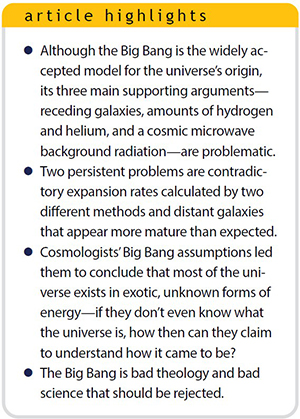 The Big Bang’s three main supporting arguments are (1) the redshifts of distant galaxies, which are seen as evidence for an expanding universe; (2) the Big Bang’s ability to account for the amounts of hydrogen and helium in the universe; and (3) the existence of a cosmic microwave background (CMB) radiation that’s said to be an afterglow from about 400,000 years after the Big Bang happened.
However, an expanding universe doesn’t necessarily imply the Big Bang. God could have imposed an expansion on a large, newly created universe, perhaps to guard against gravitational collapse. Moreover, a number of both conventional and creation scientists openly question this particular interpretation of the redshift data. There’s a way to test whether or not galaxy redshifts really are caused by an expansion of space, but scientists who performed this test have obtained contradictory or equivocal results.1
Likewise, the Big Bang model has an adjustable parameter called the baryon-to-photon ratio. Theorists choose a particular ratio value that allows the Big Bang to produce the observed amounts of hydrogen and helium.2 Even with this freedom, the Big Bang still cannot correctly account for the amount of lithium in the universe.3
The Big Bang’s strongest argument is perhaps the existence of the CMB radiation. And yet, the details of this radiation have repeatedly contradicted Big Bang expectations, forcing multiple revisions to the model.4
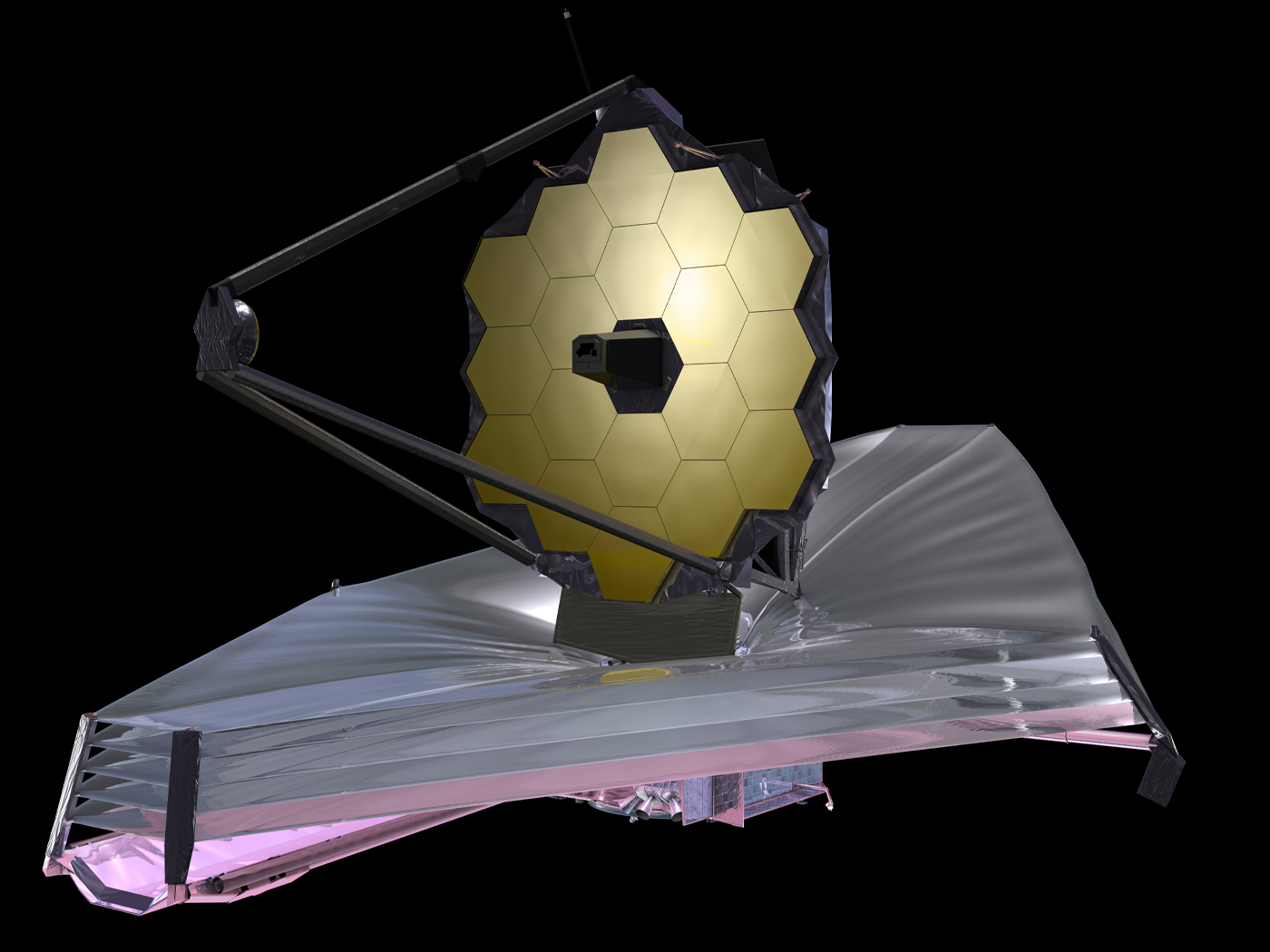
Moreover, the Big Bang is plagued by other serious, persistent problems.2 Two different methods of calculating the presumed expansion rate of the universe—one using galaxies’ estimated distances and speeds and the other inferred from CMB radiation details—give contradictory answers, and distant galaxies often appear more mature than Big Bang reckoning expects. This long-standing problem has only been exacerbated by data from the James Webb Space Telescope.1
Another challenge is that Big Bang assumptions forced theorists to conclude that 95% of the universe is comprised of exotic, unknown “stuff.” Big Bang proponents acknowledge that by their own reckoning they know almost nothing about the universe’s basic composition and yet boldly claim to (mostly) understand the process through which the universe supposedly came into being. It’s like not knowing the ingredients in a birthday cake yet claiming to understand its recipe!
If the Big Bang is such a poorly constructed scientific model, why do its proponents cling to it so tenaciously? For many, embracing a weak scientific model is preferable to acknowledging that they will one day have to give an account to our universe’s Creator.
Some Christians claim God used the Big Bang to make the universe, but that idea doesn’t fly. In addition to the Big Bang’s scientific problems, it contradicts Genesis at multiple points—billions versus just thousands of years of history, stars before the earth rather than the earth before the stars, etc.
The Big Bang is a modern-day myth that’s both bad theology and bad science. It’s long past time for it to be abandoned in favor of the true origins story found in Genesis.
References
- Hebert, J. 2022. James Webb Telescope vs. the Big Bang. Acts & Facts. 51 (7): 14–17.
- Hebert, J. 2019. Continuing Troubles for the Big Bang Model. Acts & Facts. 48 (11): 10–13.
- Thomas, B. Big Bang Fizzles Under Lithium Test. Creation Science Update. Posted on ICR.org September 22, 2014, accessed May 27, 2025.
- Hebert, J. 2018. Does the Cosmic Microwave Background Confirm the Big Bang? Acts & Facts. 47 (6): 10–12.
Stage image credit: NASA/WMAP Science Team. Used in accordance with federal copyright (fair use doctrine) law. Usage by ICR does not imply endorsement of copyright holder.
Dr. Hebert is a research scientist at the Institute for Creation Research and earned his Ph.D. in physics from the University of Texas at Dallas.