The Institute for Creation Research’s Column Project team recently completed analysis of the Australasian continent, which encompasses Australia, New Guinea, and New Zealand. The study compiled 486 stratigraphic columns from oil wells, cores, seismic profiles, and outcrop data. We correlated six megasequences across Australasia and mapped their extent and thicknesses.1 We also tracked a seventh pre-Sauk Megasequence, conventionally known as the Upper Precambrian or Proterozoic. The data show Australasia contributes its own unique evidence for the historicity of the progressive global Flood.
Australasia’s Rich Pre-Sauk
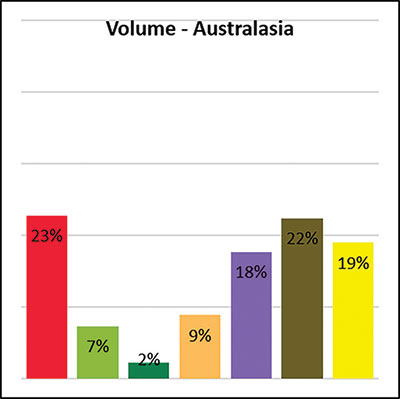
A graph of the sediment volume preserved for each megasequence shows a chapter-by-chapter progression of the Flood similar to the other five continents (North and South America, Africa, Asia, and Europe) with one exception: Australasia has more pre-Sauk sediment than most (Figure 1).2 And in Australia’s McArthur Basin, some of these Precambrian rocks are producing oil and gas. Detailed chemical analysis indicates these oils are from buried marine plankton.3
These discoveries, and similarly productive pre-Sauk sediments in Russia, China, and Oman, are difficult for evolutionists to explain because tremendous volumes of organic material must have been quickly buried to provide these oil and gas resources. But the Flood’s rapid and catastrophic nature means it could have encapsulated ample organic material, even in its earliest days or weeks, explaining this basin’s oil and gas potential. More research on these resources and sediments is needed.
Australasia’s Progressive Flood
The earliest generally accepted Flood sediments begin with Cambrian System rocks, corresponding to the Sauk Megasequence. Hereafter, the volumetric pattern across Australasia exhibits the same pattern as the rest of the world. Figure 1 shows minimal sediments deposited in the first three megasequences and progressively more in the Absaroka until peaking in the Zuni.
The latter three megasequences also increased dramatically in surface coverage. The Zuni has the most sedimentary volume (after the pre-Sauk) and the second most surface coverage, corresponding to the Flood’s peak.2 The final megasequence (Tejas) has the most widespread surface coverage, suggesting it formed during the Flood’s receding phase.2
Six Continents of Data
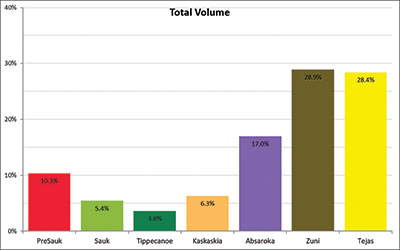
The Australasia rock data show the same pattern of a progressive global Flood recognized in our earlier studies.2 Figure 2 shows total sediment volumes from all six continents according to megasequence. Even the high percentage of pre-Sauk in Australasia is tempered in the global snapshot. The Zuni still contains the most volume globally, and the Tejas is a close second.
With Australasia’s data, we have even stronger evidence that the Flood was historical and global. Every continent shows similar deposition patterns from the same time and in the same order. What else could explain these findings?4
References
- A megasequence is a thick, definable package of sedimentary rock bounded top and bottom by extensive erosional surfaces. Each megasequence represents a major sea level rise and fall across the continents.
- Clarey, T. L. and D. J. Werner. 2023. A Progressive Global Flood Model Confirmed by Rock Data Across Five Continents. Proceedings of the International Conference on Creationism. 9: article 23, 412–445.
- Jarrett, A. J. M. et al. 2022. Petroleum Supersystems in the Greater McArthur Basin, Northern Territory, Australia: Prospectivity of the World’s Oldest Stacked Systems with Emphasis on the McArthur Supersystem. The APPEA Journal. 62 (1): 245–262.
-
Genesis 7 and 8 provide answers to these rock data and explain why there was a progressive global Flood.
Stage image: A composed satellite photograph of Australia
Stage image credit: Copyright © Reto Stöckl / NASA Goddard Space Flight Center. Used in accordance with federal copyright (fair use doctrine) law. Usage by ICR does not imply endorsement of copyright holder.
* Dr. Clarey is the director of research at the Institute for Creation Research and earned his Ph.D. in geology from Western Michigan University.