The phylum Arthropoda suddenly appears in the fossil record in a most un-Darwinian way.1 The largest group within the arthropods is the class Insecta—the insects. There is no fossil evidence depicting how insects supposedly came from non-insects. Entomologists can only suggest or estimate they originated many millions of years ago.2 ICR’s Dr. Jeff Tomkins addresses this evolutionary problem known as the hexapod gap. Hexapods are the insects and springtails.
Insects first appear about 385 million years ago, according to evolutionary dating. The earliest known insect, which appeared suddenly without any insect precursors, was a wingless creature that looked much like a modern silverfish. But after this initial appearance, there was allegedly an absence of insects in the sedimentary rocks for the next 60 million years. There was no sign of a single roach, grasshopper, or dragonfly. This huge evolutionary gap between 385 million and 325 [supposed] million years ago is known among paleontologists as the hexapod gap.3
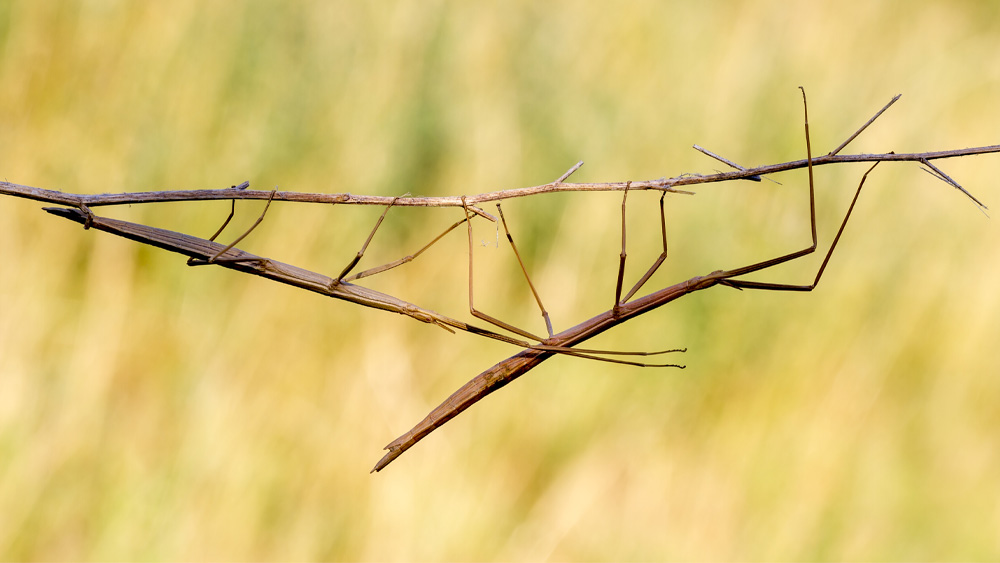
In other words, insects have always been insects. This includes the fascinating leaf and stick insects called the phasmids. Scientists writing in the Proceedings of the National Academy of Sciences give recognition not to the Creator but to natural selection for phasmid innovation.4 They wrote, “Phasmids (stick and leaf insects) exemplify the extraordinary power of natural selection to shape organismal phenotypes.”5 A recent article in Phys.org, a science website, stated that “regardless of type, those insects that express a protective stick- or leaf-like appearance all evolved the same basic body parts.”6
Creationists would disagree. Entomologists have never observed the alleged evolution of these same basic body parts. Instead, the insects were created with the basic stick- or leaf-like appearances that are found in the fossil record and today. With such design features, the insects can move in and fill various niches, which is described by the continuous environmental tracking (CET) model.7 In other words, since nature has never shown it has an extraordinary power to shape organisms, it stands to reason that a Creator who exists beyond nature actually wielded this astonishing control.
The Phys.org article also stated,
Something else the team learned was that because the same body parts kept evolving in different insects, they could predict how some modern insects will evolve. The key was looking at the environmental factors that led to changes that had already occurred. Creatures that live in similar environments, they note, tend to evolve in similar ways, including their means of camouflage.6
The evolutionists exhibit their faith in selection for detailed morphological changes in these insects. We do see minor changes of the same body parts occur, and this is predicted by CET. This is because phasmids—like all insects—are “active, problem-solving creatures that continuously track environmental changes to better fit existing niches or fill new ones.”7
And speaking of camouflage, how did the remarkable phasmidian camouflage evolve? Scientists at the University of Gottingen don’t know.
The age estimation of the phylogenetic tree suggests that most of the old lineages emerged after the dinosaurs became extinct 66 million years ago. Thus, the remarkable camouflage of stick and leaf insects most probably evolved afterwards as adaptation against predatory mammals and birds.8
Boisseau et al. appeal to the unscientific philosophy of convergent evolution to explain the evolution of the 20 basic body features.5,9,10 Science writer Yirka states in Phys.org,
Prior evidence has shown that similar physical characteristics can evolve in unrelated creatures, a process called convergent evolution. For this new study, the researchers looked at two specific types of insects to learn more about how convergence works. They discovered that stick- and leaf-imitating insects had all evolved the same 20 basic body features, including body shape, head shape and lobster-like features. In all cases, they noted, the features had evolved to help the insects blend into the background to avoid being eaten by predators.6
Saying the stick- and leaf-imitating insects “all evolved the same 20 basic body features” is not a scientific explanation. There are similar physical characteristics found in these two unrelated animals, so they can blend into the environment. But there is no indication as to “how convergence works” or if convergence worked.
Insects were incredibly diverse and complex from the beginning. They have been designed with the ability to undergo limited variation in their basic body plan as they move in and fill ecological niches.
References
- Clarey, T. Cambrian Explosion Alive and Well. Creation Science Update. Posted on ICR.org January 14, 2021.
- Thomas, B. Rare Insect Evolved at the Wrong Time. Creation Science Update. Posted on ICR.org December 30, 2008.
- Tomkins, J. P. 2018. Evolutionist Can’t Fill the Hexapod Gap. Acts & Facts. 47 (8): 14.
- Guliuzza, R. 2010. Natural Selection is Not ‘Nature’s Design Process.’ Acts & Facts. 39 (4): 10–11.
- Boisseau, R. et al. 2024. Divergence Time and Environmental Similarity Predict the Strength of Morphological Convergence in Stick and Leaf Insects. Proceedings of the National Academy of Sciences. 122 (1): e2319485121.
- Yirka, B. Convergent Evolution: Stick and Leaf Insects Share 20 Body Features. Phys.org. Posted on phys.org December 27, 2024.
- Guliuzza, R. and P. Gaskill. Continuous Environmental Tracking: An Engineering Framework to Understand Adaptation and Diversification. Proceedings of the International Conference on Creationism. 8, article 11: 158–184.
- University of Gottingen. Was Early Stick Insect Evolution Triggered by Birds and Mammals? EurekAlert! Posted on eurekaalert.org October 7, 2019. Emphasis added.
- Guliuzza, R. 2017. Major Evolutionary Blunders: Convergent Evolution Is a Seductive Intellectual Swindle. Acts & Facts. 46 (3): 17–19.
- Bethell, T. 2017. Chapter 10. In Darwin’s House of Cards. Seattle, WA: Discovery Institute Press.
* Dr. Sherwin is a news writer at the Institute for Creation Research. He earned an M.A. in invertebrate zoology from the University of Northern Colorado and received an honorary doctorate of science from Pensacola Christian College.