



Archive of Articles
    [stage_edit] =>
    [body] =>
	My years at ICR have been punctuated by numerous creation/evolution debates, but actually my first such debate came as a sophomore in high school. When the issue came up, I was selected to "debate" the class evolutionist.

	My opponent began her presentation by defining evolution as simply "change over time." She documented many examples of change in non-living things as well as plants and animals. Even people change over time. We are, on average, taller than our ancestors just a few generations ago. As a population certainly we age. No one could dispute that these changes have occurred, thus she had "proven" that evolution had occurred.

	And therein lies the crux of the matter. You simply must define terms carefully. Evolution in the meaningful sense implies big changes, like a fish turning into a person. Has this happened? Do the small changes we observe over time add up to the big changes needed by evolution? Did a single-celled organism become a marine invertebrate, then a fish, then an amphibian, then a reptile, then a mammal, then an ape-like ancestor then a person? These truly big changes must have occurred if evolution really accounts for all of life.

	It's instructive to try to imagine what must happen to turn a cell into an invertebrate, or a worm into a fish, or a fish into an amphibian, etc. List the structural changes needed. A cell doesn't have the genes needed to produce even a simple nodal chord, nor does a fish have the genes to produce legs. This extra genetic information must be added from some external source, but science knows of no such source. Mutations do produce novel genetic changes, but never has a mutation been known to add coded information to an already complex DNA system. On the contrary, it usually and easily causes a deterioration of the information present in the DNA. For random mutations to add the information for a leg where there is none is asking a lot, in fact, asking too much. Never has a helpful mutation been observed, yet trillions are needed.

	Listing all the differences between a fish and an amphibian, or a reptile and a bird, or reptile and mammal helps to clarify the immensity of evolution's task. Not only are there skeletal changes, but think of the totally new organs needed, different reproductive systems, altered respiratory and cardiovascular make-up, thermal schemes and on and on.

	Step back and take a look at the big picture. Evolution, as a concept of everything, is worse than non-science, it is nonsense. The highly complex information laden DNA code cannot yet even be read by today's genomists. How could it have written itself by chance mutation or genetic recombination. Surely some things simply cannot be.

	When a vote was taken as to who won the debate, I came out on top 32-1. The lone vote for evolution was an exchange student from Marxist China, and even he admitted I had the better arguments. He just didn't dare vote against the party line.

	Maybe that's the key. It takes a prior, gut-level commitment to evolution to continue to favor it in spite of the weight of evidence to the contrary.
    [body_edit] =>
	My years at ICR have been punctuated by numerous creation/evolution debates, but actually my first such debate came as a sophomore in high school. When the issue came up, I was selected to "debate" the class evolutionist.

	My opponent began her presentation by defining evolution as simply "change over time." She documented many examples of change in non-living things as well as plants and animals. Even people change over time. We are, on average, taller than our ancestors just a few generations ago. As a population certainly we age. No one could dispute that these changes have occurred, thus she had "proven" that evolution had occurred.

	And therein lies the crux of the matter. You simply must define terms carefully. Evolution in the meaningful sense implies big changes, like a fish turning into a person. Has this happened? Do the small changes we observe over time add up to the big changes needed by evolution? Did a single-celled organism become a marine invertebrate, then a fish, then an amphibian, then a reptile, then a mammal, then an ape-like ancestor then a person? These truly big changes must have occurred if evolution really accounts for all of life.

	It's instructive to try to imagine what must happen to turn a cell into an invertebrate, or a worm into a fish, or a fish into an amphibian, etc. List the structural changes needed. A cell doesn't have the genes needed to produce even a simple nodal chord, nor does a fish have the genes to produce legs. This extra genetic information must be added from some external source, but science knows of no such source. Mutations do produce novel genetic changes, but never has a mutation been known to add coded information to an already complex DNA system. On the contrary, it usually and easily causes a deterioration of the information present in the DNA. For random mutations to add the information for a leg where there is none is asking a lot, in fact, asking too much. Never has a helpful mutation been observed, yet trillions are needed.

	Listing all the differences between a fish and an amphibian, or a reptile and a bird, or reptile and mammal helps to clarify the immensity of evolution's task. Not only are there skeletal changes, but think of the totally new organs needed, different reproductive systems, altered respiratory and cardiovascular make-up, thermal schemes and on and on.

	Step back and take a look at the big picture. Evolution, as a concept of everything, is worse than non-science, it is nonsense. The highly complex information laden DNA code cannot yet even be read by today's genomists. How could it have written itself by chance mutation or genetic recombination. Surely some things simply cannot be.

	When a vote was taken as to who won the debate, I came out on top 32-1. The lone vote for evolution was an exchange student from Marxist China, and even he admitted I had the better arguments. He just didn't dare vote against the party line.

	Maybe that's the key. It takes a prior, gut-level commitment to evolution to continue to favor it in spite of the weight of evidence to the contrary.
    [typeID] => 3
    [visible] => t
    [pdf] =>
    [publishURL] => can-small-we-see-add-up-big-changes-needed-for-evo
    [publishDate] => 0000-00-00
    [authorAsterisk] => f
    [domainID] => 1
    [publication] =>
    [volume] =>
    [issue] =>
    [page] =>
    [author] => John D. Morris, Ph.D.
)
-->
Every culture in the world understands their civil responsibility to those in higher authority. What has escaped most people—even many Christians, is that the HIGHEST authority is the Creator and Owner of all things. That is why Jesus Christ told us to do both: give to "Caesar" what belonged to him and to God what belonged to Him.
God deserves, and we are responsible to give HONOR to Him.
Several forms of "honor" are spoken of in the Scriptures: trust, love, obedience, etc., but we must not neglect to "honor the Lord with thy substance, and with the firstfruits of all thine increase" (Proverbs 3:9). It is this PERSONAL "rendering" that seems to bring the most challenging pain—both to those who only render "taxes" to the government and to those who should render "tribute" to God.
God is clear about "rendering" a portion of our wealth to Him.
The New Testament is very specific that "every one of" us (I Corinthians 16:2), indeed, "every man according as he purposeth in his heart" (II Corinthians 9:7) is to give of his resources to our Lord. We are further told that it is to be "as God hath prospered him" (I Corinthians 16:2) and that it be "out of that which ye have" (II Corinthians 8:11). In more modern terms, we are to give proportionately (a percentage) of what we earn or possess. The only percentage tribute ever taught in Scripture is the tithe—10% of our "increase."
What's the Christian to do?
While not specifically demanded of the Christian, many view the tithe as a starting place for our thinking. We have both the obligation to give and the opportunity to give more. We are to give cheerfully (Acts 20:35; II Cor-inthians 9:7), lovingly (John 3:16; II Corinthians 8:8-9), expectantly (Luke 6:38 and II Corinthians 9:10-11), and sacrificially (Mark 12:41-44 and Mark 14:3-9). Our gifts should be directed to God-glorifying and Bible-honoring churches and ministries.
Can ICR help?
If we can help in your financial planning and thinking, please contact us.
[body_edit] =>Every culture in the world understands their civil responsibility to those in higher authority. What has escaped most people—even many Christians, is that the HIGHEST authority is the Creator and Owner of all things. That is why Jesus Christ told us to do both: give to "Caesar" what belonged to him and to God what belonged to Him.
God deserves, and we are responsible to give HONOR to Him.
Several forms of "honor" are spoken of in the Scriptures: trust, love, obedience, etc., but we must not neglect to "honor the Lord with thy substance, and with the firstfruits of all thine increase" (Proverbs 3:9). It is this PERSONAL "rendering" that seems to bring the most challenging pain—both to those who only render "taxes" to the government and to those who should render "tribute" to God.
God is clear about "rendering" a portion of our wealth to Him.
The New Testament is very specific that "every one of" us (I Corinthians 16:2), indeed, "every man according as he purposeth in his heart" (II Corinthians 9:7) is to give of his resources to our Lord. We are further told that it is to be "as God hath prospered him" (I Corinthians 16:2) and that it be "out of that which ye have" (II Corinthians 8:11). In more modern terms, we are to give proportionately (a percentage) of what we earn or possess. The only percentage tribute ever taught in Scripture is the tithe—10% of our "increase."
What's the Christian to do?
While not specifically demanded of the Christian, many view the tithe as a starting place for our thinking. We have both the obligation to give and the opportunity to give more. We are to give cheerfully (Acts 20:35; II Cor-inthians 9:7), lovingly (John 3:16; II Corinthians 8:8-9), expectantly (Luke 6:38 and II Corinthians 9:10-11), and sacrificially (Mark 12:41-44 and Mark 14:3-9). Our gifts should be directed to God-glorifying and Bible-honoring churches and ministries.
Can ICR help?
If we can help in your financial planning and thinking, please contact us.
[typeID] => 4 [visible] => t [pdf] => [publishURL] => honor-tribute [publishDate] => 0000-00-00 [authorAsterisk] => f [domainID] => 1 [publication] => [volume] => [issue] => [page] => [author] => Henry M. Morris III, D.Min. ) -->
God provides the resources, we are to "manage" His wealth.
Jesus gave us two illustrations that tell us how He judges His "servants" from the eternal perspective.
A "pound" is issued equally to the Lord's servants (Luke 19:11-27).
A nobleman went away to receive a kingdom, but told his servants to "occupy" until he returned. Before he left, he gave each of his servants a "pound" (a Greek mna was equal to 100 Roman denarii. One denarius was given to the labors for a days work. Two denarii were given to the innkeeper by the Good Samaritan).
When the owner returned, he judged the servants on how much investment return they had made with his money. There is no indication that the servants were expected to use the money for their needs ("My God shall supply all your need according to His riches . . . " Philippians 4:19. The lord gave rewards of authority in proportion to each servant's investment effectiveness. The lord impoverished the fearful servant and gave the "pound" to the most effective servant. Investment is directly proportional to the degree of risk. If we are too fearful to "risk" our "pound," we will be impoverished in eternity. If we "risk" for the sake of the Lord's Kingdom, we will be well rewarded.
"Talents" are granted in proportion to the servants' ability (Matthew 25:14-30).
The servants were given different amounts of money, "talents," in recognition of differing abilities. (One Greek talent was equal to 6,000 Roman denarii—nearly three years wages.) Here again the owner left the country and was gone for a "long time." The servants were to invest the money for his benefit. The reward is based on the use of the money, not the return. The one "unprofitable servant" who did not use the owner's "talent" was called "wicked and slothful" and cast into "outer darkness."
How will the Lord judge your use of HIS money when He returns to "judge the quick and the dead?" Remember, the ONLY two things in this world that are eternal are the souls of men and the word of God.
[body_edit] =>God provides the resources, we are to "manage" His wealth.
Jesus gave us two illustrations that tell us how He judges His "servants" from the eternal perspective.
A "pound" is issued equally to the Lord's servants (Luke 19:11-27).
A nobleman went away to receive a kingdom, but told his servants to "occupy" until he returned. Before he left, he gave each of his servants a "pound" (a Greek mna was equal to 100 Roman denarii. One denarius was given to the labors for a days work. Two denarii were given to the innkeeper by the Good Samaritan).
When the owner returned, he judged the servants on how much investment return they had made with his money. There is no indication that the servants were expected to use the money for their needs ("My God shall supply all your need according to His riches . . . " Philippians 4:19. The lord gave rewards of authority in proportion to each servant's investment effectiveness. The lord impoverished the fearful servant and gave the "pound" to the most effective servant. Investment is directly proportional to the degree of risk. If we are too fearful to "risk" our "pound," we will be impoverished in eternity. If we "risk" for the sake of the Lord's Kingdom, we will be well rewarded.
"Talents" are granted in proportion to the servants' ability (Matthew 25:14-30).
The servants were given different amounts of money, "talents," in recognition of differing abilities. (One Greek talent was equal to 6,000 Roman denarii—nearly three years wages.) Here again the owner left the country and was gone for a "long time." The servants were to invest the money for his benefit. The reward is based on the use of the money, not the return. The one "unprofitable servant" who did not use the owner's "talent" was called "wicked and slothful" and cast into "outer darkness."
How will the Lord judge your use of HIS money when He returns to "judge the quick and the dead?" Remember, the ONLY two things in this world that are eternal are the souls of men and the word of God.
[typeID] => 4 [visible] => t [pdf] => [publishURL] => [publishDate] => 0000-00-00 [authorAsterisk] => f [domainID] => 1 [publication] => [volume] => [issue] => [page] => [author] => Henry M. Morris III, D.Min. ) -->
This portion of Acts & Facts is dedicated to challenging all of us to be faithful as "stewards" (I Corinthians 4:2) of what God has allowed us to use. Let us review the foundational principles upon which the Bible builds the responsibility of stewardship.
Foundational Principle #1: God is the Creator and Owner of all things.
The teaching of God's creative ownership is absolutely clear in Scripture. Psalm 24:1 claims the Lord's ownership of the earth "and the fulness thereof; the world, and they that dwell therein." Psalm 50:10 is the famous verse about God owning "the cattle upon a thousand hills." "All things," Paul says, "were created by Him, and for Him" (Colossians 1:16).Foundational Principle #2: God is the Source and Foundation of all wealth and power. "Both riches and honor come of thee . . ." (I Chronicles 29:12), and "The silver is mine, and the gold is mine, saith the Lord of hosts" (Haggai 2:8). Indeed, ". . . He giveth to all life, and breath, and all things" (Acts 17:25), as well as "Every good gift and every perfect gift" (James 1:17).
Foundational Principle #3: God is the Ruler and Sovereign over all authority. Christ's commission to His disciples was based on Him having "all power" (Matthew 28:18). I Chronicles 29:11 and 12 say in part: "Thine, O Lord, is the greatness . . . for all that is in the heaven and in the earth is thine; . . . and thou reignest over all; and in thine hand is power and might; and in thine hand it is to make great, and to give strength unto all." He is the "King of Kings and Lord of Lords" (Revelation 19:16).
Foundational Principle #4: God delegates authority and we are to manage His resources. The initial authorization was given to Adam and Eve (Genesis 1:18) and later to Noah (Genesis 9:1-7). The parables of the Talents (Matthew 25:14-30) and the Pounds (Luke 19:11-27) reinforce our responsibility to "steward" God's resources for His glory.
It is easy to forget our "stewardship" responsibilities in a world that lauds monetary success and accumulation. Our goal should be to build "treasures in heaven" (Matthew 6:20) through our good stewardship on this earth. There are only two things now present in this earth that are eternal: the souls of men and the word of God. How have we used our resources to invest in these eternal things?
Happy New Year!
If you are led to make a year-end gift to ICR of something other than cash (stocks/bonds/real estate/a vehicle, etc.), please know that I will be in the office to assist you. Keep in mind that, to qualify for a 2001 receipt, we must take delivery of your gift by December 31.
[body_edit] =>This portion of Acts & Facts is dedicated to challenging all of us to be faithful as "stewards" (I Corinthians 4:2) of what God has allowed us to use. Let us review the foundational principles upon which the Bible builds the responsibility of stewardship.
Foundational Principle #1: God is the Creator and Owner of all things.
The teaching of God's creative ownership is absolutely clear in Scripture. Psalm 24:1 claims the Lord's ownership of the earth "and the fulness thereof; the world, and they that dwell therein." Psalm 50:10 is the famous verse about God owning "the cattle upon a thousand hills." "All things," Paul says, "were created by Him, and for Him" (Colossians 1:16).Foundational Principle #2: God is the Source and Foundation of all wealth and power. "Both riches and honor come of thee . . ." (I Chronicles 29:12), and "The silver is mine, and the gold is mine, saith the Lord of hosts" (Haggai 2:8). Indeed, ". . . He giveth to all life, and breath, and all things" (Acts 17:25), as well as "Every good gift and every perfect gift" (James 1:17).
Foundational Principle #3: God is the Ruler and Sovereign over all authority. Christ's commission to His disciples was based on Him having "all power" (Matthew 28:18). I Chronicles 29:11 and 12 say in part: "Thine, O Lord, is the greatness . . . for all that is in the heaven and in the earth is thine; . . . and thou reignest over all; and in thine hand is power and might; and in thine hand it is to make great, and to give strength unto all." He is the "King of Kings and Lord of Lords" (Revelation 19:16).
Foundational Principle #4: God delegates authority and we are to manage His resources. The initial authorization was given to Adam and Eve (Genesis 1:18) and later to Noah (Genesis 9:1-7). The parables of the Talents (Matthew 25:14-30) and the Pounds (Luke 19:11-27) reinforce our responsibility to "steward" God's resources for His glory.
It is easy to forget our "stewardship" responsibilities in a world that lauds monetary success and accumulation. Our goal should be to build "treasures in heaven" (Matthew 6:20) through our good stewardship on this earth. There are only two things now present in this earth that are eternal: the souls of men and the word of God. How have we used our resources to invest in these eternal things?
Happy New Year!
If you are led to make a year-end gift to ICR of something other than cash (stocks/bonds/real estate/a vehicle, etc.), please know that I will be in the office to assist you. Keep in mind that, to qualify for a 2001 receipt, we must take delivery of your gift by December 31.
[typeID] => 4 [visible] => t [pdf] => [publishURL] => biblical-foundations-for-stewardship [publishDate] => 0000-00-00 [authorAsterisk] => f [domainID] => 1 [publication] => [volume] => [issue] => [page] => [author] => Henry M. Morris III, D.Min. ) -->
[stage_edit] =>
[body] =>
"And the light shineth in darkness; and
the darkness comprehended it not." (John 1:5)
Common folklore holds that petrification takes "millions and millions of years." Even though every knowledgeable scientist knows differently, this misconception continues. The great ages concept forms the backdrop for the entire evolution worldview, thus there's no desire to lessen the hold "millions and millions of years" has on the lay public. But petrification can and does happen rapidly. At least this argument can and should be removed from evolution's arsenal.
Petrification is that subset of fossilization in which the organic material is encapsulated or replaced by silica. In wood it can best be accomplished by injection of hot, silica-rich water into the wood. The silica fills in the voids left by decaying cells, or, most often, surrounds each cell with an impervious shell, halting all organic activity or decay.
Wood can be petrified in a laboratory in a very short period of time using high pressure injection. Likewise in nature many examples can be given of recent or living objects rapidly petrifying in the presence of silica and hot water. In Yellowstone National Park, hot waters percolating through volcanic ash dissolve the silica contained therein. Trees growing near the bubbling sources naturally draw the waters into their trunks. As the silica penetrates into the pores, organic activity is interrupted, and the tree eventually dies by petrification.
Many, many examples could also be given of human structures, mine timbers, bridge supports, etc., being petrified since their time of emplacement. It obviously doesn't take a long time; it takes the right conditions.
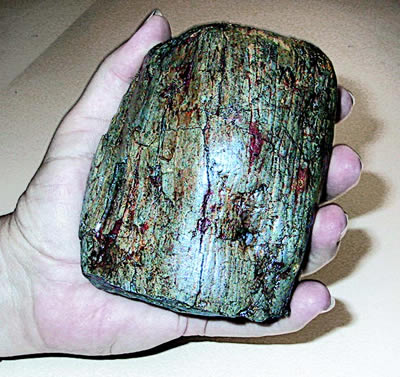
Recently, at a seminar in the state of Washington, I was given a "petrified fence post" pictured above. Subsequent analysis showed that it was definitely petrified wood, had a nail imprint and marks of a strand of barbed wire. It was found along an old fence line probably dating from the late 1800s in an area of central Washington dominated by a thick blanket of volcanic ash. All that remained of the post was a stub four inches long, three inches wide and two inches thick. It was obviously a "worked" piece of wood, for the clearly visible tree rings had been truncated. The log from which it had come was probably two feet or so in diameter, judging from the curvature of the rings.
Does it prove anything? No, not really, but maybe this report will encourage some reader to realize that these long age/evolutionary stories of "millions and millions of years" he's heard over and over again are really just myths. The Biblical truth of creation/flood/young Earth might just be right after all.
[body_edit] =>
"And the light shineth in darkness; and
the darkness comprehended it not." (John 1:5)
Common folklore holds that petrification takes "millions and millions of years." Even though every knowledgeable scientist knows differently, this misconception continues. The great ages concept forms the backdrop for the entire evolution worldview, thus there's no desire to lessen the hold "millions and millions of years" has on the lay public. But petrification can and does happen rapidly. At least this argument can and should be removed from evolution's arsenal.
Petrification is that subset of fossilization in which the organic material is encapsulated or replaced by silica. In wood it can best be accomplished by injection of hot, silica-rich water into the wood. The silica fills in the voids left by decaying cells, or, most often, surrounds each cell with an impervious shell, halting all organic activity or decay.
Wood can be petrified in a laboratory in a very short period of time using high pressure injection. Likewise in nature many examples can be given of recent or living objects rapidly petrifying in the presence of silica and hot water. In Yellowstone National Park, hot waters percolating through volcanic ash dissolve the silica contained therein. Trees growing near the bubbling sources naturally draw the waters into their trunks. As the silica penetrates into the pores, organic activity is interrupted, and the tree eventually dies by petrification.
Many, many examples could also be given of human structures, mine timbers, bridge supports, etc., being petrified since their time of emplacement. It obviously doesn't take a long time; it takes the right conditions.
Recently, at a seminar in the state of Washington, I was given a "petrified fence post" pictured above. Subsequent analysis showed that it was definitely petrified wood, had a nail imprint and marks of a strand of barbed wire. It was found along an old fence line probably dating from the late 1800s in an area of central Washington dominated by a thick blanket of volcanic ash. All that remained of the post was a stub four inches long, three inches wide and two inches thick. It was obviously a "worked" piece of wood, for the clearly visible tree rings had been truncated. The log from which it had come was probably two feet or so in diameter, judging from the curvature of the rings.
Does it prove anything? No, not really, but maybe this report will encourage some reader to realize that these long age/evolutionary stories of "millions and millions of years" he's heard over and over again are really just myths. The Biblical truth of creation/flood/young Earth might just be right after all.
[typeID] => 3
[visible] => t
[pdf] =>
[publishURL] => are-human-artifacts-ever-petrified
[publishDate] => 0000-00-00
[authorAsterisk] => f
[domainID] => 1
[publication] =>
[volume] =>
[issue] =>
[page] =>
[author] => John D. Morris, Ph.D.
)
-->