Research into insect eyes continues to reveal amazing structure and function. For example, although fruit flies’ eyes are attached firmly to their heads, it was discovered that their retinas can move internally to smoothly track visual motion.1
Scientists from the University of Konstanz, Germany, recently discovered how light is processed by the brain of the hummingbird hawk-moth. They uncovered the incredible manner in which this insect’s neural pathways extract only relevant information so the brain is not overwhelmed by too much visual data. The brain’s neural systems filter and categorize information early on to reduce the complexity to a manageable level.
The area of the tiny insect brain called the lamina serves as the first visual processing center. It directly connects to the eye and is the first portion of the brain the German biologists studied.2 Within this visual processing center are the lamina monopolar cells (LMCs), which is where one of the filtering steps occurs.3 The brain is designed so that the visual portion efficiently filters all but a fraction of the original visual stimuli.
The article in Phys.org describes the following process of how the photoreceptor input is distinguished and grouped:
In order for them [hawkmoths] to get the best possible picture of their surroundings, input from photoreceptors in the eye must be processed afterward by the brain. It is as if the input travels through a multi-layer filter, constantly being filtered, categorized and ultimately being forwarded along in reduced form to the next area of the brain.2
Furthermore, design features ensure that whether the moth is in dim light or bright light, the brain can “operate as efficiently as possible in response to current light conditions and to maintain a balance between signal strength and image resolution.”2
God has designed photoreceptor cells, and others cells within the compound eyes and brains of insects, with the coordinated ability to take on several tasks. With this hawkmoth research, biologists have observed something amazing—individual cells are able to undertake diverse tasks and switch between them.
They discovered that “the same cell fulfills different tasks in different layers of the lamina: ‘For the first time, we see that the lamina is split into functional layers: in one layer, a cell collects signals, while, in another, the same cell inhibits neighboring cells,’” stated neuroethologist4 Ronja Bigge of the University of Konstanz.2
Indeed, Bigge et al. stated in their Current Biology paper, “Based on these findings, we propose a novel mechanism of delineating distinct spatial processing functions in a single cell.”3 Spatial processing of visual information had not been known to occur in this area of the insect brain. Such processing by the hawkmoth is critical for three-dimensional orientation, object recognition, and navigation. These incredible design features in a single cell point to the all-wise Designer, the Lord Jesus.
In regard to further research, neuroethologist Anna Stöckl said, “We are excited to uncover what evolution has in store for us.” Such a statement is a classic example of circular reasoning. The author assumes evolution is a fact before conducting the research, so whatever evidence is uncovered will inevitably be interpreted to validate the molecules-to-man theory.5,6
In the last decade, divinely engineered blueprints are clearly seen within the insect brain. In addition to these recent hummingbird hawk-moth discoveries are the split-second modulation in the dragonfly,7 the strong internal compass system of the hawk moth,8 the transitive inference (logical reasoning) in the paper wasp,9 cognitive (learned) foraging routes and memorized spatial locations in a tropical butterfly species,10 and more. These amazing neurological abilities reflect creative design and incredibly detailed organization that befits an incredibly detailed and creative Designer.
References
- Sherwin, F. Fruit Fly Jitters. Creation Science Update. Posted on ICR.org November 17, 2022.
- Looking Deep into the Eyes of Insects. University of Konstanz. Posted on phys.org. January 21, 2026.
- Bigge, R., Arikawa, K, and Stockl, A. The Functional Morphology of Hawkmoth Lamina Monopolar Cells Reveals Mechanisms of Spatial Processing in Insect Motion Vision. Current Biology. Posted on cell.com January 16, 2026.
- A neuroethologist studies the relationship between an animal’s nervous system and its behavior in the environment.
- Thomas, B. Evidently, Evolution Proves Evolution! Creation Science Update. Posted on ICR.org June 20, 2008.
- Thomas, B. Cyclostratigraphy: Another Round of Circular Reasoning? Creation Science Update. Posted on ICR.org June 23, 2014.
- Sherwin, F. Aerial Engineering and Physics of the Dragonfly. Creation Science Update. Posted on ICR.org May 26, 2022.
- Sherwin, F. Amazing Moth Compass. Creation Science Update. Posted on ICR.org September 1, 2022.
- Sherwin, F. Brainy Paper Wasps. Creation Science Update. Posted on ICR.org August 10, 2022.
- Sherwin, F. Butterfly Learning and Memory. Creation Science Update. Posted on ICR.org December 19, 2024.
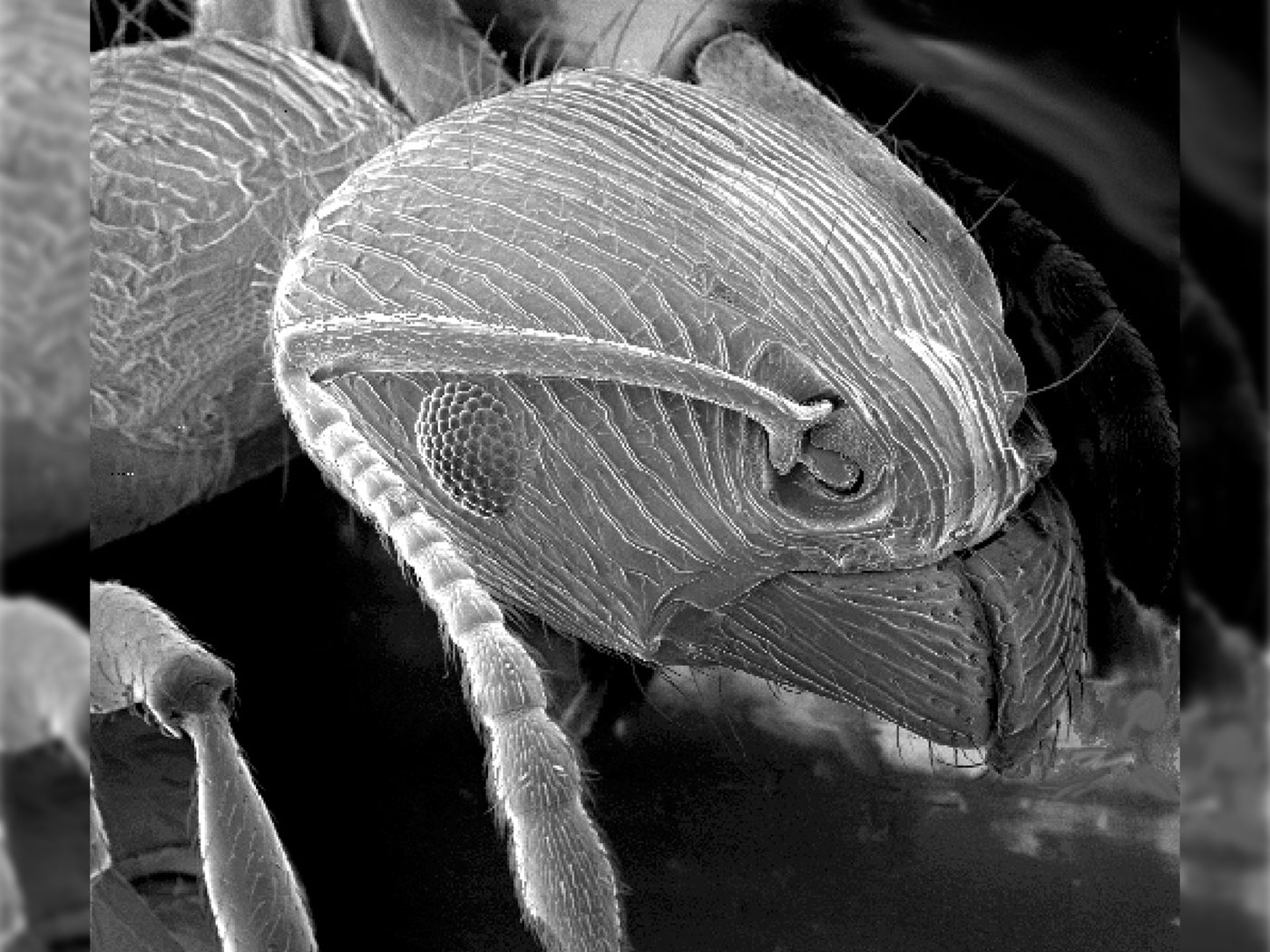
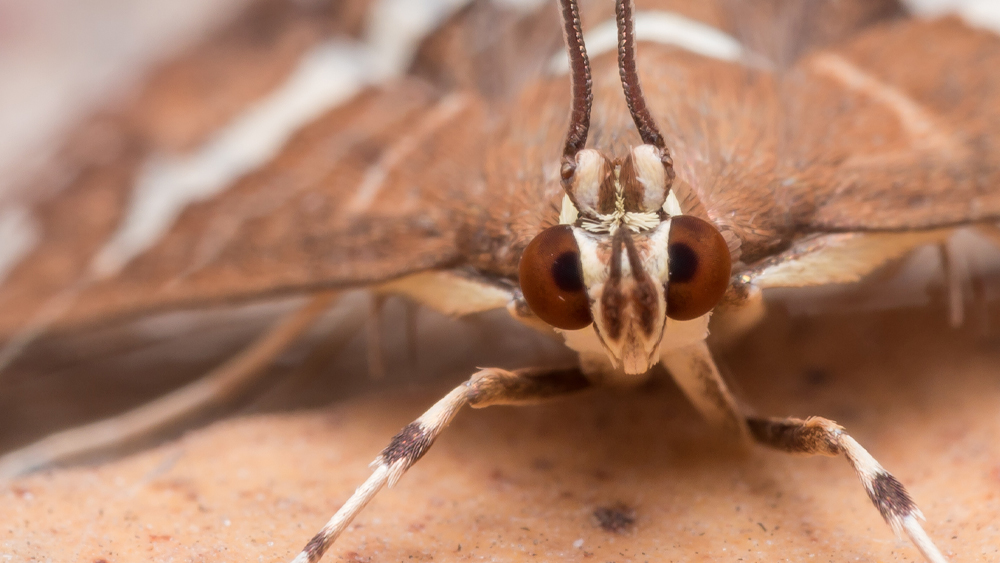
Stage image: An example of moth eyes
* Dr. Sherwin is a science news writer at the Institute for Creation Research. He earned an M.A. in invertebrate zoology from the University of Northern Colorado and received an honorary doctorate of science from Pensacola Christian College.