As you read this article, think about your body. It’s composed of over 100 trillion cells working nonstop in a complex choreography of microscopic building and repairing. Scientists have looked inside these cells and viewed the unparalleled sophistication of their millions of tiny machines made of protein.1 In this article we’ll look at several kinds of these incredible micro-machines. An evolutionary website recently made this statement about a spindle machine involved with mitosis—the cell’s nuclear division:
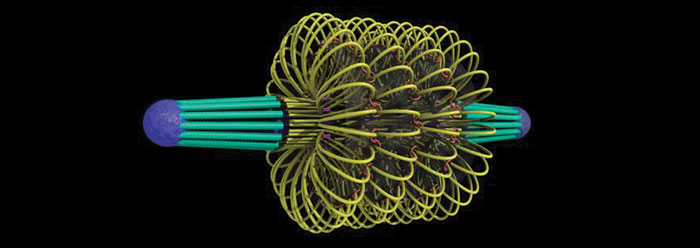
At the cellular level, the mitotic spindle apparatus is arguably the most complicated piece of machinery in existence.2
The spindle apparatus is formed from very thin protein threads called microtubules that stretch between opposite poles of the cell during mitosis. These are forming by the millions right now inside your body!
If you took high school biology, you were probably taught how cells make protein—a process called protein synthesis. In recent decades, newly discovered details show this process to be incredibly complex and highly orchestrated.
Transcription is the first part of the protein synthesis that occurs in the cell nucleus. During transcription, DNA is copied nucleotide by nucleotide in an operation mediated by an amazing enzyme called RNA polymerase. This tiny biological machine moves along the DNA, rapidly reading the genetic code. This results in a growing string of messenger RNA (mRNA) emanating from the RNA polymerase as the nucleotides are read. This mRNA then leaves the nucleus, and its code is translated into proteins or polypeptides (the second part of protein synthesis) via ribosomes in the cytoplasm.
In a further display of amazing complexity, a portion of the ribosome is designed to undergo a “large-scale rotation” by pivoting along a hinge while also functioning like a ratchet!3
At virtually the same time, however, the cell duplicates its entire genome (DNA) in preparation for mitosis, followed by division into two cells. This step is called replication and is every bit as complex as transcription. For example, right now in millions of your cells, replication is beginning at about 10,000 to 100,000 different places on a DNA strand. The small portions of replication are called replicons (unit lengths of DNA). Replication is effected by a highly complicated machine generically called replisome that attaches to the DNA strand.
To have both replication and transcription occur at once is akin to having two microscopic locomotives (molecular machines) heading toward each other on the same railroad track (DNA strand). When these molecular machines occasionally collide, it results in a genetic train wreck that can cause aging and diseases like cancer. Enter another amazing molecular machine with several functions called Dicer. This enzyme cuts or cleaves pre-microRNA (pre-miRNA) and double-stranded ribonucleic acid (dsRNA). This biochemical slicing results in short, double-stranded RNA fragments. With further investigation, researchers discovered another unrelated function of Dicer—it removes the transcription machine from the DNA “track,” allowing the replicase machine to proceed without collision.4
Finally, speaking of the long DNA molecule, God designed machinery that actually repairs tangles in your DNA automatically:
One of these DNA repair enzymes acts as a kind of molecular scissors to cut DNA at damage points and resolve tangles that can form when things go wrong. This must be done with great specificity in order to restore the DNA code to its previous state and not generate mutations.5
Where does this “great specificity” the secular authors speak of come from? Nothing less than “the living God, who made the heaven, the earth, the sea, and all things that are in them” (Acts 14:15).
References
- Sherwin, F. 2004. Molecular Motors vs. Evolutionism. Acts & Facts. 33 (4).
- Hewitt, J. The Machinery of Mitosis: Kinetechores, centrioles and chromosome pumps. PhysOrg. Posted on phys.org October 4, 2013, accessed October 26, 2014.
- Mohan, S., J. P. Donohue, and H. F. Noller. 2014. Molecular Mechanics of 30S Subunit Head Rotation. Proceedings of the National Academy of Sciences. 111 (37): 13325-13330.
- Jansen, J. How a Molecular Superman Protects Genome From Damage. Cold Spring Harbor Laboratory News. Posted on cshl.org October 16, 2014, accessed October 25, 2014.
- Field, S. How to Remove Tangles in Your DNA. PhysOrg. Posted on phys.org October 8, 2014, accessed November 10, 2014.
Image Credit: University of North Carolina Mitotic Spindle Group.
* Mr. Sherwin is Research Associate, Senior Lecturer, and Science Writer at the Institute for Creation Research.