by Brian Thomas, M.S., & Tim Clarey, Ph.D. *
Another support beam has fallen from evolution’s explanatory framework as European scientists now report the discovery of flowering plant fossils in Middle-Triassic rocks—conventionally assumed to be around 240 million years old. According to secular age assignments, flowering plants were not supposed to have evolved until 100 million years later!1 These fossils force a shift in the ever-changing story of plant evolution.
Most paleontologists believe flowering plants, or angiosperms, did not “evolve” until the Early Cretaceous system—supposedly 135 million years ago. They often refer to the Cretaceous as a time of transition.2 Charles Darwin referenced the sudden appearance of fully-formed flowering plant parts in the fossil record as an “abominable mystery” in a letter to Joseph Hooker in 1879, and these new blooming fossils only intensify the puzzle.
Newly Described Fossil Pollen
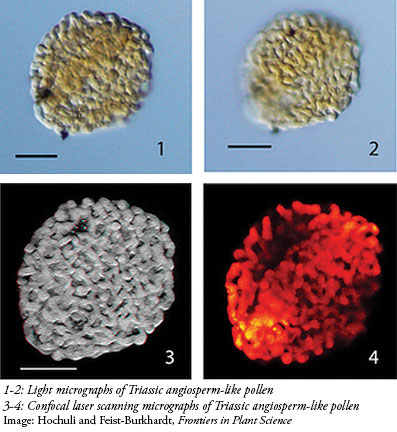 The fossil pollen grains in question, recovered by Peter Hochuli and Susanne Feist-Burkhardt from cores in northern Switzerland, have caught the evolutionary world off-guard. The researchers wrote, “In this paper we focus on fossil evidence, presenting the so far oldest angiosperm-like pollen from the Middle Triassic (ca. 243Ma [million years]), a record that predates the generally accepted first occurrence of angiosperm pollen by more than 100Ma.”1
Their accompanying color photographs show pollen-grain features diagnostic of flowering plants, clearly not gymnosperms like palms or cycads. “The described pollen grains show all the essential features of angiosperm pollen,” according to their report.3
And instead of the few primitive-looking pollens that evolutionary scientists were expecting to find in lower rock layers, the researchers discovered pollens of different but already well-developed types. The study authors wrote of the “sudden appearance” of angiosperm fossils “on most continents as well as the rapid radiation of numerous clades [which] implies a considerable diversification within approximately 3.5 Ma or else it represents a wave of immigration from other areas.”1 In other words, they had difficulty explaining how such a wide variety of flowering plants suddenly occur in this Triassic layer.
They encountered another challenge in trying to decipher why, after this sudden burst of supposed evolutionary creativity, angiosperms avoided fossilization for 100 million years. The study authors wrote, “If we accepted the monosulcate [single-groove angiosperm] pollen from the Middle and Late Triassic as evidence for a pre-Cretaceous origin of crown group [ancestral] angiosperms the lack of fossil records throughout the Jurassic would remain difficult to explain.”1
Reasoning in a Circle?
To account for this difficulty, the authors invoked speculative “stem relatives,” writing that “considering the hundred million year gap in the record as well as morphological differences to the earliest Cretaceous we suggest that these pollen grains most likely represent stem relatives of the angiosperms.”1
Why call these fossils “stem relatives of the angiosperms” instead of simply “angiosperms”? In the scientists’ words, it’s because of an assumed 100-million-year gap of angiosperm absence, not because of any direct scientific observation.
Here’s the problem: It’s one thing to assert that these fossils represent evolutionary ancestors of modern plants because they are supposedly millions of years older than the accepted age. But it’s entirely circular to then assert that the angiosperm fossils must have formed millions of years before the accepted age simply because evolution requires that plants evolved over long ages.
More Story-Changing Finds
This isn’t the first fossil evidence for pre-Cretaceous-system angiosperms. Hochuli and Feist-Burkhardt mentioned several reports of angiosperm-like pollens from both Triassic and Jurassic system rocks going back to the 1960s. Unfortunately, most of these finds either “received mixed attention” or were “simply ignored” by most evolutionists, probably because pre-Cretaceous angiosperms disrupt well-established evolutionary theories.1
For example, Robert Bakker devoted an entire chapter in his book The Dinosaur Heresies to “When Dinosaurs Invented Flowers.” Bakker explained, “When plant-eating dinosaurs evolved more effective teeth or fermenting chambers, the plant species had to adjust to the new weaponry or die,” as if merely the presence of a challenge produces its own solution within plants and animals.4 Bakker continued in confident narrative, “As more and more new kinds of Cretaceous beaked dinosaurs entered the system, more and more angiosperm families evolved.”5
But now that angiosperms have been identified in Triassic layers, at least one chapter in Bakker’s book needs substantial editing.
Moreover, previous finds have knocked even more support beams from rickety evolutionary stories about plant origins. In 2005, lead author Vandana Prasad reported that grass-signature fossils were discovered in dinosaur dung from India.6 In 2011, Prasad’s team also documented microscopic rice-related fossils in other sauropod fossils.7 Grasses, including rice, are classified as angiosperms since they produce flowers, albeit small ones. Evolutionary pictures of dinosaurs never depicted them with grass in their mouths, but now they certainly should.
A Better Explanation
The discovery of angiosperms in rock layers below those containing most dinosaurs and the discovery of grass fossils among sauropod (long-neck) dinosaurs confirm two biblical details about behemoth, the dinosaur from the book of Job that “sways his tail like a cedar.”8 The text describes its diet, saying, “Look at Behemoth, which I made along with you and which feeds on grass like an ox.”9 Prior to the discovery of grass particles in fossil dinosaur dung from India, the evolutionary picture had no place for dinosaurs eating grass, but it was recorded in Scripture all the while!
Job also affirms that God made behemoth “along with you,” meaning during the creation week when God made angiosperms, dinosaurs, and man.8 So seeing flowering plant fossils mingled with creation-week animal fossils is no surprise to Bible believers.
The Bible’s record of all the major phases of world history shows no trace of a Triassic time but offers a better explanation for these pollen fossils. First, without using circular reasoning or speculation, eyewitnesses wrote the events recorded in Scripture, indicating that there is error in assuming long ages of plant evolution.10
Second, Scripture reports the instant creation of each plant kind. This exactly fits these pollen fossils’ sudden appearance. Third, it describes in detail a worldwide flood capable of preserving life’s traces in fossil forms. In that context, distinct flora and fauna fossils do not represent separate times divided by some 100-million-year gap but distinct ecosystems buried by massive surges of sediment-laden Flood waters.11
Finally, the Bible’s timeline shows a creation that is thousands, not billions, of years old, erasing any need to explain why pollen grains buried deep in fossil layers look so similar to that of living herbs and flowers.
References
- Hochuli, P. A. and S. Feist-Burkhardt. 2013. Angiosperm-like pollen and Afropollis from the Middle Triassic (Anisian) of the Germanic Basin (Northern Switzerland). Frontiers in Plant Science. 4 (344): 1-14.
- Lucas, S. G. 2007. Dinosaurs: The Textbook, 5th ed. New York: McGraw-Hill.
- The team compared gymnosperm pollen grains found at the same site to show “a distinct contrast to the exine structure of the columellate, angiosperm-like grains” (reference 1).
- Bakker, R. T. 1986. The Dinosaur Heresies. New York: William Morrow and Co., 184.
- Ibid, 197.
- Prasad, V. et al. 2005. Dinosaur Coprolites and the Early Evolution of Grasses and Grazers. Science. 310 (5751): 1177-1180.
- Prasad, V. et al. 2011. Late Cretaceous origin of the rice tribe provides evidence for early diversification in Poaceae. Nature Communications. 2 (9): 480.
- Thomas, B. 2013. Dinosaurs and the Bible. Dallas, TX: Institute for Creation Research.
- Job 40:15.
- 2 Peter 1:16.
- See Parker, G. 2006. Creation: Facts of Life. Green River, AR: Master Books.
* Mr. Thomas is Science Writer and Dr. Clarey is Research Associate at the Institute for Creation Research.