Archaeologists uncovered the remains of a well-maintained and well-built British road beneath an ancient Roman road in 2011. This evidence contrasts what modern texts teach about primitive-pagan peoples inhabiting the land before Caesar conquered it and even draws into question the long ages of human development suggested by evolution.
The ancient road, just south of Shrewsbury, was cobbled and even engineered with a camber for draining off water. The Daily Mail reported, "[It] even has a kerb fence system to hold the edge in place."1 Researchers used carbon-dating to determine its pre-Roman status.
Tim Malim, an archaeologist working on the project, told the Daily Mail, "The traditional view currently is that the Romans came over to Britain, built the roads and civilised the people. But we have found that this road was built before the Romans invaded."1
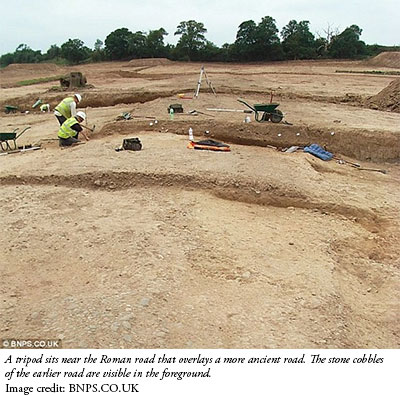 And only knowledgeable and civilized people could have built roads so well, which means these ancients were not at all "primitive" in their abilities to build and design like we do today.
A new book by former Exeter College Fellow Graham Robb examined in more detail the concept of pre-Roman roads and other civil structures in Britain. In The Ancient Paths, Robb showed how hundreds of ancient towns were aligned and connected with a certain order. He told the Telegraph, "I thought it can't be true, I have to disprove it. But they were a very advanced civilisation."2
"Very advanced" does not fit the standard conception of Stone Age or Iron Age peoples. But it does match ancient records.
In his book, After the Flood, historian Bill Cooper wrote of ancient Welsh records containing a list of kings going back centuries before the Roman invasion. Cooper referenced Geoffrey of Monmouth, a 12th-century Welsh monk and scholar who translated The Chronicle of the Early Britons from Welsh into Latin.3 Cooper wrote, "Geoffrey tells us that Belinus was a great road-builder, and that Billingsgate in London was built by and named after him."4 Belinus "ruled the [entire British] kingdom from ca 380-374 BC."5, 6
The Chronicle itself, recently translated from ancient Welsh to English, provides details about these roads, including how their layout is reminiscent of the striped pattern on the British flag:
And so he, Belinus, summoned before him all the stonemasons of Britain, and commanded them to build roads of stone and mortar, according to law. And one of the roads ran through such cities as lay in its path from the tip of Cornwall [Totnes] up to Cape Bladdon [Caithness] in Albany, the entire length of Britain. And another was built at his command to run across the land from Menevia [present-day St David's] on the one coast to Port Hamon on the other, the same being Southampton. And two other roads also he caused to be laid, running obliquely from corner to corner, passing, as did the others, through the cities [that lay in their path]."7
So, artifacts like well-maintained stone roads built prior to Julius Caesar's 55 BC invasion of Britain and ancient chronicles that plainly state that is exactly what took place (not to mention the name of modern-day "Billingsgate" matches king Belinus' chronicled name) do not at all support secular historians' assertions of an opaque history featuring vague iron, bronze, stone, primitive, and even ape-man ages.8 After all, British chronicles, as well as those of several other European and ancient nations, trace their kings' ancestries all the way back to Japheth—Noah's son!
Bible-affirming historical evidence, both written and buried, not only affirms pre-Roman British civilization but also corroborates a Genesis-based history that stands starkly at odds with evolutionary ages.
Do all roads lead to Rome? Perhaps on closer inspection, all roads lead back to Genesis.
References
- Ellicott, C. So what did the Romans do for us? Archaeologists find cobbled road that was built 100 years BEFORE they invaded. Mail Online. Posted on dailymail.co.uk March 16, 2011, accessed October 16, 2013.
- Dixon, H. 'Roman' roads were actually built by the Celts, new book claims. The Telegraph. Posted on telegraph.co.uk October 13, 2013, accessed October 18, 2013.
- The work of Geoffrey of Monmouth and others "was consigned to oblivion after the massacre, at the instigation of Augustine, of the [1,200] British monks at Bangor in AD 604 and was thus entirely unknown or ignored by the later Saxon and Norman chroniclers of England." See Cooper, B. 1995. After the Flood. Chichester, England: New Wine Press, 69.
- Ibid, 74.
- "Belinus" is his Latinized name, which in Welsh was Beli. His brother Bran (Brennius in Latin) was famous because he "eventually led the Celtic sack of Rome in ca 390 BC," an event that Roman records separately verify. See Ibid, 74.
- Ibid, 73.
- Cooper, B. (trans.) 2002. Chronicle of the Early Britons. Digital book, accessed October 28, 2013.
- Thomas, B. Were Stone Age Britons Trigonometry Experts? Creation Science Update. Posted on icr.org September 21, 2009, accessed October 18, 2013.
* Mr. Thomas is Science Writer at the Institute for Creation Research.
Article posted on October 30, 2013.