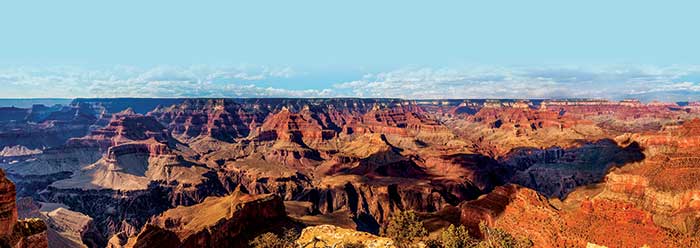
In a prior column, I pointed out that Earth’s strata, which often lay conformably one on top another, are believed to be separated by millions of years of time, according to traditional thinking.1 The dates—derived by radioisotope dating, the fossil content, or whatever means—often indicate that the top of one bed is much older than the bottom of the overlying bed. This age difference claim is made in spite of the fact that the layers are right on top of each other—clearly appearing like their deposition was continuous. The contact between them is frequently parallel and neatly stacked with no evidence of erosion or anomalous deposition at all in between the layers. Of course, there are some places where erosion has taken place or where the removal of an intervening bed is obvious, but I want to call your attention to the “layer-cake” stratification of multiple parallel beds similar to those plainly seen in Grand Canyon and other places.
Keep in mind that the layers are clearly underwater deposits and typically contain marine fossils. A few rare strata exhibit what might be proposed to be a terrestrial origin, but these are exceptions to the rule, and the claims concerning them are often quite controversial. Without a doubt, nearly all geologists conclude that the vast majority of strata were water-deposited.
As a general rule, if a surface is underwater, it receives sediment. Even in a calm ocean, a steady stream of sediments will collect on the ocean floor. But if the surface is above water, it normally undergoes erosion. Continental erosion incessantly gouges out stream beds and river valleys. It almost never produces flat pancake-like surfaces.
Exceptions to the rule involve fast-flowing water. Flat, past erosion surfaces imply “sheet erosion,” during which equivalent depths of large, rapidly flowing volumes of water rush over a wide surface, eroding it down to a common elevation. This seldom happens today except with devastating floods or hurricanes, and even then the affected area is local. Moving water erodes every geologic surface—even hard rock.
How then can we account for the near-ubiquitous presence of flat, parallel strata, especially where no evidence of erosion of any sort can be found? According to standard thinking, millions of years passed between the deposition of each of the individual layers, but where is the evidence of exposure and erosion? Where are the drainage ditches and the river valleys that should have been carved into the exposed sediment surfaces during all that time?
The uniformitarian model proposes that flat-lying sediment layers deposited underwater must have been uplifted above sea level and undergone neither deposition nor erosion, then down-dropped below sea level again to receive the next layer of sediment. This happened again and again with each surface experiencing simultaneous non-deposition and non-erosion while it was above sea level. In Grand Canyon, the flat layers must have been uplifted and dropped at least six times. Uniformitarians sometimes claim strata sequences like these must have “bobbed up and down like a cork” over millions and millions of years, all the while resisting deformation and signs of erosion and maintaining their flat and parallel geometry.
How realistic is it to propose exposure above sea level for millions of years without erosion? The normal weathering processes of rainfall and violent storms would have carved out channels and gullies across the exposed land surface, but we see no evidence that this ever occurred! Instead, we see flat layers upon flat layers as if they were neatly deposited one on top of the other—just what you’d expect in deposits from a continuous and global flood.
Once again, we see that uniformitarianism fails a simple geologic test. Rather than relying on human wisdom-based uniformitarianism, Bible-based catastrophism is a much better perspective within which to interpret Earth’s strata. The Grand Canyon “layer-cake” stratification is yet another sign of God’s handiwork.
Reference
- Morris, J. 2012. Gaps in the Geologic Column. Acts & Facts. 41 (2): 16.
* Dr. Morris is President of the Institute for Creation Research.
Cite this article: Morris, J. 2013. Up and Down Like a Cork? Acts & Facts. 42 (9): 14.