The most common sedimentary rock type is known as shale, made up of tiny silt or clay particles cemented together. Tiny particles are easily carried along by moving water. Thus, in uniformitarian thinking, shale particles take an inordinate amount of time to fall through a column of water and settle on the bottom, even when the water is completely calm.
Some shales are black in color, loaded with organic material. The classic North American example of black shale is the Chattanooga Shale; evolutionary scientists traditionally thought that it was deposited in deep, stagnant ocean water. But that may be too simple, because other evolutionists acknowledge the problem of the “Chattanooga Black Shale Enigma.”1
Flood geology places essentially all strata during the great Flood of Noah’s day—a depositional situation that is quite different from deep and stagnant water. Seldom more than 20 feet thick, the Chattanooga Shale is underlain by an amazingly flat, featureless erosional surface, with no significant high or low areas where deposition took place. Such flat erosion usually speaks of rapid sheet erosion. This shale deposit is often presented as classic evidence for uniformitarian deposition in a “calm and placid sea,” but could there be another interpretation?
A closer look at the details provides a catastrophic depositional model instead.
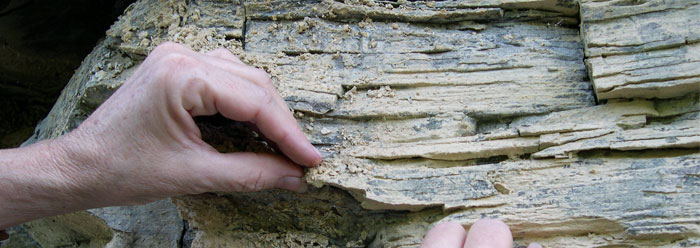
The shale consists of innumerable fine layers, or laminations, that can be easily separated. Often between the layers are fossils of both marine creatures such as brachiopods and land plants such as lepidodendrons. Also present are animal escape burrows, formed as rapidly buried sea creatures attempted to burrow out of an underwater grave. The mix of environments seems to indicate that it was not a calm environment.
The laminations are also problematic. Instead of being uniformly flat, they are graded and tilted up at an angle, and in some places they form cross-beds, requiring a rapid current environment. An overall look at the strata leads to a diagnosis of hummocky cross-stratification, also indicative of rapid water current and continual deposition of particles. The clay particles themselves are uniformly aligned, as revealed by an AMS (anisotropy of magnetic susceptibility) study, a prime indicator of current.
Most importantly, the layer is enormous in areal extent. It was first identified in Tennessee (where it received its name), but now is widely recognized from Alabama to Canada on the east coast, to Iowa and Texas, to Oregon on the west coast, and into northern Mexico and even offshore.2 No modern analogy exists for such a deposit.
The Flood account in Genesis specifically informs us that the Flood was catastrophic in nature (Genesis 7:11-12, 17-20, 24, etc.) and global in extent (e.g., 6:13, 17; 7:10, 21-23; 8:3, 5, 11; 9:15). We would expect its damage to give evidence of this catastrophic cause and extent, and indeed we do. The Chattanooga Shale surely provides such evidence. It provides no such support for the uniformitarian worldview.
References
- Prothero, D. R. and R. H. Dott, Jr. 2004. Evolution of the Earth, 7th ed. Dubuque, IA: McGraw-Hill, Inc., 291.
- Weil, S. A. et al. 1979. National Uranium Resource Evaluation: Chattanooga Shale Conference, U.S. Department of Energy.
* Dr. Morris is President of the Institute for Creation Research.
Cite this article: Morris, J. 2012. The Chattanooga Shale, an Evolutionary Enigma. Acts & Facts. 41 (11): 15.