 Humans living before Noah’s Flood routinely had 900-year lifespans (Genesis 5). The Bible gives no hint that this longevity was in any way miraculous. And it is very difficult to imagine a mechanism or mechanisms, whether genetic or environmental, that would promote extreme longevity in humans that would not also promote extreme longevity in animals. So, it would make sense that pre-Flood animals also experienced great longevity. Since nearly all the world’s fossils, including those of dinosaurs, are the remains of creatures that perished in the Genesis Flood, their fossils might contain clues hinting at very long lifespans. Longevity studies in living animals have repeatedly confirmed that creatures that take a long time to mature tend to live longer than those that mature more quickly.1 Could this have been the case for dinosaurs as well?
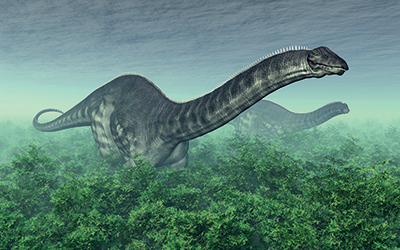
Larger animals generally live longer than smaller animals. Obviously, some dinosaurs were very large. This is especially true of the sauropods, the long-necked, long-tailed giants like Apatosaurus. Creationists have long speculated that these dinosaurs had very lengthy lifespans, and preliminary data may be starting to confirm this expectation.
Estimating Dinosaur Age
Scientists infer dinosaur ages by counting the growth bands, or rings, in their bones. The bones used for such studies are often, but not always, weight-bearing long bones like the femur or humerus. However, damage to the fossil can make it difficult or impossible to count the rings. On top of that issue, the innermost growth bands can also be “erased” due to a process called secondary bone remodeling. It’s challenging to determine what age to assign to the first remaining, still visible growth band.
Estimating Dinosaur Volume
Body mass depends directly on the body’s volume. The formula for volume is usually a constant multiplied by a length dimension that has been raised to the third power, or cubed (Figure 1). For a perfect cube, this constant is one. For a sphere, this constant is 4/3 π or about 4.19.
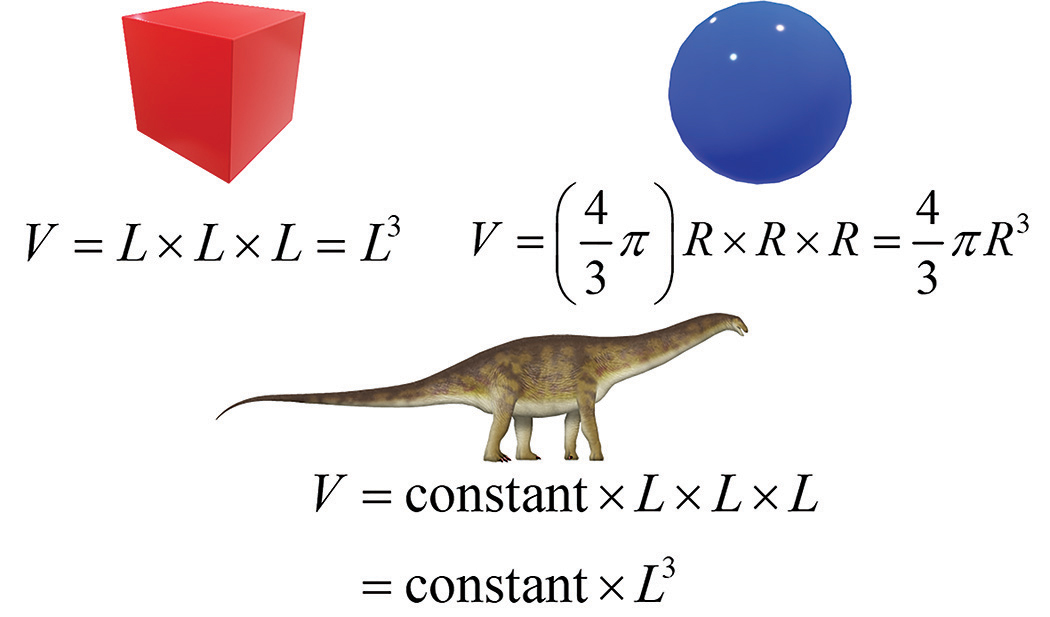
In principle, a similar formula can be used for finding the volume of more complex objects, like dinosaurs. The volume of the dinosaur is the cube of its total body length multiplied by some constant. And the length of a prominent bone, like a femur, is assumed to be a stand-in for the total body length. Based on this assumption, a sauropod dinosaur twice as long as another member of the same species would have a femur twice as long as the other sauropod’s femur.
Fast-Growing Dinos?
In 2001, scientists counted 14 growth rings in two scapulae— shoulder blades—from two subadult Apatosaurus fossils. The growth bands ranged in size from 22% to 56% of the estimated adult scapula length. The researchers concluded that Apatosaurus reached adulthood in about 15 years.2,3
Such a short growth interval would imply amazingly rapid growth, with a peak growth rate of 5.5 tons per year.2,3 Also, assuming that the total body length was proportional to the scapula length, it should have taken the Apatosaurus 14 years just to go from 22% to 56% of its adult length. Yet ages at maturity tend to increase with increasing body mass or weight.4 Apatosaurus was one of the largest land animals to have ever lived. Hence it would seem very strange if it reached adulthood so quickly.
An Expression for Body Weight
Often, large animal body lengths increase with age according to the equation,
(1) L(t) = Ladult – (Ladult – Lhatch)e–bt
where Ladult is the adult length, Lhatch is the length at hatching, e is a number called Euler’s constant (about 2.71828), b is a constant that controls how quickly the animal grows, and t is the age in years.5 Since equation (1) gives dinosaur body length, the cube of equation (1) should be directly related to dinosaur volume V(t) as shown in Figure 1:
(2) V(t) = constant × L(t) × L(t) × L(t) = constant × L3 (t)
The t in equation (2) is included as a reminder that both length and volume change as the dinosaur grows. And since volume is directly related to mass, and mass is directly related to body weight, equation (2) should be directly related to the dinosaur’s weight. Inserting the cube of equation (1) into equation (2) results in a complicated, messy expression, but we can simplify it.
Even the largest sauropod dinosaurs hatched from eggs the length of a football. But the adult body size was so large that the body weight at hatching was negligible compared to the final adult body weight, which we call Wadult. So, we can simplify our expression for body weight so that we just have:
(3) w(t) = Wadult (1 – e–bt)3
Here, w(t) is body weight at some age t. Wadult is estimated from the largest known fossil specimen, presumed to be a full-grown adult. The body weight starts at zero, increases, and then eventually levels off to become a nearly flat, horizontal line. The four curves in Figure 3 have this general shape.
Dividing both sides of equation (3) by Wadult and multiplying by 100% gives the percentage of adult body weight at an age t:
(4) % adult body weight = 100 × (1 – e–bt)3
As mentioned earlier, a sauropod’s total body length was assumed to be directly related to the length of one of its bones. So, doubling the bone length would presumably correspond to a doubling of total body length. Remember also that body weight depends on volume, and volume depends on the cube of a length. During those 14 years of growth, the Apatosaurus body weight started at (0.22)3 = 0.01 = 1% of its final value, and ended at (0.56)3 = 0.18 = 18% of its final value. But to construct a growth curve, what ages should be assigned to these percentages? And what is the value of b in equations (3) and (4)?
A Clever Approach
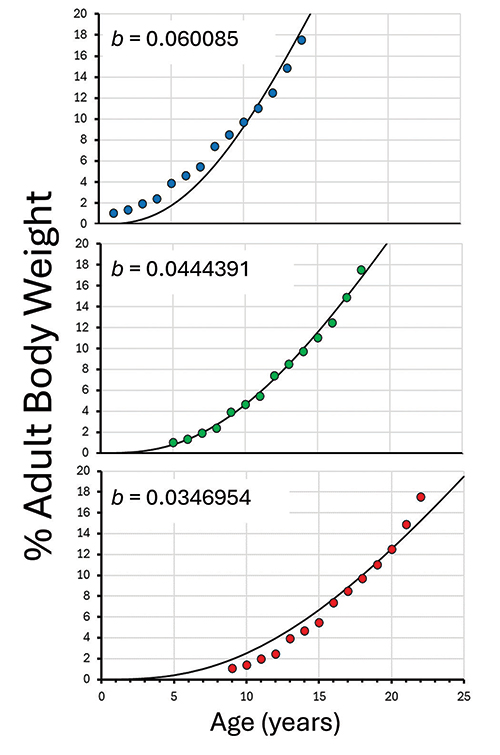
Paleontologists Thomas Lehman and Holly (Woodward) Ballard used a clever approach to determine the age that should be assigned to the first visible Apatosaurus growth ring.3 They experimented with different possible starting ages (one, two, three, four, five years, etc.) for the first ring. The age assigned to the first ring automatically determined the ages to be assigned to the other 13 consecutive data points. For each trial, a computer found the value of b that gave the best-fitting curve to the 14 data points. One of the test curves gave a better overall fit to the data than the other trials. That best-fitting curve indicated the age that should be assigned to the first growth band. This is illustrated in Figure 2.
The 14 weight percentages are exactly the same in the top, middle, and bottom graphs. But different trial ages were assigned to the first percentage in all three cases. The value of b in all three instances is the value that gave the best-fitting curve to those 14 percentages for that particular trial. When the first weight percentage was assigned an age of one year (top of Figure 2), the percentages, represented by the blue dots, generally fell above the plot of equation (4). When the first percentage was assigned an age of nine years (bottom of Figure 2), the red dots tended to fall below equation (4). But there was a “sweet spot” (middle of Figure 2) when the first ring was assigned an age of five years, at which the weight percentages fit very tightly to the growth curve, as illustrated by the green dots. Lehman and Ballard concluded that the first growth band should be assigned an age of five years. This automatically determined the value of b to use for the Apatosaurus growth curve. They reported the best fit to the data when b = 0.045, which is very close to the value of b = 0.044 that I obtained in Figure 2.
Results
With b known, Lehman and Ballard could construct the full Apatosaurus growth curve. They used the same method to find growth curves based on an Alamosaurus humerus, a Janenschia femur, and the pubis of an unknown sauropod from the Northampton Sands in England. The resulting growth curves, after expressing them in terms of body weight, are shown in Figure 3. The data points used to obtain the curves, the implied peak growth rates, and the ages at maturity (99% of adult body weight) are depicted as well.
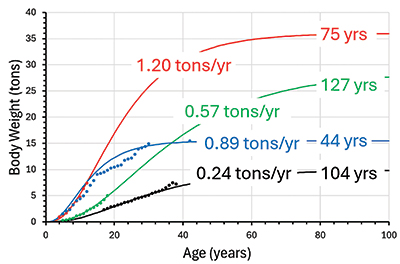
In today’s world, contrary to what we see in Figure 3, very few vertebrate land animals take more than 40 years to stop growing, with the notable exceptions of long-living Galápagos giant tortoises and African bush elephants.6 Yet the lowest estimated sauropod age at maturity is 44 years, and some of these ages may have exceeded a century.
Admittedly, there is uncertainty in these numbers. For Apatosaurus and Alamosaurus, we have only a very small percentage of all their potential growth data. Moreover, dinosaur body weight estimates obtained from femur and humerus bones are considered more trustworthy than estimates from other bones like the pubis and scapula.7 Likewise, the discovery of a larger, more mature sauropod might reveal an unexpected change in growth trajectory that could either increase or decrease these estimated ages at maturity. But without such a change in trajectory, the discovery of a larger bone would increase the age at maturity. Taking that and the number of data points into consideration, the Janenschia curve (blue) is probably the most reliable, the Apatosaurus curve (green) is the least reliable, and the reliability of the Alamosaurus (red) and Northampton sauropod (black) curves fall somewhere in the middle.
In their research, Lehman and Ballard counted only the most prominent sauropod growth bands.3 Ballard recently collaborated with renowned paleontologist John “Jack” Horner and determined that T. rex likely took at least 40 years to reach its full size. But this T. rex result was obtained after including less prominent growth bands in the count.8 This raises the possibility that less conspicuous growth bands should also have been included in this sauropod study. That would make the sauropod ages at maturity, and presumably their full lifespans, higher than those reported here.
Conclusion
If at least some sauropod dinosaurs took a long time, possibly a century or more, to mature, their full lifespans were likely much longer. This is hardly surprising, since humans in the pre-Flood world also lived for centuries.
Dinosaur and other fossils are the remains of animals that were buried and entombed in a global watery cataclysm that occurred thousands of years ago.9 And many of these fossil creatures, including the sauropod dinosaurs, had very long lifespans compared to living creatures today.1,10–12 That sounds . . . biblical!
References
- Hebert, J. 2026. Molluscan Methuselahs: Fossil Crassostrea Oysters. Acts & Facts. 55 (4): 14–17.
- Erickson, G. M., K. C. Rogers, and S. A. Yerby. 2001. Dinosaurian Growth Patterns and Rapid Avian Growth Rates. Nature. 412 (6845): 429–433.
- Lehman, T. M. and H. N. Woodward. 2008. Modeling Growth Rates for Sauropod Dinosaurs. Paleobiology. 34 (2): 264–281.
- Calder, W. A. III. 1984. Size, Function, and Life History. Cambridge, MA: Harvard University Press.
- von Bertalanffy, L. 1938. A Quantitative Theory of Organic Growth (Inquiries on Growth Laws II). Human Biology. 10 (2): 181–213.
- Contrary to popular belief, experts think crocodilians probably do stop growing eventually. See reference 11, page 180.
- Sander, P. M. et al. 2011. Sauropod Bone Histology and Its Implications for Sauropod Biology. In Biology of the Sauropod Dinosaurs: Understanding the Life of Giants. N. Klein et al., eds. Bloomington, IN: Indiana University Press, 276–302.
- Hebert, J. Prolonged 40-Year Growth in T. rex: Evidence for Pre-Flood Longevity? Creation Science Update. Posted on ICR.org January 20, 2026, accessed June 17, 2026.
- Original soft tissue in dinosaur fossils is strong evidence that dinosaurs lived thousands, not millions, of years ago. See Thomas, B. 2014. Original Tissue Fossils: Creation’s Silent Advocates. Acts & Facts. 43 (8): 5–9.
- Hebert, J. 2024. Fossil Sharks Show Signs of Greater Past Longevity. Acts & Facts. 53 (5): 20.
- Hebert, J. 2025. Fossil Crocodilians Grew Larger and Longer, and Lived Longer than Extant Crocodilians. Creation Research Society Quarterly. 61 (3): 172–188.
- Hebert, J. 2026. Did Fossil Birds Live Longer than Today’s Birds? Acts & Facts. 55 (1): 20.
Dr. Hebert is a research scientist at the Institute for Creation Research and earned his Ph.D. in physics from the University of Texas at Dallas.