 Deserts are often viewed as barren wastelands, yet they boast some of the most captivating organisms on Earth. You have to be unusual to live in a desert, and the Joshua trees of Joshua Tree National Park are no exception. Resembling Dr. Seuss’s truffula trees, these distinct plants raise intriguing questions about how desert ecosystems developed and were colonized in the post-Flood world.
Of the 12 U.S. national parks in desert regions, Joshua Tree is unique because it straddles the boundary between two major ecosystems: the higher elevation Mojave Desert and the lower elevation Sonoran Desert. Located about 130 miles east of Los Angeles, this almost 800,000-acre wilderness was designated as a national monument in 1936 and a national park in 1994 to protect its rich biological communities.
It All Starts with the Landscape
To appreciate any ecosystem, you must understand its underlying geology. Tucked behind the San Bernardino Mountains, Joshua Tree National Park is a classic rain shadow desert. Warm, moist air from the Pacific Ocean is forced upward by the mountains, cooling and dropping its rain on the ocean-facing slopes. As the dried air proceeds over the mountains, it descends and warms, creating exceptionally arid conditions across the interior region: the Mojave Desert.
The parched environment is the most important factor affecting which plants you will encounter at Joshua Tree, but it’s the less obvious change in elevation that leaves nerdy ecologists oohing and aahing as they pass through the distinct plant communities of this region.
The Upper Desert
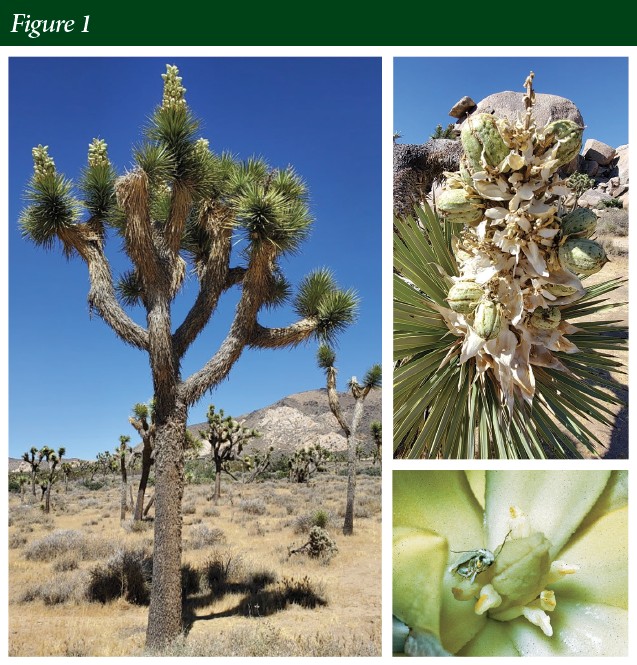
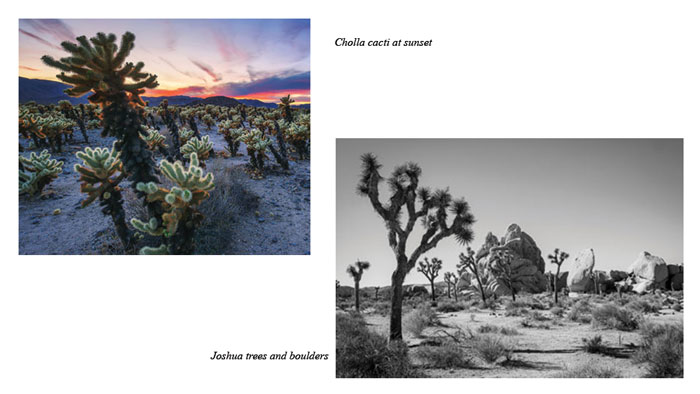
Driving from Los Angeles towards the west entrance to the park, you’ll notice a climb in elevation. The plants are your barometer. As you move steadily upward past unimpressive desert scrub, something almost magical occurs. First there’s one, then another, then as far as the eye can see, hundreds of odd-looking “somethings”—you are now entering the realm of the Joshua tree (Figure 1).
Named by early Mormon settlers for their resemblance to the biblical Joshua pointing the way across the wilderness (I don’t see it), these organisms are actually yuccas. Most yucca species grow in low clumps near the ground, but the Joshua tree hoists its foliage high on long stems. Rather than producing annual growth rings, its trunks slowly stiffen through lignification—a process where woody polymers reinforce internal tissue. Because they lack rings, precise ages are difficult to determine, though the trees are estimated to live between 150 and 300 years.
Joshua trees, like all yuccas, share a tight symbiotic relationship with the yucca moth.1 The female moth intentionally pollinates the flowers, ensuring the plant produces seeds. She then lays her eggs in the flower, allowing her larvae to feed on a portion of the developing seeds while leaving enough for the tree to reproduce. The moth even marks visited flowers with a pheromone, or chemical substance, to signal to other yucca moths, “This flower is taken.” Yucca moths are the sole pollinators of yuccas, and yuccas are the exclusive food source for yucca moth larvae.
This symbiotic relationship is so close that conventional biologist Christopher Irwin Smith says it’s “almost as if the moth and the tree were made for each other.”2 Hmm. From a creationist perspective, such intricate interdependency makes sense as an engineered system, though it raises an interesting question: how did this partnership survive an event as disruptive as the global Flood of Genesis? You can ponder this question as you leave the upper desert and begin the descent into the lower Colorado division of Joshua Tree, considered the western part of the larger Sonoran Desert.
The Lower Desert
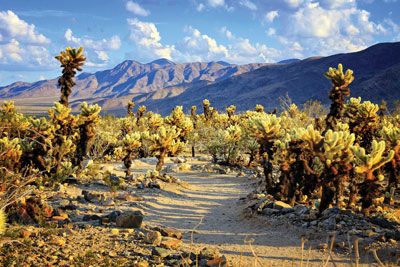
While seeing the quirky Joshua trees may be the highlight of the park, those who venture down to the less trafficked lower desert will experience a remarkable transition between two desert ecosystems (Figure 2).
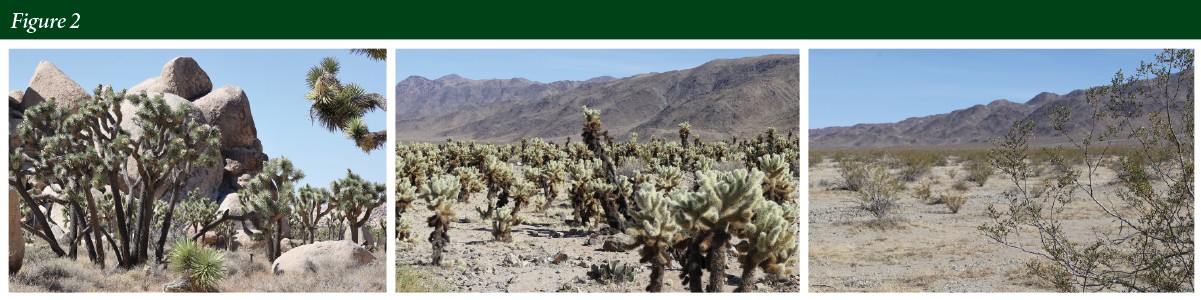
As you meander down Pinto Basin Road through the heart of the park, the plants again will reveal your change in elevation. Descending below 3,000 feet, you say goodbye to the Joshua tree and stumble into another forest of the not-so-cuddly teddy-bear cholla (pronounced “choy-yah” in the Spanish fashion). Joshua Tree National Park brings together just the right environmental conditions that lead to an unbelievable number of these plants growing at Cholla Cactus Garden.
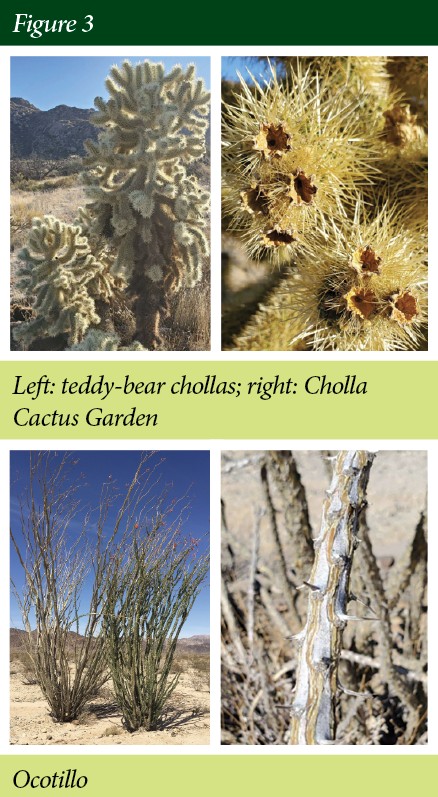
Continue a mile down the road and the chollas give way to the dead-looking ocotillo, which quickly turns into an endless sea of creosote bushes. While not known for their beauty, each of these unique plants is designed to tolerate the harsh conditions of the lower desert (Figure 3).3
Driving through Joshua Tree shows how certain plants prefer and thrive in specific environments. But it also makes you wonder how these plants came to populate this dry wilderness in the first place.
Deserts in a Post-Flood World
Would a “drive” through the pre-Flood world reveal the same landscapes and plant communities we see in Joshua Tree National Park today? Perhaps, yet Scripture and the geologic record suggest the pre-Flood world was different, characterized by a more equitable climate and lush vegetation. The mountain ranges we see today came from catastrophic upheaval during the Flood. Before the Flood, without large mountain ranges, rain shadows would be less severe and deserts rare.
In His wisdom, God engineered plants that were able to thrive in arid environments, but this skill set was probably underutilized in the verdant pre-Flood world. This is supported by the fact that yuccas and cacti are rare in the fossil record. Even conventional biologists recognize the recent success enjoyed by desert-loving plants. According to botanist Isaac Lichter-Marck, “When the deserts emerged, those plants that had the necessary preadaptations to take advantage of new conditions were the ones that thrived.”4 Arid-engineered plants had to patiently wait for an ecological disturbance that would expose new environmental niches in which they could thrive. That came, ironically, in the form of a flood.
As seeds and propagules—parts of a parent plant able to start growing when detached and planted on their own, like bulbs or seedlings—began to germinate after the Flood, they faced a changed landscape: barren land stripped of vegetation, bordered by new mountain ranges blocking rain. This was the opportunity arid-engineered plants had been waiting for. Rather than avoiding extreme conditions, they were preloaded with a core set of traits and adaptability that allowed them to make these extremes their home. For instance, the long stems of Joshua trees are probably a post-Flood adaptive trait within the yucca kind that allowed them to elevate their leaves away from extreme desert floor heat during the summer and protect them from the ground-hugging cold of winter.
The yucca plant/yucca moth mutualism is also interesting to consider from a flood perspective. If the yucca plant survived the Flood as a seed, the moth would need to wait several years after the waters subsided before yucca plants were again producing floral nurseries for its young. The answer to this conundrum probably lies in the yucca moth’s ability to “sleep” for a very long time—a state called diapause. Yucca moths have gone up to 30 years in a dormant pupal state, emerging only when they sense that conditions are right.5 To survive the Flood, this partnership was likely put on hold for several years while yuccas regrew and yucca moths “slept” the time away, tucked safely in cocoons buried in post-Flood vegetation mats.
Traversing Joshua Tree National Park offers a view of an environment changed after the Flood—and fosters an appreciation for incredibly engineered plants and animals designed to adapt in an ever-changing world.
References
- Sheppard, C. A. and R. A. Oliver. 2004. Yucca Moths and Yucca Plants: Discovery of “the Most Wonderful Case of Fertilization.” American Entomologist. 50 (1): 32–46.
- Smith, C. I. Some Trees and Insects Are Made for Each Other. Live Science. Posted on livescience.com November 13, 2009.
- Phillips, S. J. and P. W. Comus, eds. 2000. A Natural History of the Sonoran Desert. Tucson, AZ: Arizona-Sonora Desert Museum Press.
- Sanders, R. With Rapidly Increasing Heat and Drought, Can Plants Adapt? UC Berkeley news release. Posted on news. berkeley.edu January 31, 2023.
- Powell, J. A. 2001. Longest Insect Dormancy: Yucca Moth Larvae (Lepidoptera: Prodoxidae) Metamorphose After 20, 25, and 30 Years in Diapause. Annals of the Entomological Society of America. 94 (5): 677–680.
Stage image: The iconic Joshua tree yucca
Dr. Brown is the director of the Creation Research Society and an associate professor of biology at Arizona Christian University. He earned his Ph.D. in molecular biology from Cornell University.