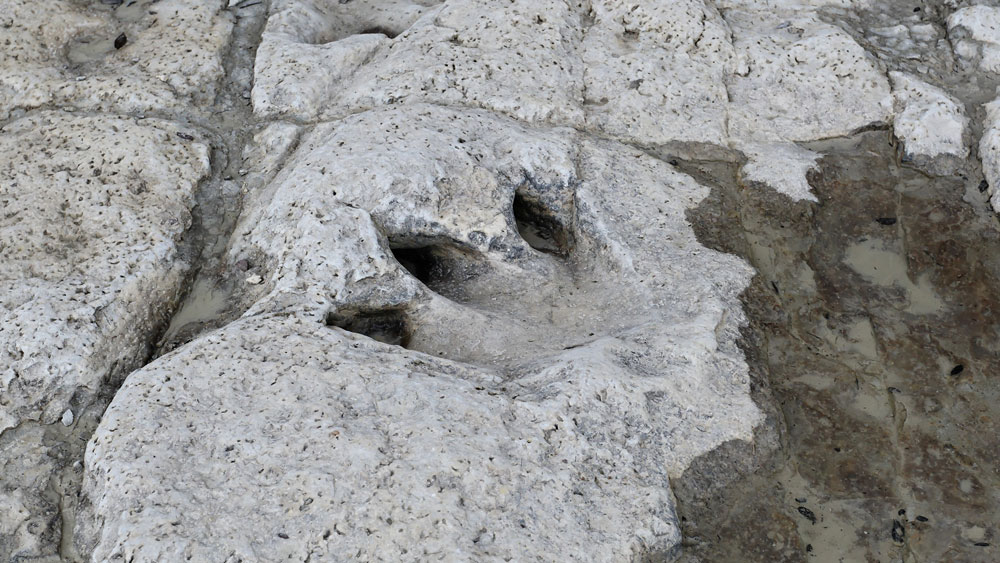
A new discovery of 18,000 individual dinosaur tracks in the Bolivian El Molino Formation contains the highest number of theropod dinosaur tracks in the world.1 The tracks were spread over nine sites in an area encompassing nearly 1.5 football fields. Remarkably, the site also contains the highest number of dinosaur swim tracks ever reported.1
Publishing in PLoS One, the joint science team from the United States and Bolivia wrote,
The Carreras Pampa tracksite in the Torotoro National Park, Bolivia, records a wealth of dinosaur tracks, tail traces, and swim tracks. In this study, we report 1,321 track¬ways and 289 solitary tracks, totaling 16,600 theropod tracks, 280 swim trackways, totaling 1,378 swim tracks, and several trackways with tail traces. Numerous avian [bird] tracks occur locally and are associated with the theropod tracks.1
In addition, the team documented the orientation of the trackways, finding them to have traveled across the site in two primary directions.1 The swim tracks also followed one of these same directions but were formed on top of (later than) the walking trackways.1 The scientists wrote,
The abundant swim tracks were made by the theropods, which nearly floated and swam while kicking the soft bottom with the tips of their toes. The presence of swim tracks impressed upon walking tracks indicates that the latter formed first, and the swim track producers swam later in the same area [and same direction].1
They continued:
This stratigraphic relation indicates that the substrate preserved walking track impressions even while water levels rose enough for dinosaurs to swim. Swimming trackways and isolated, shallow swim tracks were created by individuals who paddled and scratched the substrate.1
The science team also found that
Theropod footprints with tail-drag traces are abundant and well preserved in the tracksite, appearing in trackways featuring shallow, deep, and very deep tracks. The tail traces suggest that dinosaurs exhibited some form of locomotive behavior in response to sinking into soft substrate, which resulted in their tails coming into contact with the surface.2
The rock unit upon which the trackways are found was a rippled limestone bed containing an abundance of small ostracod shells and carbonate ooids and invertebrate burrows. Ooids are little BB-sized balls of limestone that accumulate and roll in shallow waves. And ostracods are tiny crustaceans about one sixteenth of an inch in length. They are commonly found in marine environments but also live in freshwater. The scientists also found fish teeth and shell fragments of bivalves in the same layer. Collectively, these features—the rippled limestone, ooids, and ostracods—are a dead ringer for a shallow ocean deposit.
At another site in the same rock layer, north of Torotoro, the paleontologists reported finding “a variety of invertebrates, plants, and vertebrates, including dinosaurs, reptiles, mammals, amphibians, and terrestrial and marine ichthyofauna.”1 This mixture of terrestrial (dinosaurs) and marine fauna in the El Molino Formation continues to baffle conventional science. No wonder the uniformitarian paleontology team wrote, “No single paleoenvironmental interpretation explains the entire El Molino Formation [the unit that contains the trackways].”1
But why would dinosaurs and birds be “running, sauntering and even swimming”2 across a soft, fresh limestone bed that was likely flooded by a few feet of ocean water? And why so many in the same directions? What were they heading for and/or moving away from? And why did this happen just prior to the disappearance of all the dinosaurs in the rock record?
The global Flood provides the best answer to all of these questions. And it offers an explanation for the walking first, then the swimming, and the tail dragging. It also explains the terrestrial and marine mixing that is so common around the world.3,4
These Bolivian dinosaur trackways were made as the floodwaters were approaching their highest point, late in the Zuni Megasequence (end of the Cretaceous).5 Massive tsunami waves generated by tectonic activity were continually washing in ocean fauna and depositing sediments higher upon the land surface. This is the cause of the ubiquitous mixed terrestrial and marine environments.
The dinosaurs that made these tracks were doing their best to stay above the rising water and were likely heading toward a remnant of higher ground. That may be why so many of the tracks are heading in similar directions. To do so, they had to wade in shallow water on top of a fresh limey substrate, maybe in between tsunami waves. This respite was just long enough to leave their tracks. Then, as the next wave hit, creating the rippled surface and deepening the water, the dinosaurs were forced to swim. But they still kept heading in the same direction, toward what little high ground may have remained.
This explains the order of trackways, starting with walking, the sinking into the soft lime (creating tail marks), and then the outright swimming. It was for survival. But eventually, the floodwaters overcame all of these creatures, washing them away and entombing many of them elsewhere in other rock layers.
Deliberately ignoring the global Flood that occurred about 4,500 years ago leads to great confusion and fictional stories. Believing in the truth of God’s Word resolves many apparent mysteries and leads to clarity and salvation through Jesus.
References
- Esperante R. et al. 2025. Morphotypes, Preservation, and Taphonomy of Dinosaur Footprints, Tail Traces, and Swim Tracks in the Largest Tracksite in the World: Carreras Pampa (Upper Cretaceous), Torotoro National Park, Bolivia. PLoS One. 20 (12): e0335973.
- Starr, M. 2025. 18,000 Tracks Discovered in World’s Largest Dinosaur Tracksite. Science Alert. Posted on sciencealert.com December 4, 2025.
- Clarey, T. 2020. Carved in Stone: Geological Evidence of the Worldwide Flood. Dallas, TX: Institute for Creation Research, 301–304.
- Clarey, T. 2015. Dinosaurs in Marine Sediments: A Worldwide Phenomenon. Acts & Facts. 44 (6): 16. 5. Clarey, Carved in Stone, 282–311.
* Dr. Clarey is the director of research at the Institute for Creation Research and earned his doctorate in geology from Western Michigan University.