What if a fossil no bigger than a grain of rice showed engineering so precise that it still puzzles scientists? That is the intrigue surrounding Salterella, a tiny cone-shaped creature recently studied by Virginia Tech researchers. Their work highlights a surprising feature—a shell made from two different minerals. They describe it as an evolutionary “experimentation” from the start of animal life.1 Yet the structure points instead to purposeful craftsmanship woven into even the smallest creatures.
Researchers found that Salterella built its tapering shell from both calcium phosphate and calcium carbonate. These minerals usually form under different conditions, yet this creature arranged them into a layered cone that anchored into the seafloor and kept its strength. Instead of showing trial-and-error development, this dual-mineral design reveals thoughtful engineering—a built-in ability to use available materials to form a strong, resilient home.2
The structure is remarkable. Each cone narrows in a gentle spiral that spreads stress downward, helping the animal resist currents and pressure from shifting sediment. The layered minerals add stiffness without extra weight. These traits match design principles used in modern composite materials—combine substances with different strengths to make a stable, dependable structure.
The sophistication becomes even clearer when we look at Salterella’s sudden appearance in the Cambrian layers. It does not appear through small, gradual steps. Instead, it shows up fully formed, with complete and functional architecture from the start. Scientists still debate its closest relatives. The newest study suggests a link to Cnidarians, yet even that view recognizes the integrated structure of its shell.1 The fossil record shows no partial cones, failed layers, or early attempts. We see only the finished design, matching patterns found in other Cambrian studies.3
From a creation perspective, this picture fits especially well. Scripture says creatures were made “after their kind,” already equipped with the features they need. The built-in ability to use two minerals to form such a cone points to planning, not chance. The layered shell of Salterella may have helped it thrive in different seafloor settings, showing the Creator’s care even in small organisms. Rapid burial of shells—seen in many fossil formations and consistent with catastrophic flood processes—also helps explain how the delicate cones were preserved so clearly.4
The mineral mix is further evidence of ingenuity. Calcium phosphate gives stiffness, and calcium carbonate provides lighter, easier-shaped layers. Using both requires precise biological pathways that control ions, crystal growth, and mineral placement. For a creature only millimeters long, this level of control points to detailed internal programming—much like what creation scientists see in other complex shells that highlight remarkable design.2
The fossil’s setting also supports thoughtful design. Cambrian layers contain many creatures with complete body systems, sensory tools, armor, and specialized behaviors. Salterella stands among them as another example of intricate design appearing suddenly—just what a creation model expects when organisms are created with fully functioning traits.
In the end, Salterella is more than a small fossil. Its dual-mineral shell shows composite engineering on a tiny scale and reveals design that goes far beyond ideas of early biological experiments. Instead of pointing to trial-and-error development, this little cone points to the wisdom behind creation—where even small creatures reflect the mind of the One who made them.
References
- Vayda, P. J. et al. 2025. A Cnidarian Affinity for Salterella and Volborthella: Implications for the Evolution of Shells. Journal of Paleontology. 1–24.
- Kouchinsky, A. 2000. Shell Microstructures in Early Cambrian Molluscs. Acta Palaeontologica Polonica. 45 (2): 119–150.
- Meyer, S. C. 2013. Darwin’s Doubt: The Explosive Origin of Animal Life and the Case for Intelligent Design. New York: HarperOne, 53–96.
- Clarey, T. L. and D. J. Werner. 2023. A Progressive Global Flood Model Confirmed by Rock Data Across Five Continents. Proceedings of the International Conference on Creationism. 9, article 23: 412–445.
* Dr. Corrado earned a Ph.D. in systems engineering from Colorado State University and a Th.M. from Liberty University. He is a freelance contributor to ICR’s Creation Science Update, works in the nuclear industry, and is a Captain in the U.S. Naval Reserve.
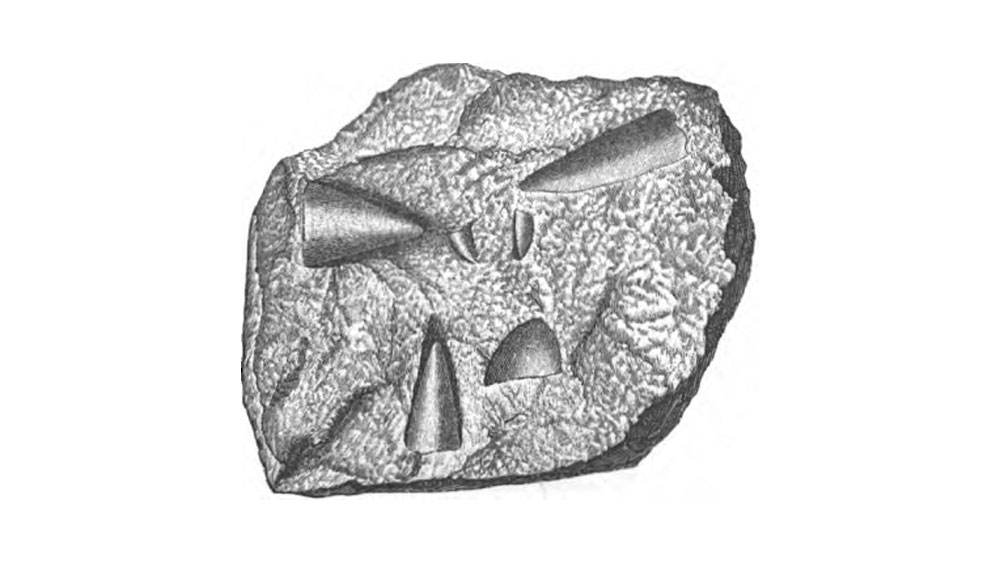
Stage image: Fossil of Salterella pulchella, a cone-shaped Cambrian creature. Its complex shell structure raises questions about claims of early evolutionary experimentation.