A recent study published in Nature Ecology & Evolution claims that the “impossible” actually happened—not just once, but three different times.1
Impossible Ocean Barriers
The impossibilities began with the discovery of a new fossil rhinoceros species on Devon Island in the Canadian High Arctic. This smaller and thinner version of today’s African rhino was given the name Epiaceratherium itjilik.1,2 It was found about 75% complete in a geological feature called Haughton Crater—a nearly 15-mile-wide impact site that was supposedly struck in the early Oligocene (Mid-Cenozoic). The fossil rhino itself was found in beds near the boundary of the Oligocene and Miocene.
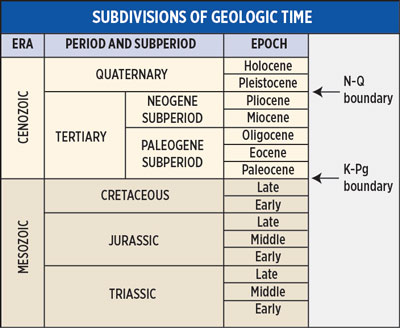
According to evolutionary paleontologists, rhinos are found on multiple continents in Early Cenozoic rock layers—specifically, in layers identified as Paleocene and Eocene units.1 These strata were all deposited above the K-Pg (Cretaceous-Paleogene) Boundary on top of rock layers containing fossil dinosaurs. Previously, the genus Epiaceratherium was found in multiple locations across Europe and Asia but only in Eocene-Oligocene rocks.1 Therefore, it was surprising to find Epiaceratherium itjilik in rock layers that were much higher in the rock record, extending the range of Epiaceratherium to the Oligocene-Miocene Boundary (Upper Cenozoic). Evolutionary scientists say this was 20 million years higher than expected.1
This created a big problem. According to evolutionary plate reconstructions, there was no way to cross the Atlantic Ocean at that time. The authors of the study wrote,
So, how did this new fossil get from Europe to Devon Island? To answer that, evolutionary paleontologists claim the NALB somehow still existed, allowing animal dispersal from Europe to North America as late as the Miocene.1
To justify this “impossible” interpretation, the research team found six other Miocene mammal fossils in both North America and Europe “that hinted at late dispersal over the NALB.”1 They also conducted various numerical models and geophysical models. But models aren’t necessarily reality. To first get to Greenland, the rhinos would either have had to cross the Barents Sea and the Fram Strait or travel across the Atlantic Ocean from Europe to Iceland and then Greenland.1 However, there is no physical evidence (i.e., plate tectonic connections) that these land bridges existed at the end of the Oligocene—as would be needed to get the rhinos to Devon Island. And there are no sunken islands in the Atlantic Ocean to facilitate the crossings.
Claims of impossible land bridges are nothing new. In 2022, evolutionists tried to fabricate "stepping stone islands" to get trees like Ulmus (elm), Fraxinus (ash), Tilia (basswood), and Fagus (beech) to Iceland after the Atlantic had opened.3 These trees all have a very restricted dispersal radius. But there is little evidence that these necessary closely spaced islands ever existed. Today, there are no sunken volcanoes between Europe, North America, and Iceland to provide an island pathway for these plants.3
Finally, there are two final ocean barriers that have existed since the Early Cenozoic (Paleocene) when the plates separated and created them: the Nare Strait that separates Greenland from Ellesmere Island (today, 16 miles) and the Davis Strait that separates Greenland from Baffin Island (today, 725 miles).1 Since Devon Island is in between these two islands, it also is separated from Greenland by the same two ocean waterways (and separated from Ellesmere Island by another 2.5 miles of water).
In exasperation, the study authors suggested the rhinos may have swum or even floated on sea ice, writing, “Whereas it is possible that rhinocerotids dispersed via swimming (for example, the Asian rhinoceros is capable of swimming), we hypothesize an additional mechanism facilitated dispersal between Europe and North America.”1 But they never mention how far the ocean distances were nor offer an explanation for their mysterious “additional mechanism.”
Impossible High Latitude
A second “impossible” claim by the article was the high latitude environment where these rhinos were supposed to be living. According to conventional science, these rhinos were supposed to have lived where their fossil bones were found—on Devon Island in Canada’s High Arctic.1 In addition, plant fossils found with the mammal bones indicate a temperate climate.1 The research team wrote,
The presence of a rhinocerotid in the High Arctic represents a palaeoecological puzzle. Though the flora of the Haughton Crater [where the fossils were found] suggests a temperate palaeoclimate, there was a near-modern light regime with months of winter darkness.1
So, how do they explain this conundrum? The authors don’t. They simply appeal to the need for future research.1
Impossible Protein Preservation
And there is a third “impossible” discovery associated with this fossil. The claimed 23-million-year-old rhino had preserved proteins in its teeth enamel. Earth.com science writer Sanjana Gajbhiye added,
In 2025, another breakthrough pushed the story even further. Scientists managed to extract partial proteins from the rhino’s tooth enamel – an achievement once thought impossible for fossils this old. The work, led by postdoctoral fellow Ryan Sinclair Paterson at the University of Copenhagen, has extended the timeline for recoverable evolutionary proteins by millions of years.2
This is yet another “impossibility” because empirical studies have demonstrated that proteins cannot last even a million years.4 And the rhino bones were also well preserved. Coauthor Marisa Gilbert of the Canadian Museum of Nature said, “What’s remarkable about the Arctic rhino is that the fossil bones are in excellent condition. They are three dimensionally preserved and have only been partially replaced by minerals.”2 For this reason, ICR predicts that there are likely other preserved organic tissues in the bones of this rhinoceros fossil, not just in the teeth enamel.
Global Flood Dissolves All Impossibilities
What could possibly explain these “impossibilities”? A recent global Flood. ICR’s Flood model suggests that the fossil rhinos, other mammals, and plants, found on multiple continents, were ripped off the highest elevation land surfaces as the floodwaters crested the pre-Flood continents on Day 150 of the Flood year.5 Furthermore, ICR’s research efforts found that pre-Flood high ground existed across much of Canada, Greenland, and Scandinavia. The ecosystem that once existed there was swept off by massive waves and deposited in sediment as the floodwater began to recede, creating the various Cenozoic layers globally.5 Most of these animals and plants found on Devon Island likely never lived at these extreme high latitudes; they just ended up there. Tsunami waves could easily wash these animals and plants great distances.6 And rapidly moving plate motion continued to split the continents throughout much of the Cenozoic, even as the water receded, creating a wider Atlantic Ocean and splitting Greenland from Devon Island.5 This entire process occurred during the second half of the yearlong Flood described in Genesis, just 4,500 years ago.5
A young-earth interpretation eliminates all three “impossibilities” that conventional science is stumped by because they do not accept the reality of a global flood. First, there was never a need for phantom land bridges. Second, the rhinos and temperate-climate trees didn’t have to live at extremely high latitudes. They were simply moved there by plate motion and tsunami waves. And third, preserved proteins found in the teeth enamel tell us the rhino fossil is not millions of years old but only thousands of years old. No island hopping or swimming for great distances is necessary to explain these mysterious rhino fossils—just a global flood.
References
- Fraser, D. et al. 2025. Mid-Cenozoic Rhinocerotid Dispersal Via the North Atlantic. Nature Ecology & Evolution.
- Gajbhiye, S. 2025. ‘Frosty Rhino’ Species Once Roamed Arctic Forests Million of Years Ago. Earth.com. Posted on Earth.com October 30, 2025, accessed November 3, 2025.
- Clarey, T. 2022. Flood Explains Mysterious Iceland Plant Fossils. Posted on ICR.org April 29, 2022, accessed November 3, 2025.
- Thomas, B. 2013. A Review of Original Tissue Fossils and Their Age Implications. Proceedings of the International Conference on Creationism. 7, article 14.
- Clarey, T. 2020. Carved in Stone: Geological Evidence of the Worldwide Flood. Dallas TX: Institute for Creation Research.
- Clarey, T. 2023. Arctic Lemur-like Fossils Were Transported During Flood. Creation Science Update. Posted on ICR.org on February 13, 2023, accessed November 3, 2025.
*Dr. Clarey is the director of research at the Institute for Creation Research and earned his doctorate in geology from Western Michigan University.
Stage Image: Indian rhinoceros in Kaziranga National Park, Assam, India
Stage Image credit: Tisha Mukherjee, CC BY-SA 4.0, public domain. Used in accordance with federal copyright (fair use doctrine) law. Usage by ICR does not imply endorsement of copyright holder.